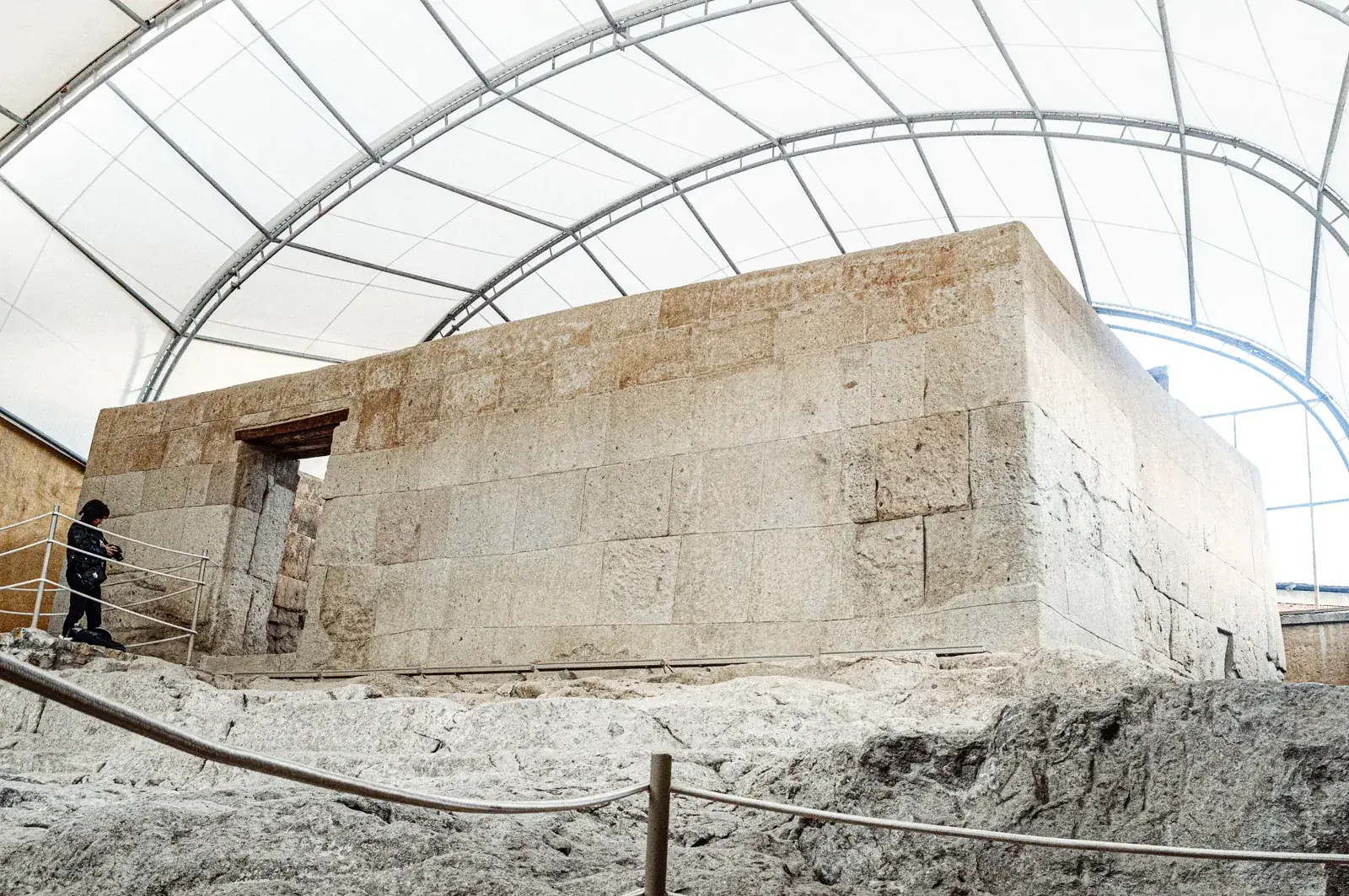
The Spanish conquest of the Inca empire began in 1532, when Francisco Pizarro and a small force captured the Inca ruler Atahualpa at Cajamarca. A civil war and epidemic disease had already weakened the empire, and Spain's indigenous allies were decisive. Peru then became the heart of a viceroyalty governed from Lima until the 1820s.
For visitors, the period is visible in the plazas of Cusco and Lima, in churches built over Inca foundations and in the sites linked to Manco Inca and Túpac Amaru II.
An empire at a fragile moment
When Pizarro landed on the northern coast in 1532, the Inca empire had just come through a civil war between two sons of the late ruler Huayna Capac, Huáscar and Atahualpa. Atahualpa had won, and his army was still in the north when the Spaniards arrived. Years earlier, European diseases such as smallpox had spread ahead of the invaders along trade routes and are thought to have killed many people, possibly including Huayna Capac himself.
Pizarro had travelled twice before and had secured a royal licence from the Spanish crown. His third expedition was small, a few hundred men with horses, steel weapons and some firearms. That force alone cannot explain what followed. The Spaniards exploited divisions within the empire, and many groups that resented Inca rule, among them the Cañari and the Chachapoya, supplied warriors, porters and information. Scholars still debate how much weight to give each factor, and the old image of a handful of men toppling an empire is now treated as incomplete.
Cajamarca, 1532
The decisive event took place at Cajamarca in the northern highlands, where Atahualpa met the Spaniards in November 1532. The Inca ruler arrived with a large retinue, apparently confident and unarmed in the ceremonial sense. Pizarro's men attacked, killed many of the attendants and took Atahualpa prisoner. Accounts come mostly from Spanish chroniclers, so details differ and should be read with that bias in mind.
Atahualpa offered to fill a large room with gold and, twice over, with silver in return for his freedom. The treasure arrived, much of it melted down, but the Spaniards put him on trial and had him executed in July 1533. Today the town is described in Cajamarca, where visitors can see the Ransom Room (Cuarto del Rescate), which tradition links to the story, and the hot springs known as the Baths of the Inca. How much of the building is original is a question worth asking on a tour.
Cusco falls and Lima is founded
Pizarro marched south and entered Cusco in late 1533, installing a puppet Inca, Manco, who soon discovered that real power lay with the newcomers. The Spaniards divided the city's palaces among themselves, and the Inca temple of the Sun, the Qorikancha, became the foundation for the church and convent of Santo Domingo.
In January 1535, Pizarro founded Lima, the "City of the Kings", on the Rímac valley near the coast. He chose the coast because it offered a port and easier contact with Spain and Panama, even though the Inca centre of power had always been in the mountains. That decision shifted the country's political weight to the coast, a pattern that persists in modern Peru. The conquerors, meanwhile, fell out with each other, and the 1540s and early 1550s were marked by violent civil wars among Spaniards, including the killing of Pizarro in Lima in 1541.
Resistance: Manco Inca and Vilcabamba
In 1536, Manco Inca escaped from Cusco, raised a large army and besieged the city for many months. The siege nearly succeeded, and some of the fighting took place around Sacsayhuamán, above Cusco. After it failed, Manco withdrew into the forested mountains of Vilcabamba, where he and his successors kept up a small Inca state in exile for about three decades.
That state ended in 1572, when the Spanish captured the last ruler, Túpac Amaru I, and executed him in the main square of Cusco on the orders of Viceroy Francisco de Toledo. The remote Vilcabamba region is often linked in popular writing to supposed lost cities, but historians place the exile capital at sites in the Vilcabamba mountains, and the topic is better approached through the research than through legend. Hikers can reach related ruins on routes such as the one described in Choquequirao.
How the viceroyalty worked
From 1542 the Spanish crown governed its South American territories through the Viceroyalty of Peru, with its seat in Lima. At first the viceroyalty covered almost all Spanish South America; it was later reduced when new viceroyalties were created in the north and around the Río de la Plata in the 1700s. Beneath the viceroy sat a high court, the Audiencia, and local officials who collected tribute.
The economy relied on silver, above all from Potosí, in what is now Bolivia, and on mercury from Huancavelica. Labour came partly from the mita, an adapted Inca system of rotating service that the Spanish turned into a harsh draft for the mines. Large estates, the haciendas, and church property grew over the same period. Lima grew into a wealthy administrative city, with a university, San Marcos, founded in 1551, and the seat of the Inquisition from 1570. Indigenous communities kept their languages and customs under a separate legal status, but they bore heavy obligations.
Religion and cultural mixing
Spanish clergy worked to convert the population, and campaigns against what they called idolatry destroyed many shrines and objects. Yet Catholicism in the Andes absorbed local elements. Saints took over mountain and water cults, processions followed older calendars, and the feast of Corpus Christi in Cusco still includes parading of saints from the city's parishes. See Andean beliefs for how those layers coexist today.
Mixing was also biological and artistic. A large mestizo population emerged, and indigenous and Black artisans, many of them enslaved or forced to migrate, shaped the baroque churches and paintings. The Cusco School is the best-known result in painting, while colonial architecture shows the same fusion in stone. Tracing these meetings is often more illuminating than the simple opposition of conqueror and conquered.
Túpac Amaru II and the great rebellion
By the later 1700s, Bourbon reforms had raised taxes and tightened control, and unrest grew. In 1780, José Gabriel Condorcanqui, a regional leader who took the name Túpac Amaru II after his Inca ancestor, rose in the Cusco region. His wife, Micaela Bastidas, played a major part in organising the movement. The revolt spread across the southern Andes and into present-day Bolivia and is regarded as one of the largest uprisings of the colonial period.
Spanish forces defeated the rebels in 1781, and Túpac Amaru II was executed in the main square of Cusco, now the Plaza de Armas, after witnessing the death of family members. Spanish authorities banned several symbols of Inca identity afterwards. The leader became a symbol in later centuries, and his story leads directly into independence, which came about a generation later.
Where to see colonial Peru
The easiest introduction is the historic centre of Lima, with its cathedral, convents and carved balconies, followed by the Plaza de Armas of Cusco and the Santo Domingo church built over the Qorikancha walls. In the north, Cajamarca preserves the setting of the 1532 encounter, and Ayacucho holds a remarkable number of colonial churches.
For wider background, the history overview places the conquest in the longer sweep from the first civilisations to today. Museums in Lima and Cusco show colonial painting, silverwork and furniture. When guides give dates and numbers, check them against a second source, because popular tellings of the conquest often compress or dramatise events. Be especially careful with figures for the ransom and for population loss, which scholars estimate rather than know.
Frequently asked questions
How did so few Spaniards defeat the Inca empire?
Several things came together: a civil war between Huáscar and Atahualpa, epidemic disease, the capture of the ruler at Cajamarca and the support of indigenous groups hostile to Inca rule. Spanish horses and steel also mattered in open battle. Most historians now stress these combined causes instead of military superiority alone.
Who was Atahualpa?
Atahualpa was the Inca ruler who defeated his half-brother Huáscar in a civil war and was then captured by Pizarro at Cajamarca in 1532. He was executed in 1533 after a trial the Spaniards organised. Many Peruvians regard him as the last independent ruler of the empire, though Inca resistance continued for decades.
Why was Lima founded on the coast and not in Cusco?
Pizarro wanted a port for contact with Spain and Panama, and the coast gave easier access to ships. Cusco was high in the mountains and difficult to supply from outside. Lima was founded in January 1535 and became the capital of the viceroyalty.
What was the viceroyalty of Peru?
It was the Spanish administrative region that governed most of Spanish South America from Lima, starting in the 1540s. Over time, new viceroyalties took over the north and the south-east, shrinking its area. It ended with independence in the 1820s.
Who was Túpac Amaru II?
José Gabriel Condorcanqui, a regional leader who took the name Túpac Amaru II, led a major rebellion in the southern Andes in 1780 and 1781. He was captured and executed in Cusco. His name is used today by streets, schools and political movements across the country.
Can I visit places linked to the conquest?
Yes. Cajamarca has the Ransom Room, Cusco has Sacsayhuamán and the Qorikancha, and Lima has the historic centre, where Pizarro is traditionally said to be entombed in the cathedral. Treat claims of authenticity with some caution and ask what is original and what was rebuilt.
Did the Incas really have a last refuge?
Yes, but it was a state in exile, not a hidden city. Manco Inca and his successors ruled from the Vilcabamba region from 1537 until 1572. The ruins associated with it are remote, and attribution of specific sites is still discussed by archaeologists.