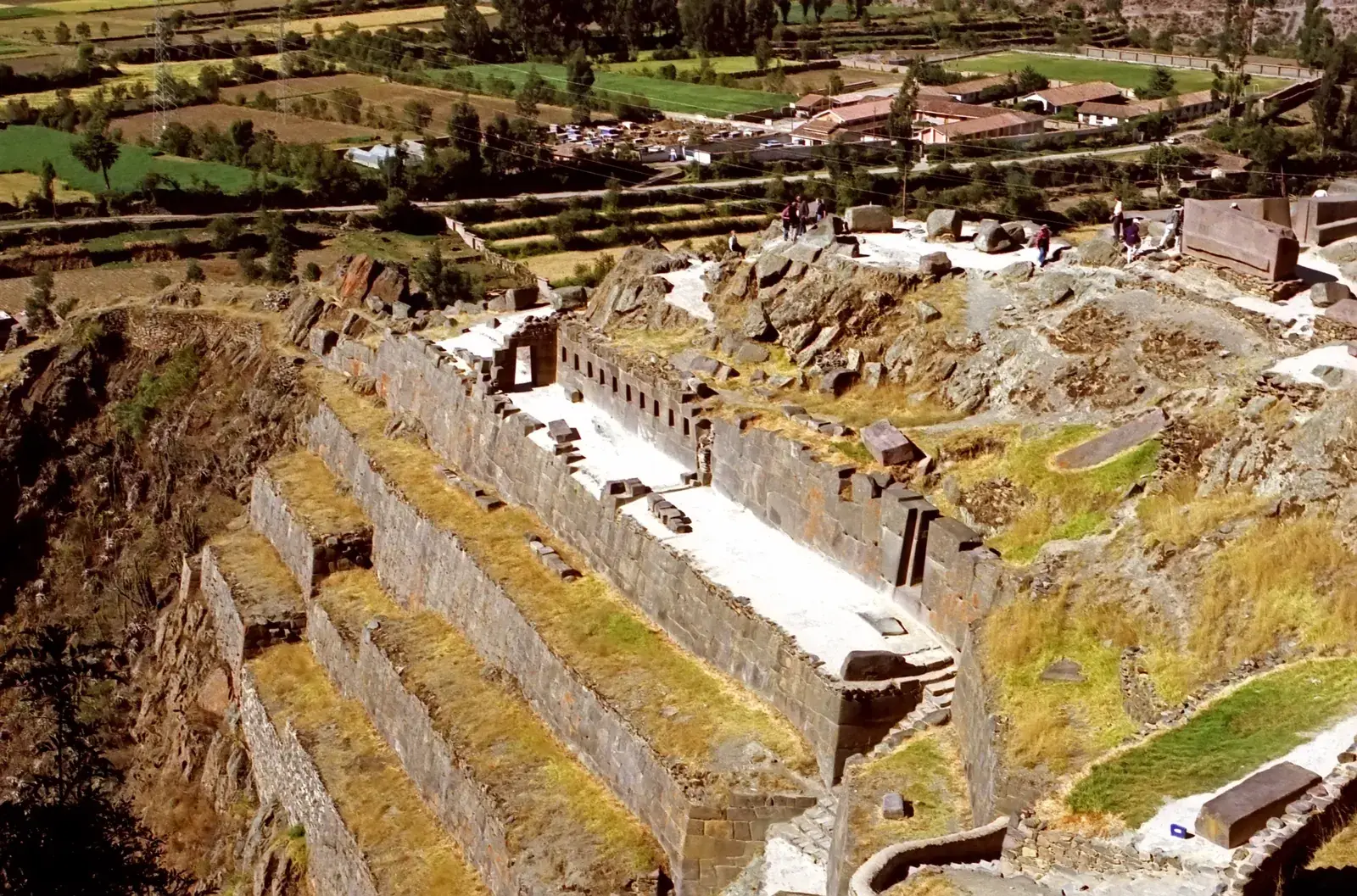
The Inca Empire, called Tawantinsuyu ("the four parts together") in Quechua, was the largest state in the pre-Columbian Americas. It grew from a small kingdom around Cusco in the fifteenth century, largely under Pachacuti, and reached from southern Colombia to central Chile. It was governed through roads, storehouses and labour service rather than money, and fell to the Spanish after 1532. Its stonework and roads are the main visible legacy.
Origins and rise
The Incas told their own origin stories, in which the first ruler, Manco Capac, emerged with his sister-wife from Lake Titicaca or from a cave near Cusco. Historians treat these as myth and tie the real rise to the Cusco valley after about AD 1200, when the Incas were one among many Andean groups.
The decisive moment came around 1438, when an attack by the neighbouring Chanka people brought a prince later called Pachacuti to power. He defeated the Chanka, rebuilt Cusco and began a campaign of conquest that his son Topa Inca and grandson Huayna Capac continued. Much of this account comes from Spanish chroniclers writing decades later, drawing on Inca oral tradition, so dates and the order of rulers are uncertain and are still debated by specialists.
Tawantinsuyu: the four parts
The empire was divided into four suyus that met at Cusco: Chinchaysuyu to the north-west, Antisuyu to the east towards the Amazon, Collasuyu to the south-east including the Titicaca basin and Contisuyu to the south-west. Each province had a governor, usually from Inca nobility, and local lords were often left in place if they accepted Inca rule.
The state had no money or markets as Europeans knew them. Instead it used the mit'a, a rotating labour service by which communities provided work on roads, fields and buildings, in exchange for food, drink and festivals. Large storehouses, the qollqas, held maize, textiles and weapons, and can still be seen on hillsides above Ollantaytambo and other sites.
Cusco, the navel of the empire
Cusco, the capital, was laid out in a symbolic shape and was both the political and religious centre. At its heart stood the Qorikancha, the Temple of the Sun, whose walls were said to be covered in gold. After the conquest the Spanish built the church of Santo Domingo on its foundations, and the contrast between the Inca stone and the colonial walls is one of the sights of the city. Read about it in Qorikancha.
Around the city, the fortress-temple of Sacsayhuamán and the ritual sites of the surrounding hills formed a sacred landscape. Cusco's streets still follow Inca lines in many places, and a visit to Cusco combined with the nearby sites works as a short introduction to the empire.
The Sapa Inca, religion and daily life
At the top stood the Sapa Inca, the sole ruler, regarded as a descendant of the sun god Inti. Dead rulers were mummified and kept in their palaces, where they were consulted, fed and brought out for festivals. Royal families (panacas) kept their estates after death, which pushed each new ruler to conquer fresh territory to support himself.
Most people were farmers living in communities called ayllus, growing maize, potatoes and quinoa, tending llamas and weaving. Religion revolved around the sun, the moon, mountains and sacred places called huacas, and the calendar was marked by agricultural rituals. Many of these customs survive in a Christian form, as described in Andean beliefs.
Royal estates and Machu Picchu
Rulers had country estates, with terraces, canals and palaces, in the warm valleys near Cusco. Machu Picchu is generally thought to have been one of these, built around the mid-fifteenth century for Pachacuti, though some questions about its exact function remain open. Others in the Sacred Valley include Ollantaytambo, Pisac and Moray.
These sites share a refined architecture of fitted stone and trapezoidal doorways, set to follow the mountain. A visit to the Sacred Valley shows several in a day or two, and the guide to Machu Picchu covers the best known. Estates were abandoned or reduced after the conquest, which is a large part of the reason that they survive.
Civil war and conquest
Huayna Capac died around 1527, probably during an epidemic that may have been smallpox spreading ahead of the Spanish. His sons Huáscar, based in Cusco, and Atahualpa, based in the north, fought a civil war that Atahualpa won shortly before Francisco Pizarro and his small force reached Cajamarca in 1532.
The Spanish seized Atahualpa, took a huge ransom of gold and silver and executed him in 1533. They then installed puppet Incas, the last of whom, Manco Inca, rebelled in 1536 and withdrew to Vilcabamba. Inca resistance ended only in 1572. For the full story, see the Spanish conquest.
Legacy today
The Inca language, Quechua, is still spoken by millions, and Inca terracing, roads and food crops remain in use. The Qhapaq Ñan, the Inca road system, was inscribed by UNESCO in 2014, and Machu Picchu is one of the best-known archaeological sites in the world.
Inca identity is also contested and modern. Descendants of the Incas make up part of the highland population, and Cusco's Inti Raymi festival revives the winter solstice ceremony each June. Visitors should remember that the same stones often sit inside later Spanish buildings, which reflects centuries of overlap rather than a clean break, and that there is much that scholars cannot yet explain. For the technical achievements, see Inca engineering.
Frequently asked questions
What does Tawantinsuyu mean?
It means roughly "the four parts together" in Quechua, referring to the four suyus that met at Cusco. The word "Inca" originally meant the ruler, and is now used for the people and the state as well.
How big was the Inca Empire?
At its height around 1530 it stretched about 4,000 km along the Andes, from southern Colombia to central Chile, and included parts of Ecuador, Bolivia and Argentina. Estimates of its population run to around ten million, but figures are uncertain.
Did the Incas use the wheel or writing?
They did not use wheeled transport, partly because of the mountainous terrain, and had no known script. They recorded information with knotted cords called quipus.
Who was Pachacuti?
The ruler who, from about 1438, transformed the Inca state from a regional kingdom into an empire. Machu Picchu is generally thought to have been his royal estate.
Why did the Inca Empire fall so quickly?
Historians point to the civil war, epidemic disease, Spanish weapons and horses, and local peoples who allied with the Spanish against Inca rule. No single cause explains it.
Are there any descendants of the Incas?
Yes. Many Quechua-speaking people in the southern highlands trace their heritage to the Inca period, and some families in Cusco claim descent from the royal lines.
Where can I see Inca ruins other than Machu Picchu?
Sacsayhuamán and Qorikancha in Cusco, the sites of the Sacred Valley, the Inca Trail ruins, and Choquequirao, which requires a multi-day trek. All sit within reach of Cusco.