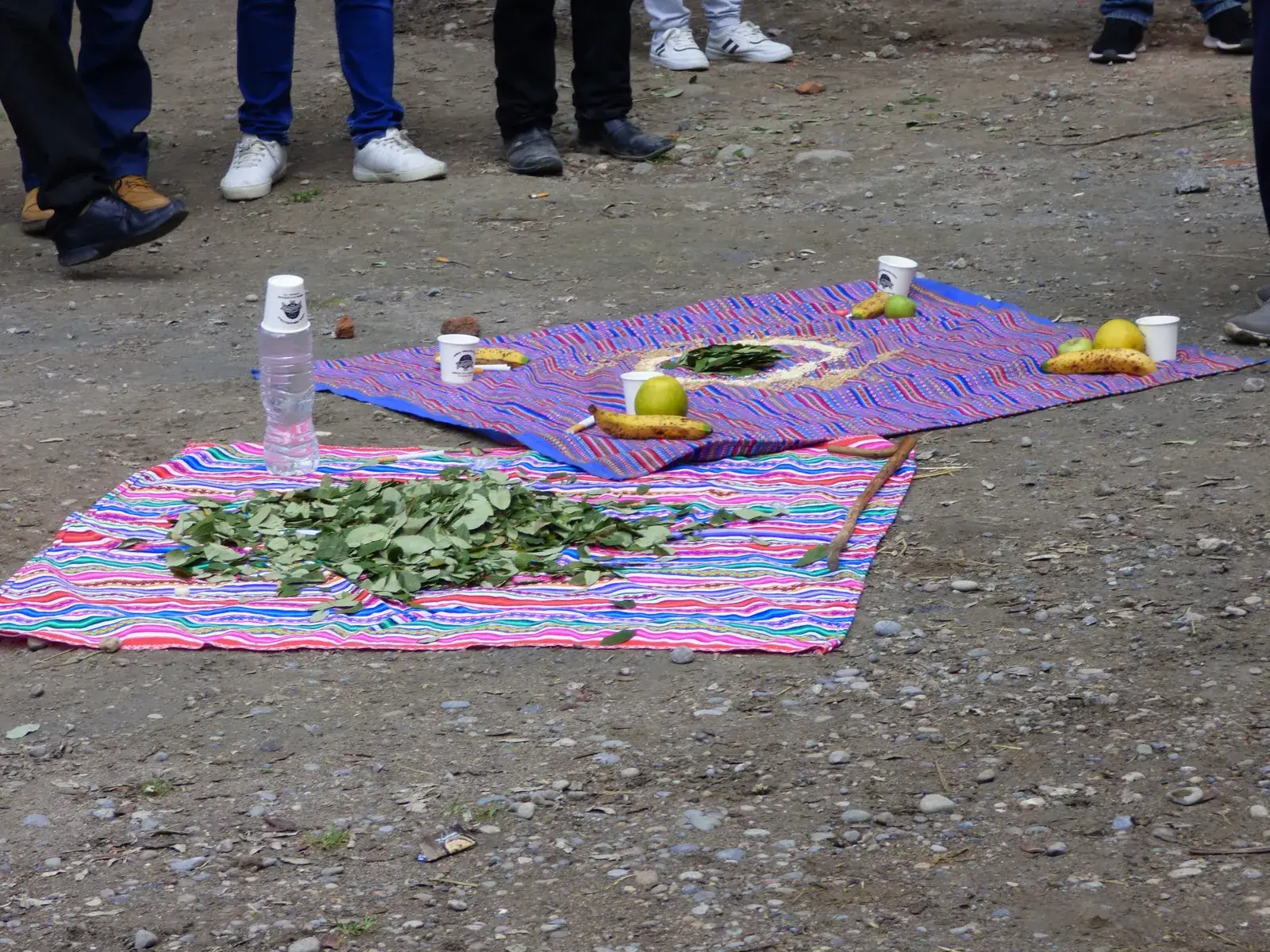
In the Andes, the land is treated as alive and as a partner in an exchange. Pachamama (Mother Earth) feeds people, the apus (mountain spirits) protect or punish communities, and people reciprocate with offerings of coca leaves, food and drink. These practices are living religion, and they blend with Catholicism rather than replacing it.
Visitors can watch some rituals at an arm's length and may be invited to others, but should ask first, follow local guidance and never treat them as a show. In the Amazon, ceremonies involving ayahuasca carry real safety risks.
Pachamama and the living landscape
Pachamama, usually translated as Mother Earth, is the earth that grows crops and feeds animals, and she is addressed in Quechua and Aymara communities as someone who gives and who must be given to in return. Farmers spill a few drops of chicha or alcohol on the ground before drinking, a gesture called ch'alla, and offerings are made at planting, at harvest and when a house is built or a herd is marked.
Behind this lies the principle of ayni, reciprocity: favours are returned in kind, between neighbours and between people and the land. This idea also shapes community work parties, known as minka, on terraces and roads.
Researchers warn against treating "Andean religion" as one fixed system. Practices differ between valleys, between the Quechua-speaking and Aymara-speaking south and between communities with a strong Catholic presence and those with less. What is described here is a general outline; the details belong to each community, and some are not shared with outsiders. For the broader historical setting, see the Inca empire.
Apus: the mountain spirits
Peaks and some other landmarks are apus, powerful beings who watch over the surrounding valleys, control weather and water, and receive offerings. Among the most revered are Ausangate and Salkantay in the Cusco region, and each region has its own guardian mountain. Mountains are often addressed by respectful titles, and people ask permission before crossing a pass or beginning an ascent.
For trekkers, this is not abstract. Guides and porters on routes such as Ausangate and the Salkantay trek may stop at a pass to leave coca leaves or pour a small libation. Joining in with respect, or standing quietly, is appropriate. Moving rocks from cairns, leaving rubbish or climbing on shrines is not.
The Inca state integrated these local sacred places into its own system. Some historians argue that its sacred geography of paths, called ceques, around Cusco organised shrines by lineage; the details are debated. Many sites visited today, such as Sacsayhuamán, were designed in relation to the surrounding peaks.
Despachos and payments to the earth
A despacho, or "pago a la tierra", is a packet of offerings prepared by a ritual specialist, called a paqo in Quechua, or in some regions an altomisayoq. Inside are coca leaves in perfect sets, grains, sweets, llama fat, flowers, wool and sometimes small figures, arranged on a sheet of paper, blessed with breath and prayer, and then burned or buried. The purpose is to thank the earth, to ask for good health, crops or travel, or to restore balance after a misfortune.
Treat the offering as you would a prayer at a church. A paqo may perform one for visitors in the Sacred Valley or near Cusco, and some communities arrange these ceremonies for paying groups. Quality varies: some practitioners are respected members of their communities, while others perform a staged version for tourists. Ask a local guide, a cultural centre or the community itself, and agree in advance on any contribution so there is no misunderstanding.
You may see small altars or bundles at passes, springs and building sites. Do not touch or photograph them without permission. See also the Sacred Valley for places where ceremonies are offered.
Catholic and Andean traditions together
After the Spanish conquest, missionaries tried to suppress local religion, built churches on sacred sites and introduced saints. The result was not simple replacement. Communities adopted Christian saints and festivals while keeping their own practices, and the two systems merged. This is called syncretism, although many Andean people simply regard themselves as Catholic.
Examples are everywhere. Crosses stand on hilltops once dedicated to apus, and are blessed in early May in the Fiesta de las Cruces. Saints' days fall near older agricultural dates. The Virgin Mary is sometimes linked with Pachamama in devotional language. In Cusco's cathedral, a painting of the Last Supper features guinea pig as the main dish, a well-known example of local flavour in colonial art; see the Cusco School.
Festivals such as Qoyllur Rit'i and Corpus Christi, described in festivals in Peru, show both strands at once. Dancers kneel before a Christ image carved in rock while others make offerings to the glacier above. Visitors should avoid labelling any of this as superstition or as merely folklore.
Shamanism in the Amazon
Amazonian peoples such as the Shipibo-Konibo, Asháninka and Awajún have their own cosmologies, built around plant knowledge, spirits of rivers and forests, and healers often called curanderos or vegetalistas. Plants are used for healing, and the best-known is the vine ayahuasca, brewed with other plants into a purgative drink that causes intense visions. Peru's government has recognised ayahuasca use in traditional communities as part of national cultural heritage.
Around Iquitos and Puerto Maldonado, a large industry of retreats has grown up for foreign visitors. Quality varies enormously: some centres are run by trained healers working with the community, while others are commercial operations with little accountability.
Plant medicine is not a tourist product. If you choose to look into it, treat it as a medical and cultural decision, take advice from a doctor beforehand and learn about the culture rather than the experience. The Amazon section of what to eat in the Amazon shows how much of the forest's knowledge is tied to food and plants.
Where visitors meet these beliefs
At Qorikancha in Cusco, the Spanish built the church of Santo Domingo on the foundations of the Inca Temple of the Sun, so the two religious worlds are visible in one set of walls. Nearby, the carved stones, water channels and terraces of Inca sites were often planned around sunrise points, springs and peaks, which suggests that the landscape was part of the design, though interpretations differ and not every alignment claimed in guidebooks is proven.
In villages of the Sacred Valley, you may see a small cross on a rooftop, a pair of ceramic bulls placed for protection, or a family sharing a drink with the ground. At markets, stalls sell the ingredients of offerings, and shop owners sometimes burn a little incense on the first sale of the day. These are daily habits rather than performances.
The most accessible way to learn is to ask a licensed local guide, or to read about the beliefs before arriving. A community project or cultural centre can explain customs better than a quick tour. Tourist labels such as "Inca ritual" or "sacred energy" are often marketing rather than history.
How to behave respectfully
Ask before photographing people, altars or ceremonies, and accept a no. Do not step into a ritual circle, take offerings or coca from an altar, or interrupt prayers. Dress modestly at holy sites and in churches, keep voices low, and follow your guide's instructions about where to stand. If you are offered a drink at a ch'alla, you may take a small amount and follow the example of those around you; declining politely is also acceptable.
Pay fairly for any service and avoid haggling over a ceremony. Be sceptical of anyone selling "Inca secrets", "initiations" or "shaman certificates", which are generally invented for visitors. Terms such as pagan, primitive and superstition should be avoided in conversation; ask questions instead, and listen.
General courtesy is covered in etiquette in Peru. Using the same care at high-altitude shrines, as part of trekking, makes your presence easier for communities who live and work there.
Frequently asked questions
What is Pachamama?
Pachamama is the Andean Mother Earth, the source of food and life. People thank her with offerings and with a few drops of drink poured on the ground before they drink.
What is an apu?
An apu is a mountain spirit that protects the people of a region. Prominent peaks such as Ausangate are honoured with offerings of coca and chicha, particularly at passes and before journeys.
What is a despacho ceremony?
A despacho is a bundle of symbolic offerings prepared by a paqo and then burned or buried as a thanks or request to the earth. Ask a local guide or community about legitimate options and agree any contribution beforehand.
Are Andean people Catholic or following Inca religion?
Most identify as Catholic and also keep older practices, particularly around farming and the mountains. The two are woven together, so it is not a choice between one or the other.
Can tourists attend ceremonies?
Sometimes, if invited or if a community offers ceremonies for visitors. Ask permission, stay at the edge, and do not photograph without consent. Never gate-crash a private or sacred event.
Is ayahuasca legal in Peru?
Traditional use is recognised as cultural heritage and the plants are not banned in the way many drugs are, but the retreat business is largely unregulated. Legal status does not make it safe; check the current position and see a doctor first.
What are the three worlds in Andean thought?
A common description separates the upper world (hanan pacha), this world (kay pacha) and the inner or lower world (ukhu pacha). The condor, puma and snake are often linked to them. Scholars debate how strict this scheme was.