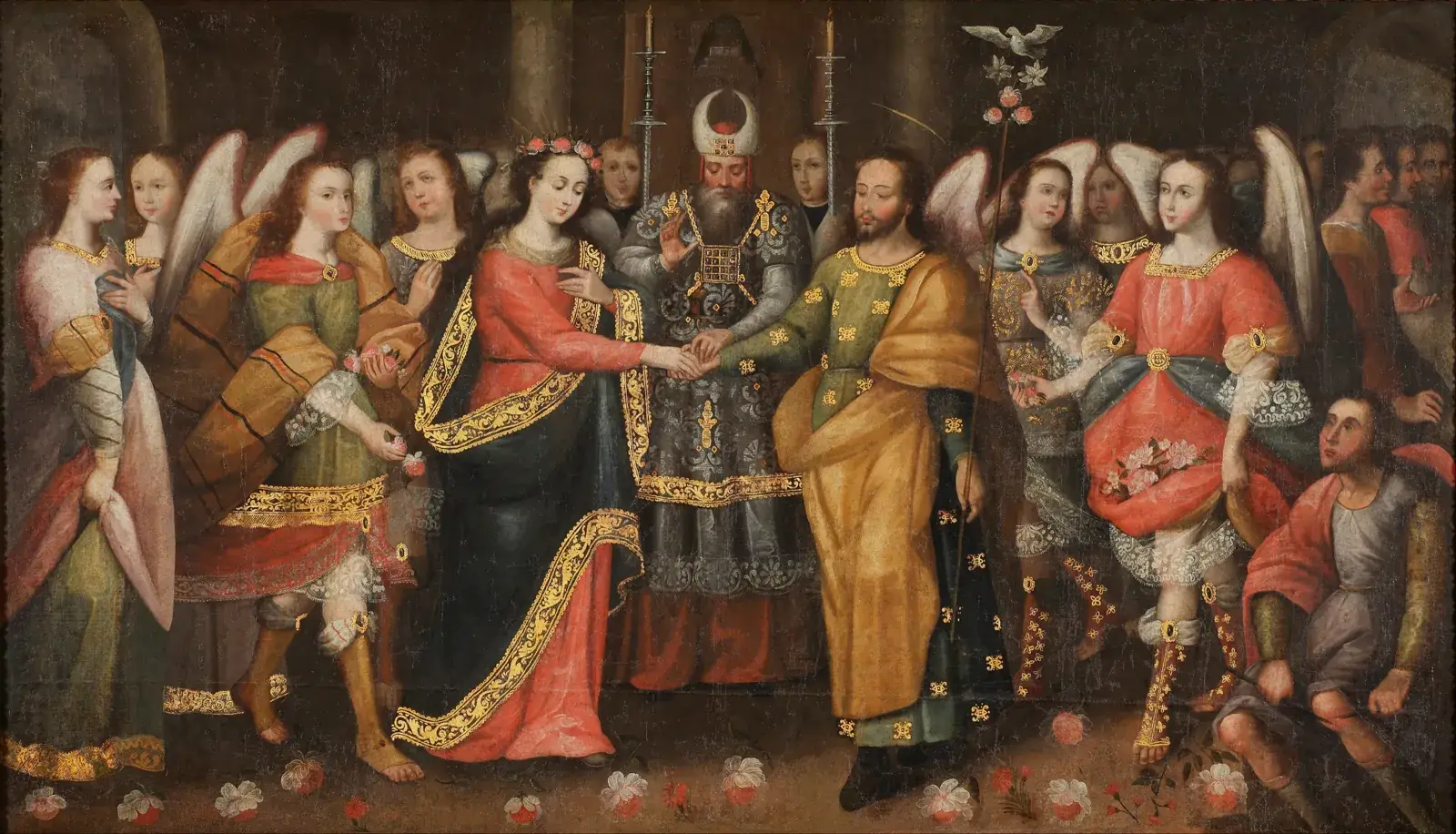
The Cusco School (Escuela Cusqueña) is the body of religious painting produced in and around Cusco from the 1500s to the late 1700s, largely by indigenous and mestizo painters. It is known for warm colour, gold-leaf decoration and local details such as Andean fruit, birds and food.
The best places to see it are Cusco's cathedral, its religious art museum, and churches along the road to Lake Titicaca, with further works in Lima and Arequipa. The most famous paintings include a Virgin whose skirt forms a triangle like a mountain and a Last Supper where the main dish is guinea pig.
What the Cusco School is
After the conquest, the church needed images for hundreds of new parishes, convents and chapels. European paintings and prints were shipped across the Atlantic, but local workshops soon produced the great majority of what hung on the walls. In Cusco, a guild of painters grew up, and it supplied churches across the southern Andes and beyond, with works travelling as far as present-day Bolivia, Chile, Argentina and Ecuador.
The label "school" covers several centuries and a wide range of quality. Early works follow Italian and Flemish models closely, often copying prints. Later work is bolder and more decorative, with flat areas of strong colour and a love of ornament. Most paintings are anonymous, made in workshops rather than by single named masters. Historians now see the school not as a copy of European art but as a local tradition that answered the needs of its own public, which explains why the paintings differ so much from works made in Spain or Italy.
Quechua painters and the names to know
A few artists are documented. Diego Quispe Tito, born in the early 1600s in the Cusco area and of Inca descent, is often described as the first great figure and a painter of landscape-filled scenes. Basilio de Santa Cruz Pumacallao, from the later 1600s, worked on large cycles for churches and for the bishop. In the 1700s, Marcos Zapata produced much of the cathedral's painted cycle, working in a lively late style.
Many other painters had Quechua names, and some were of noble Inca families. They worked within a guild structure where Spanish and indigenous painters sometimes competed for commissions. Their position gave them a role as interpreters between worlds, because they translated Christian stories into images that local viewers recognised. The movement faded in the later 1700s, after the Túpac Amaru revolt and as taste and economic conditions shifted, but its influence remained in popular painting, retablos and later regional art; see contemporary art for echoes today.
Gold, colour and technique
A visual signature of the school is the use of gold leaf applied over the painted surface to make patterns on clothing, in a technique known as brocateado. It gives Virgins and saints a shimmering robe of gold lines like woven brocade, and the effect is strongest in candlelight, which was the original viewing condition. Backgrounds are often dark, with bright figures and richly patterned textiles.
Colours were made from pigments that included locally available minerals and plant dyes, as well as imported products. The paintings are usually oil on canvas, and many have elaborate carved and gilded frames. Large paintings were meant to be seen at a distance in dim churches, so details can look rough up close. Scholars have also found that some compositions copy engravings from Europe almost exactly, while the colours, costumes and landscapes were changed to suit local taste, a combination that makes comparison a pleasure for a patient viewer.
The Virgin with the triangular skirt
One of the most striking images is a Virgin Mary whose wide gown spreads out in a triangle, so that her body and dress together look like a mountain. Versions of this image show the Virgin merged with a hill, sometimes with the sun and moon at her sides. The best-known "Virgin of the Mountain" is associated with Potosí, in what is now Bolivia, but similar shapes appear in Cusco and Lima works.
Interpretations vary. Some scholars read the form as a link between the Virgin and the Andean earth deity Pachamama or the sacred mountains, the apus; others see a European tradition of the "Virgin as a mountain" adapted locally. The truth may include both, and visitors should be wary of guides who state one reading as settled. The theme leads naturally to Andean beliefs, where mountains and the earth remain meaningful in daily life.
The Last Supper with guinea pig
In the cathedral of Cusco, a large Last Supper by Marcos Zapata, dating from the mid-1700s, shows Christ and the apostles around a table with local dishes. Among them is a roasted cuy, or guinea pig, along with peppers, fruit and a drink in a local cup. The image is often cited as the clearest example of colonial painters putting a Peruvian meal into a biblical scene.
The detail is shown on guided visits and is easy to find, but it is only one of many local touches. Viewers notice Andean fruits and flowers in borders, parrots and other birds, and costumes that mix Spanish and Inca styles. For the food itself and how it is eaten today, see guinea pig, or cuy. Seeing the painting first is a good way to understand why the dish carries festive and ritual meaning in the highlands, beyond its role as a curiosity for tourists.
Angels, saints and Corpus Christi
Beyond Virgins, the school is known for sets of archangels shown as elegant figures in the clothes of colonial nobles, and a few in the Andes carry firearms, the so-called arquebusier angels. Another well-known series shows the Corpus Christi procession in Cusco, with saints and brotherhoods carried through the streets, giving a record of city life, clothing and festivals in the late 1600s.
Such works are useful as history as well as art. They show how Cusco looked, how the Inca nobility took part in Christian ceremony and how Spanish and Andean families were distinguished by dress. Portraits of Inca lords and ladies also exist, painted for the descendants of the Inca elite who wanted to claim status under Spanish rule. These paintings form part of the visual record behind the Inca period, and are often the best clue to how the old nobility saw itself after the conquest.
Where to see the Cusco School
In Cusco, start with the cathedral on the Plaza de Armas, where the Last Supper and many other canvases hang, then visit the religious art museum in the former archbishop's palace and the church of the Compañía. Santo Domingo and other convents also hold works. Outside the city, the church at Andahuaylillas has painted walls and ceiling, and several churches in the Sacred Valley and around Lake Titicaca keep canvases in place.
In Lima, museums with colonial galleries and the convents of the historic centre display further examples; see museums in Peru. Some works are not on permanent display, hang in dim light or are covered during restoration. Hours, ticket types and photography rules change, so check locally; flash is rarely allowed. Buying "colonial paintings" in markets is risky, because copies are common and export of genuine pieces is illegal.
Frequently asked questions
What is the Cusco School of painting?
It is the tradition of religious painting made in Cusco workshops from the 1500s to the late 1700s, mostly by Quechua and mestizo artists. It is known for gold-leaf patterns, rich colour and local details. Its works spread across the southern Andes.
Who were the main Cusco School painters?
Documented names include Diego Quispe Tito, Basilio de Santa Cruz Pumacallao and Marcos Zapata. Most works are anonymous, however, since they came from workshops. Museum labels often say simply 'Cusco School'.
Where can I see the Last Supper with guinea pig?
It hangs in the cathedral of Cusco, on the Plaza de Armas. Ask at the entrance or join a guided visit so you do not miss it, as the cathedral holds many large canvases.
Why does the Virgin have a triangular skirt?
The wide, cone-shaped gown makes the Virgin look like a mountain. Scholars link this to Andean reverence for mountains and Pachamama, to European images of the Virgin and often to both. The meaning is not settled.
Is it allowed to take photos of the paintings?
Rules differ by church and museum, and many forbid photography or flash inside. Always follow signs and staff instructions, and avoid photographing worshippers.
Can I buy a Cusco School painting?
Copies and modern works in the style are sold in Cusco, and are legal to buy and take home. Genuine colonial paintings are protected cultural property, and exporting them without permission is illegal. If a seller claims a painting is old, ask for official documentation.
Are there Cusco School paintings outside Cusco?
Yes. Works appear in churches and museums in Lima and Arequipa, and in Bolivia, Argentina, Chile and Ecuador, where Cusco workshops exported them. The churches on the road from Cusco to Lake Titicaca are a good place to see them in their original setting.