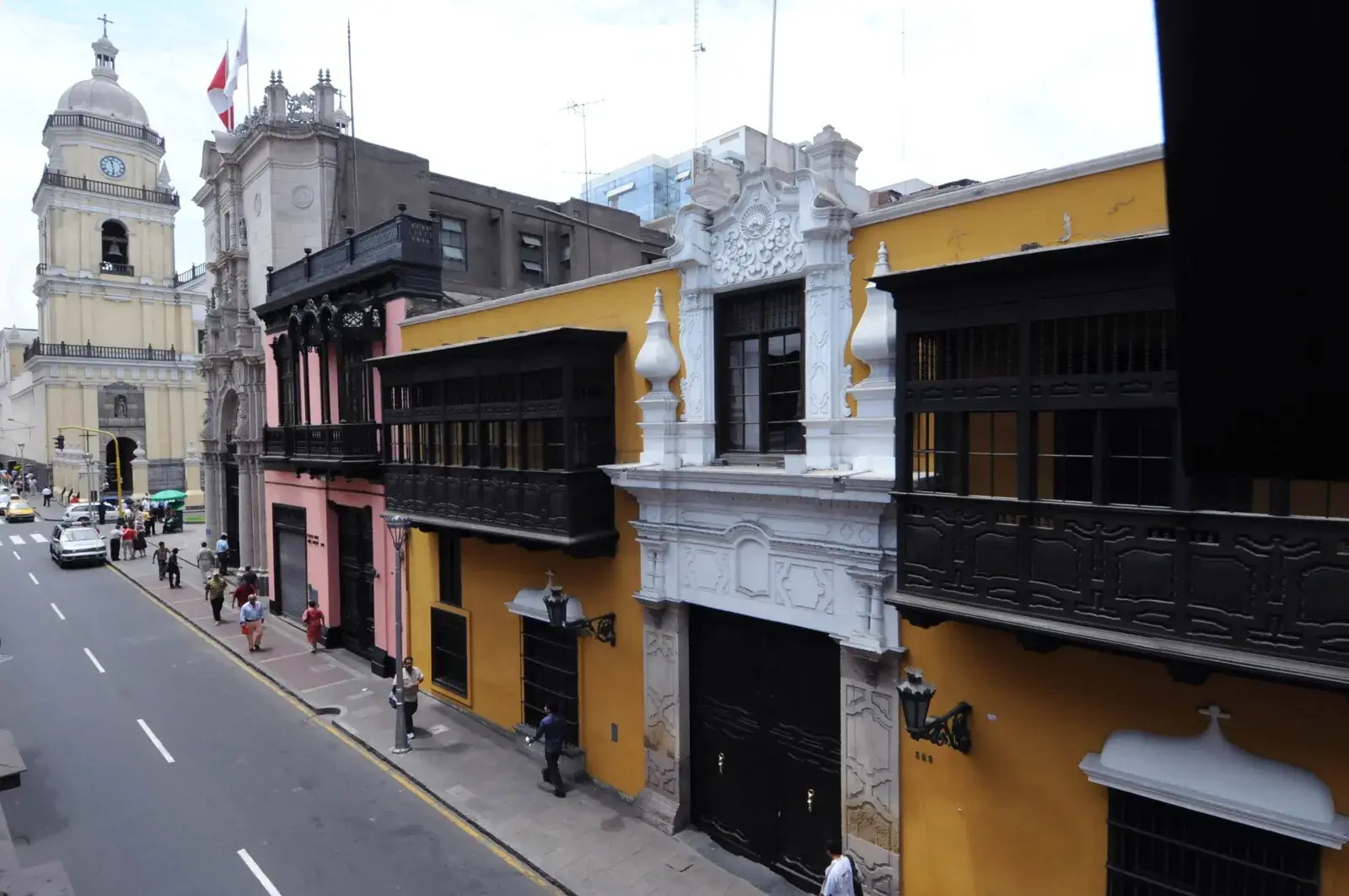
Peru's colonial architecture combines Spanish plans, Baroque decoration and local materials and labour. In Cusco, churches stand on Inca walls; in Lima, enclosed wooden balconies line the old streets; in Arequipa, buildings are carved from white volcanic stone called sillar; and in the Andes, a mestizo baroque style mixes saints with local plants and animals.
The best way to see the range is to compare the four cities rather than visit one. Earthquakes have damaged and rebuilt many monuments, so much of what stands is later than its founding date.
Building a Spanish city in the Andes
After the conquest, the Spanish laid out new cities on a grid around a main square, the plaza de armas, with the cathedral, the town hall and the houses of leading families facing it. This plan was set out in royal ordinances and repeated from Mexico to Chile, so the central plazas of Lima, Cusco, Arequipa and Ayacucho share a family likeness.
Churches and convents were the most ambitious projects. They were designed with European models in mind, from Renaissance and Baroque Spain, but they were built by local masons, carpenters and sculptors, many of whom were indigenous or of mixed descent. In practice, builders adapted the plans to materials and to earthquakes: low towers, thick walls and wide buttresses became common on the coast and in the mountains. The result is a regional character that cannot be mistaken for the Spanish original, and it varies sharply from one area to another.
Churches on Inca walls: Cusco
Cusco shows the layering of cultures more clearly than any other city. The convent of Santo Domingo stands on the walls of the Qorikancha, the Inca temple of the Sun, and the fine Inca stonework of curved and tightly fitted blocks still carries the later structure. The Compañía de Jesús, the Jesuit church on the main plaza, rose on the site of an Inca palace, and the cathedral was built over several decades from the 1500s into the 1600s.
Inca walls also survive as foundations along streets in the centre, where narrow lanes keep stone courses that are older than the houses above them. Colonial builders reused the walls because they were already there, strong and level, and also because building on them was a statement of power. A major earthquake in 1650 damaged the city and led to a large rebuilding; the Inca masonry, famously, mostly stayed in place. See Inca engineering for how those walls were made.
Balconies and courtyards: Lima
In Lima, the signature feature is the enclosed wooden balcony, a box that projects over the street from the upper floor of a mansion. Carved lattice screens let residents see out without being seen, and they allowed air to move in a warm, humid city. Many surviving examples are from the 1700s and 1800s, and a number have been restored. A good place to see them is the historic centre of Lima, around the Plaza Mayor and the streets running off it.
Houses of the period were organised around a courtyard, often with a grand staircase, and some were built with quincha, a frame of cane and wood plastered with mud, which flexes in an earthquake better than heavy masonry. The Torre Tagle mansion, from the 1700s, is a frequently cited example of the style, though access is limited because it houses part of the foreign ministry. The convent of San Francisco and its catacombs shows the interior side of the same tradition, with tiles, carved choir stalls and cloisters.
White stone: Arequipa and sillar
Arequipa is built largely from sillar, a pale volcanic tuff quarried near the volcanoes that frame the city. It is light, easy to carve and gives the buildings a whitish glow that earned the city its nickname, the White City. Thick sillar vaults and walls help buildings survive earthquakes, which are common here.
The church of the Compañía has a richly carved façade, and its decoration shows the fusion of European Baroque with Andean motifs such as plants and masks. The Plaza de Armas of Arequipa is framed by arcades and a long cathedral, and the district of Yanahuara has a viewpoint with sillar arches facing the volcano Misti. The vast cloistered complex of Santa Catalina shows how a whole walled convent town was built in coloured sillar. Together they make Arequipa the city where the local stone, more than the plan, defines the look.
Mestizo baroque in the highlands
The term mestizo baroque is used for churches in the southern Andes whose decoration blends Catholic imagery with local subjects. Façades and altars may show flowers, fruit, birds, sun and moon, or faces that look indigenous, and pulpits and ceilings are covered with gilded carving and painted patterns. Scholars debate how deliberate this was, since the carvers were working to commissions, but the local flavour is clear.
Examples are found on the road between Cusco and Lake Titicaca. The church at Andahuaylillas, south of Cusco, is often nicknamed the "Sistine Chapel of the Andes" for its painted interior. Around Lake Titicaca, churches at Juli and other towns show a similar spirit, and the stone façade of Puno's cathedral is another example. The church at Chinchero, in the Sacred Valley, stands on Inca foundations and has painted ceilings. The paintings inside many of these churches belong to the Cusco School.
Ayacucho and its churches
Ayacucho is known as the city of churches, with dozens of them in a compact centre, many with stone façades and gilded altars from the 1600s and 1700s. The city was an important regional centre in the colonial period, with a university and wealthy families who funded religious building. Its plaza is surrounded by arcades and a cathedral, and a short walk shows churches of different sizes and styles.
Ayacucho also holds some of the country's most vivid Holy Week processions, when its churches and streets are at their busiest. If you plan to visit at that time, accommodation and flights need to be booked well in advance. Outside Holy Week the city is quieter and easier to explore on foot, and a day is enough to see the main churches, the markets and the craft workshops that are a feature of the area.
How to read a colonial church
A few features help to make sense of what you see. The retablo is the large carved and gilded altarpiece behind the altar, often with niches for saints and, in the Andes, with paintings set among the carving. The choir loft at the back of the nave held singers and organ, and some convents have carved wooden choir stalls. A cloister is the arcaded courtyard of a convent or monastery, usually the quietest and best preserved part.
Look also at the towers and the walls. Free-standing bell towers, common in the highlands, were separated from the church to reduce damage in earthquakes. Thick, sloping walls and few windows are signs of seismic design. On façades, search for the small details that differ from European models: a puma, a sun face, or a flower of native origin. These are good clues for dating and for telling a local workshop from an imported design, and a guide can point them out quickly.
Frequently asked questions
What is mestizo baroque?
It is a regional style of religious art and architecture in the southern Andes in which European Baroque forms are mixed with local imagery, such as native plants, animals and faces. It is most easily seen in carved façades and pulpits and in painted churches around Cusco and Lake Titicaca.
Why are Spanish churches built on Inca walls?
The Incas had already cut and levelled the stone, and building on Inca temples and palaces also showed the new rulers' authority. In Cusco the Inca masonry often survived earthquakes that brought down the colonial structure above it. The Santo Domingo convent over the Qorikancha is the standard example.
What are the wooden balconies of Lima?
They are enclosed, carved wooden boxes projecting from the upper floors of colonial and later houses. Lattice screens let people look out without being seen and allowed air to circulate. The best concentration is in the historic centre.
What is sillar?
Sillar is a light, pale volcanic stone used in Arequipa for walls, vaults and carved façades. It is soft enough to carve in detail and is much used in the city's churches and houses.
Which Peruvian city has the best colonial architecture?
It depends on what you want. Cusco is the strongest for the mix of Inca and Spanish stone, Lima for balconies and convents, Arequipa for sillar and Ayacucho for the density of churches. A traveller with limited time often chooses Cusco and Lima, or Arequipa on the way to the south.
Did earthquakes destroy colonial buildings?
Yes, repeatedly. Lima suffered a major earthquake in 1746, Cusco in 1650 and 1950, and Arequipa in several events. Many buildings were rebuilt in new forms, which is why a visible date may not match the original foundation.
Can I enter colonial churches for free?
Some small churches can be entered for free, while major cathedrals and convents usually charge an entrance fee or sell a combined ticket. Cusco has a ticket system for several religious sites. Check current arrangements locally.