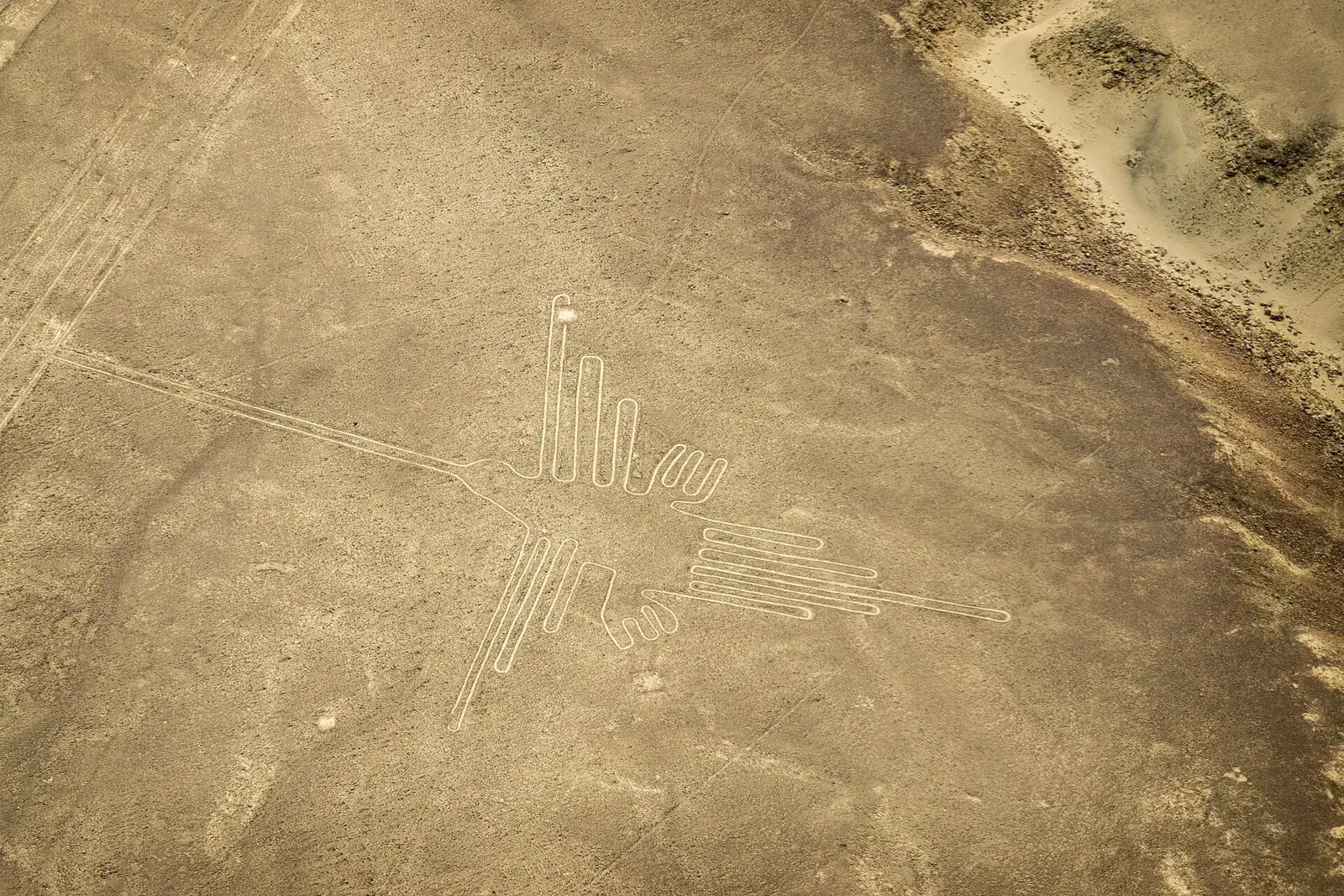
Nazca needs a night or less. The reason to stop is the geoglyph lines, best seen from a small plane on a flight of roughly half an hour, and a few sights on the ground nearby. Most travellers fit it between the south coast and Arequipa. Flights can be delayed or cancelled for weather and safety reasons, so keep some slack.
In this section
-
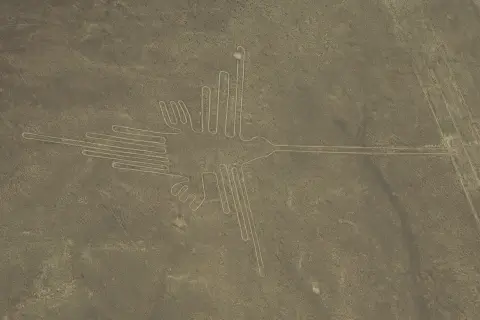 Attraction
Nazca Lines
Giant desert drawings best seen from the air, with ground-level viewpoints as a cheaper alternative.
-
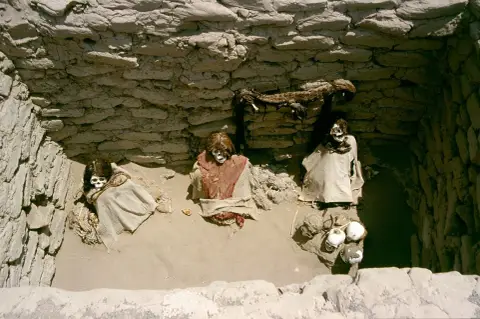 Attraction
Chauchilla Cemetery
An open desert cemetery south of Nazca where mummies of the Nazca culture lie in their original mud-brick tombs.
-
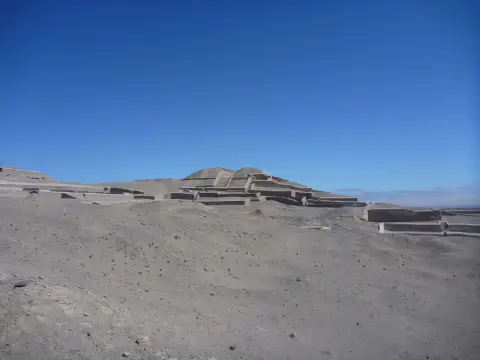 Attraction
Cahuachi
A desert complex of stepped adobe mounds in the Nazca valley, where the people who drew the lines gathered for ceremonies.
-
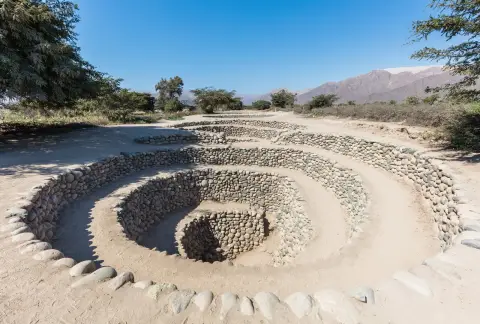 Attraction
Cantalloc Aqueducts
A field of stone-lined spiral openings east of Nazca that give access to underground water channels still in use.
The lines
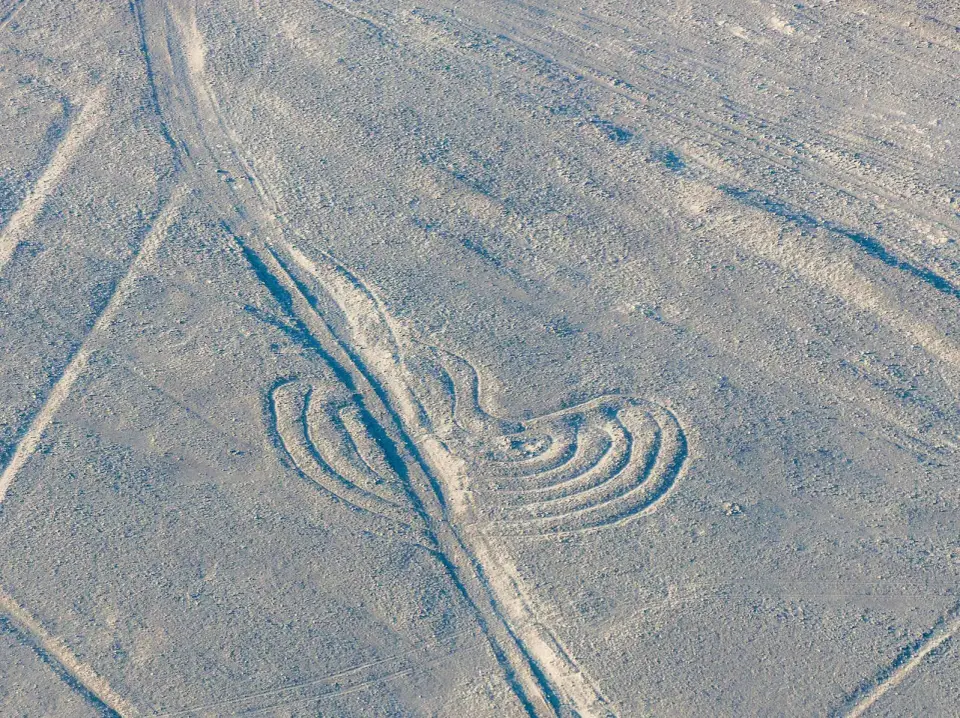
On a flat, dry plain north of the town, the surface stones were cleared in lines to reveal lighter earth underneath, forming straight lines, geometric shapes and animal figures such as a monkey, a hummingbird and a spider. They were made by the Nazca culture, roughly two thousand years ago. Many of the shapes are hundreds of metres across, and some of the straight lines run for kilometres, which is part of why the question of how people planned them without a view from above has fascinated researchers. Why they were made is still debated, with ideas ranging from ritual paths to astronomical or water-related purposes.
The figures are very large and are most clearly seen from the air. From the ground, a viewing tower along the highway shows just a few shapes. For the main figures and what each flight shows, see the Nazca Lines. The desert is one reason the lines have survived: the plain is extremely dry, there is little wind at ground level and the stones are dark and heavy enough to stay in place.
The flight
Light aircraft take off from the small local airport and circle the main figures, banking so that passengers on both sides can see them. It is short, bumpy and can be nauseating, so go on an empty stomach and use motion-sickness advice from a pharmacist or doctor. Mornings are generally calmer. There have been accidents in the past, and standards vary between companies, so choose carefully. Flights from Pisco or Ica also exist but take longer on the ground.
Bring a window-friendly camera or phone, and be ready to follow the pilot's instructions about which side to look at. Pilots announce each figure, and you will see a lot in a short time, so concentrate on looking rather than photographing every shape. Sit still, keep your eyes on the horizon between figures and breathe steadily if you feel queasy.
Tours and activities
Bookable online, chosen for their traveller reviews.
-
From €40 per person
-
From €40 per person
Other sights
The Chauchilla cemetery, in the desert outside town, shows pre-Hispanic burials with mummies and pottery exposed in open tombs. The Cantalloc aqueducts are spiral openings that gave access to underground water channels still used today. A museum in town explains the culture and the research of Maria Reiche, the German-born mathematician who devoted decades to studying the lines. Together with the flight these fill one long morning or a full day.
The local museum is a good rainy-day or hot-afternoon stop, and it helps you make sense of what you saw from the plane. Travel to these sights is usually by taxi or small tour, and the desert tracks can be dusty. Take water, a hat and a scarf, and plan the visit for the morning, when the heat is lower. If you are short of time, the cemetery gives the most striking visual impression, and the aqueducts are a quick stop on the way back.
Is it worth it
The lines are famous and strange, but the experience is brief and the town is not charming. If your time is tight, you could go by air from the coast or skip the stop. If you are interested in archaeology or aerial views, it is a memorable short detour. The arguments on whether Nazca is worth the detour are set out in more detail.
Consider your wider route. A traveller heading from Paracas and Huacachina to Arequipa passes close by, which makes a stop easy. For someone without a reason to travel on that road, the detour costs a day or more of bus travel for a half hour in the air. In short, the stop makes most sense when it fits naturally on the road between the coast and Arequipa.
Getting there and weather
Nazca is on the Pan-American Highway, a long day or night by bus from Lima, and about halfway between Ica and Arequipa; Lima to Nazca sets out the options. The climate is hot and dry, with the best visibility in the morning before haze and wind build up.
Buses to and from Nazca stop at terminals in the town, and taxis are the simplest way to reach the airport. Check whether your bus arrives at a convenient hour, since many long-distance buses reach Nazca at night or at dawn. Arriving early in the morning actually helps, as you can fly before the heat and wind arrive. See buses in Peru for general advice on long journeys.
Combining Nazca with the coast and Arequipa
A common sequence is Lima, Paracas, Huacachina, Nazca and then Arequipa. It is attractive on paper but involves a lot of road time. A smart alternative is to fly from Lima to Arequipa and skip the Nazca stretch, or to pick one or two stops only. If you do include Nazca, arrive in the evening, sleep, fly in the morning and take a night bus onward.
For a comparison of the stops, read Paracas and Huacachina. Remember that long bus rides are tiring and that roads in the desert can be affected by accidents or weather. A flexible plan, with a spare half day, is more comfortable than a tight timetable. Domestic flights, described in flying in Peru, are another way to skip the long road.
Map
Where to sleep
-
Nazca
Base for the lines and the flights over them
A grid of simple streets with hotels, restaurants and agencies that arrange the flights. Many hotels have a pool and can store luggage.
Keep in mind: Flights depend on weather and can be rescheduled, so avoid booking a tight onward bus on the same afternoon.
Find hotels →
Weather in Nazca
Forecast: MET Norway
Frequently asked questions
How long is the Nazca flight?
Usually about thirty minutes in the air, with additional time for check-in and waiting.
Can I see the lines without flying?
A few figures are visible from a roadside tower, and museums and a planetarium give context, but the full effect comes from the air.
Is Nazca worth an overnight stay?
Usually not. Many people arrive in the morning, fly and move on the same day.
How far is Nazca from Lima?
It is a long journey of several hours by road, usually done by bus. Many travellers break it up with stops at Paracas and Ica. See Lima to Nazca for the details.
What is the best time of day for the flight?
Early morning is generally calmer and clearer, with less wind and haze. Afternoons can be bumpy. Operators set their own schedules, so ask when you book.
Is the flight suitable for people who get motion sick?
It can be difficult, because the plane banks steeply and the flight is bumpy. Ask a doctor or pharmacist about motion-sickness advice, avoid a heavy meal and choose a seat near a window.
Do I need to book the flight in advance?
In busy months it helps, but many travellers book on arrival. Booking ahead is safer if you have a tight schedule, and it lets you compare operators before you decide.
Can children take the flight?
Policies vary by operator and by age. Ask about age limits, seat belts and weight rules before booking. The flight is short but can be unpleasant for young children.