The Cantalloc Aqueducts are a group of stone-lined, spiral-shaped openings in the desert about 3 km east of Nazca. They are shafts that give access to underground water channels, called puquios, built by the Nazca culture and still carrying water. Allow 30 to 45 minutes, go in the morning, and treat the visit as a short add-on to the Nazca Lines or the cemetery rather than a day out on its own.
Map
What the aqueducts are
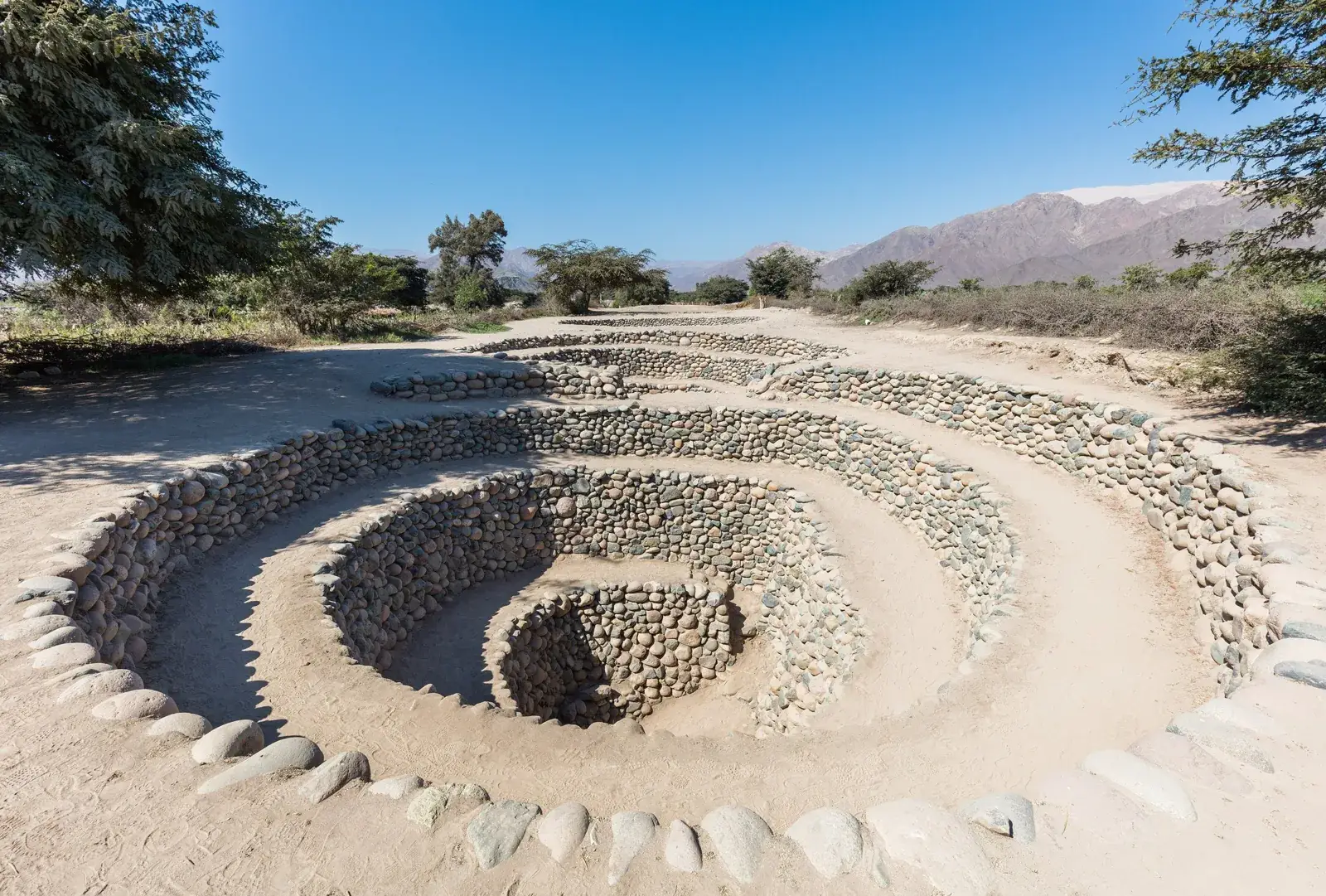
The Cantalloc Aqueducts are the best-known of the puquios of the Nazca region, a word that comes from the Quechua for a spring or water well. A puquio is a system for reaching groundwater in a place where almost no rain falls. A tunnel runs underground, usually from the aquifer down the slope, and vertical shafts are cut along its line so that people can climb in to clean and repair it. At Cantalloc the openings of those shafts are lined with river stones and shaped as spirals, which is why the site looks like a row of sunken stone whirlpools in the sand.
The site lies about 3 km east of Nazca, in the same valley as the town. More than 40 aqueducts were built in this area, and the water they carry has been used for the town and its fields all year round. The typical form is a set of concentric rings of rounded stones stepping down towards a small dark centre.
Why they matter
The coastal plain around Nazca is one of the driest places in the country, with only a few millimetres of rain in a typical year, and the rivers that come down from the Andes are dry for much of it. The puquios are the answer that people found to that problem, and they allowed a large population to live and farm in a place where surface water is scarce. Crops such as cotton, beans and potatoes are recorded as having been grown with this water.
Archaeologists do not agree on exactly when they were built. Most place the origin of the Nazca puquios around 500 CE, in the time of the Nazca culture, and satellite and drone studies have supported a pre-Hispanic date, while a minority view argues for Spanish-era builders. What is not disputed is that the system is old, that it is engineered with care, and that more than forty puquios in the region were still working at the start of this century. The design is similar to the qanats of Iran, an idea that appears to have been developed independently in the Andes.
Tours and activities
Bookable online, chosen for their traveller reviews.
-
From €40 per person
-
From €40 per person
What you see on site
Expect an open, flat area of sand with a handful of spiral openings and a path between them. The stone linings are low and neat, and in some of the openings the spiral forms a ramp or steps going down towards the water channel. Water is not always visible from the edge, and in many openings you will see only a dark stone floor, so go for the shape of the structures rather than for a flowing stream.
Beyond the spirals, a section of open trench may be visible, where the channel comes to the surface and feeds the irrigation ditches of nearby fields. Seen together, the spirals, the trench and the green plots around them make the logic of the system easy to read, which is the real reward of the visit. Information boards or a local guide, where available, explain the details; ask at the entrance rather than expecting a full museum.
How a puquio works
The gallery of a puquio is typically a tunnel about a metre square, set at roughly 10 m below the surface where it meets the aquifer, and it slopes gently so that water flows by gravity to the surface. The shafts, known as ojos (Spanish for eyes), are spaced every 10 to 30 m along the tunnel, and the funnel shape lets workers go down for maintenance. Because the water stays underground for most of its path, little is lost to evaporation in the heat.
The spiral form is often explained as a practical way to let people reach the water by walking down, and some explanations add that it helps air to circulate into the tunnel, but no explanation is certain. Treat any single reason offered by a guide as a likely rather than a proven one. The sophistication is clear without it: a maintained, gravity-fed system that has lasted for over a thousand years.
Getting there from Nazca
The aqueducts are close to town: about 3 km east of Nazca, a few minutes by car. The easiest ways are a taxi from the town with the driver waiting, or a stop on a small tour of the sights around Nazca. Agree the fare and the waiting time before you leave, and see taxis and ride-hailing for general advice on negotiating.
Many visitors stop here on the way to or from another site, such as the Chauchilla cemetery, which is on the other side of town. If you arrive by bus from the coast, the route is described in Lima to Nazca. Walking from the town is not a sensible choice in the heat, and the roads have no shade.
When to go and how long to stay
Morning is the best time, for two reasons: the sun is lower and the light picks out the texture of the stones, and the heat is manageable. Midday is hot and shadowless, and the glare off the pale sand is strong. The weather in this part of the desert is dry for most of the year, and rain is rare, so there is little need to plan around the season.
A visit takes 30 to 45 minutes, longer if you stop to take photographs or listen to a guide. The altitude is modest, around 500 m, so there is no altitude issue here, unlike in Cusco. Bring a hat, sun protection and water, wear closed shoes for the sandy ground and loose stones, and stay on the paths. Do not climb on the stone walls or throw anything into the openings, which are still part of a working water system.
Who it suits and what to combine it with
The site suits travellers who like engineering and archaeology and want something to see on the ground, since most of the reputation of Nazca rests on the lines seen from the air. It is quick, undemanding and easy for most people to walk, although the sand is uneven. It will not suit anyone expecting grand monuments, because the interest is in the construction and in the story of the water.
Pair it with the Nazca Lines flight or viewing tower, and with the other sights in the Nazca guide. If you are deciding whether the whole stop is worth the time, is Nazca worth it sets out the trade-offs, and the south coast loop shows where Nazca fits with Paracas and Huacachina. For basic precautions in the desert, read staying safe in Peru.
Where to sleep
-
Find hotels
Nazca
Base for the lines and the flights over them
Frequently asked questions
What are the Cantalloc Aqueducts?
They are the visible access shafts of underground water channels, known as puquios, built by the Nazca culture. The openings are lined with stones and shaped as spirals. Many of the puquios in the Nazca area are still used for irrigation.
Are the Cantalloc Aqueducts still working?
Yes, the puquios of the Nazca valley are still described as functioning, and water from them is used in nearby fields. Not every opening shows water at the surface, so do not expect a flowing stream at each spiral.
How old are the Cantalloc puquios?
Most researchers date the origin of the Nazca puquios to around 500 CE, the Middle Nazca period, though modifications were made later and a few scholars argue for a Spanish-era origin. There is no precise scientific dating method, so treat the date as an estimate.
How far are the aqueducts from Nazca?
About 3 km east of the town, a few minutes by taxi. It is too hot and shadeless to walk comfortably, so arrange a taxi or a small tour. See the Nazca guide for other nearby sights.
How long does a visit take?
Around 30 to 45 minutes is enough for most people. If you are combining it with a flight over the Nazca Lines or the cemetery, it fits into a single morning.
Is there an entrance fee?
Check locally before you go, because fees and opening arrangements for archaeological sites change and are not guaranteed to be the same for every visitor. Take cash in small notes in case a ticket is needed.
Can I walk down into the spirals?
Do not assume so. Access rules vary and some openings are fenced or too narrow, and the structures are fragile and part of an active water supply. Follow the signs and any instructions from the staff or your guide, and stay on the marked paths.