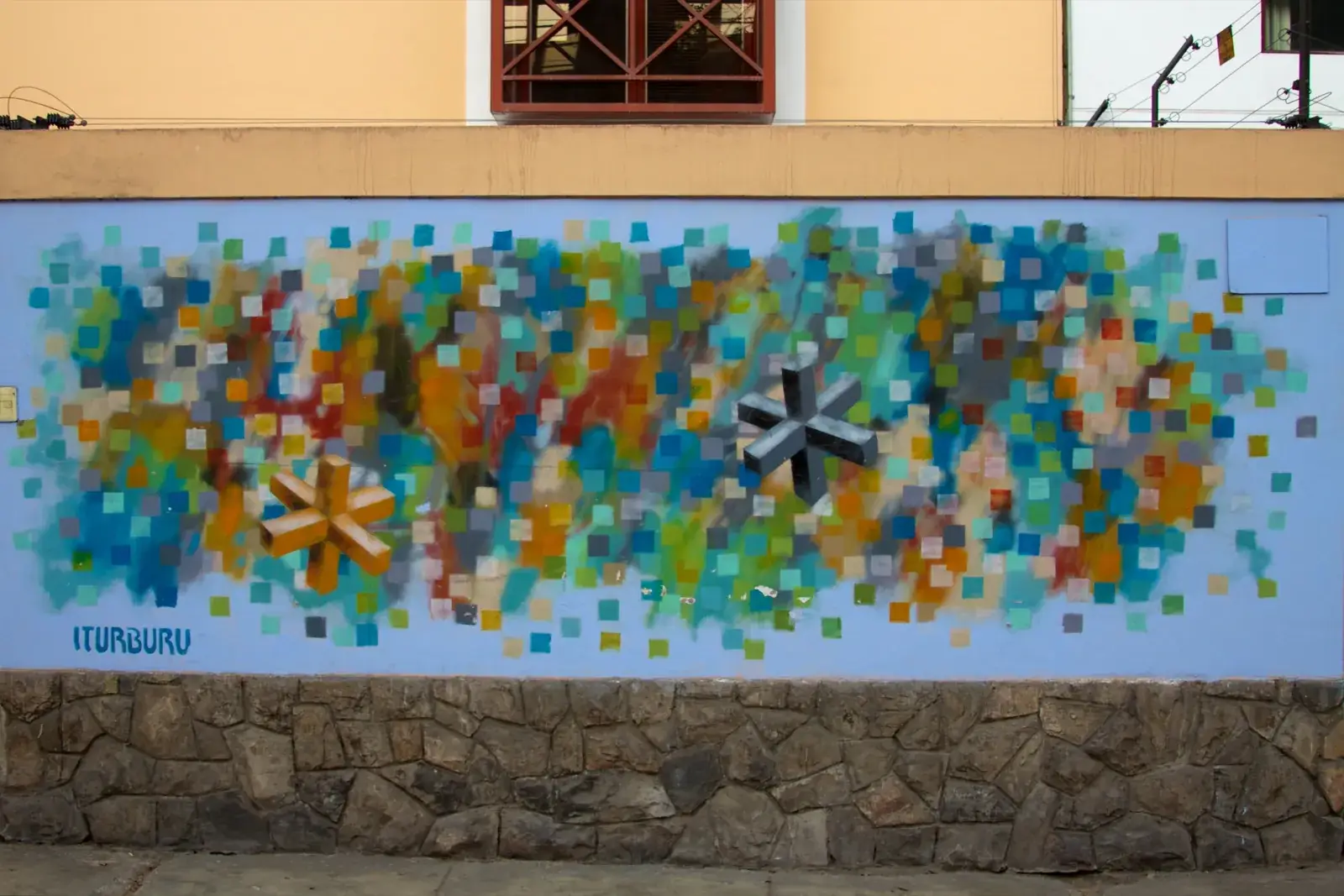
Contemporary art in Peru is concentrated in Lima, above all in Barranco, where the museums, galleries and street murals sit within walking distance. Two names to know are Fernando de Szyszlo, the abstract painter who drew on pre-Hispanic imagery, and Tilsa Tsuchiya, whose mythic figures are among the best-loved images in Peruvian painting. Cusco has many galleries, but most sell work to tourists rather than showing contemporary practice, so choose carefully.
What counts as contemporary in Peru
Peruvian art of the twentieth century grew out of a debate about identity. In the 1920s and 1930s the *indigenista* movement placed Andean peoples and landscapes at the centre of painting, and from the 1950s a generation of artists moved towards abstraction while keeping links to Andean forms. Since the 1980s, artists have worked in photography, installation, video and performance, and many take up themes such as migration, violence, class and memory.
The colonial background still matters, because Peruvian painters began from the legacy described in the Cusco School, and many artists respond to craft traditions, discussed in Peruvian crafts. The distinction between art and craft is itself debated in Peru, which is one reason to see both.
Fernando de Szyszlo
Fernando de Szyszlo (1925-2017) was born in Lima and became the leading figure of Peruvian abstract painting. His canvases use strong colour and large forms, often in red, black and ochre, and suggest altars, sacrifices and the landscape of the Andes without showing them literally. He took inspiration from pre-Hispanic art as well as from European and American modernism, and from Quechua poetry.
His work is held in Peruvian and international collections, and major Lima museums show Peruvian modern painting, including his; see museums in Peru for the main collections. Look at the way he handles space: the large dark areas and floating shapes reward a longer look, and are quite different from the figurative art of the colonial period. He also taught and wrote, and shaped a generation of younger artists.
Tilsa Tsuchiya
Tilsa Tsuchiya (1928-1984) was born on the coast in Supe to a Japanese father and a Peruvian mother, and trained in Lima and Paris. Her paintings and sculptures show stylised, hybrid beings with smooth faces and ornamental bodies, in a world mixing Andean, Amazonian and personal myth. Colour is rich, and the figures seem calm and slightly strange.
Her work is very popular in Peru, and prints and reproductions appear in many shops. Her art has been exhibited in her country and abroad, and her imagery influenced later generations. A good approach is to look at original work in a museum or gallery and then at reproductions, since the surface and scale of the paintings are hard to judge from postcards. Both she and Szyszlo are good places to start before exploring younger artists whose names change quickly.
Barranco and the Lima scene
Lima's art world is centred on Barranco, a bohemian coastal district of old villas, a bridge and steep streets down to the sea. There you find the MAC Lima, the Museo de Arte Contemporáneo, as well as the MATE, the museum founded by the photographer Mario Testino, which shows photography and Peruvian art. Check each museum's current exhibitions and opening days, since programmes change.
Around them are small galleries, studios, design shops and cafés. The neighbourhood is described in Barranco, and the nearby district of Miraflores has further galleries and cultural centres. Evenings are the busiest time, and an exhibition opening, if you happen to arrive at the right moment, is a pleasant way to meet the scene. Walking between venues in daylight is easy, and a taxi suits the evening.
Street art and murals
Murals are a visible part of Peruvian cities. In Barranco, walls along the lanes to the sea and around the central square carry large works, many by Peruvian artists, with themes from Amazonian animals to portraits and social commentary. Murals also appear in the historic centre of Lima and in districts such as Callao, where urban art projects have transformed parts of the port.
Street art in Peru often draws on Indigenous patterns and on popular painting, so it can be a quick introduction to the country's mix of traditions. Works change as walls are repainted or weathered, so a particular mural may not be there when you arrive. Take photographs for yourself, credit artists when you share images, and avoid walking into private property to get a better angle. Some tour operators run guided street-art walks, which add background on the artists.
Galleries in Cusco and other cities
In Cusco, galleries cluster around the Plaza de Armas and the artisans' district of San Blas. Many sell landscape painting, religious pastiche and work in the Cusco School manner, while a smaller number show contemporary artists, including some who work with Andean imagery in photography, collage and mixed media. Ask who the artist is and where they studied, and whether the work is original, a print or a copy.
Arequipa, Trujillo and Lima's regional counterparts also have art schools and cultural centres with changing programmes. University galleries, cultural centres run by embassies and municipal spaces are often free to enter and give a truer picture than shops. If you are buying, ask for a certificate or a receipt with the artist's name, and remember that export rules apply to older works; see the note in the next section.
Planning an art day in Lima
A workable day starts with one museum in the morning, when rooms are quiet, followed by a walk through Barranco for galleries and murals and a long lunch. Late afternoon suits the coastal paths and the bridge, and the light on the cliffs is part of why artists settled here. Choose one or two venues rather than many, since small galleries often close earlier than museums or on a different weekday.
If your interest is wider, combine the day with a historic museum, such as those in Lima, to see how modern work answers older traditions. Look at free listings, cultural centres and exhibition openings, which are usually announced online shortly beforehand. Labels may be only in Spanish, so a translation app or a short guided visit helps. Travellers with limited time can still fit in one museum and an hour of murals between a morning flight and an evening one.
Frequently asked questions
Is Barranco the best place to see contemporary art in Lima?
It is the most convenient, because MAC Lima, MATE and several galleries are close together. Miraflores and the centre also have spaces, so check listings if you want a particular exhibition.
Who is Tilsa Tsuchiya?
She was a Peruvian painter and sculptor, born in 1928 and active until her death in 1984, famous for mythic, ornamental figures. She is among the most recognisable names in modern Peruvian art.
What was Fernando de Szyszlo known for?
He was the leading Peruvian abstract painter of the twentieth century. His large canvases blend modernist abstraction with echoes of pre-Hispanic and Andean forms.
Can I visit contemporary art galleries for free?
Many commercial galleries are free to enter, and some museums have free days or low fees, though policies change. Cultural centres and university galleries often have free exhibitions.
Is street art safe to look at in Lima?
In busy districts like Barranco, yes, during the day. Keep a normal level of caution, avoid empty side streets with valuables on show and use taxis at night.
Are there contemporary art events in Peru?
Lima hosts exhibitions, art fairs and gallery nights through the year, and dates vary. Check museum websites and local listings for what is on during your visit.
How can I tell if a painting in Cusco is original?
Ask for the artist's name, the date and a receipt, and look for signs of hand work such as brush texture. Many shops sell prints or workshop copies, which are fine if priced as such.