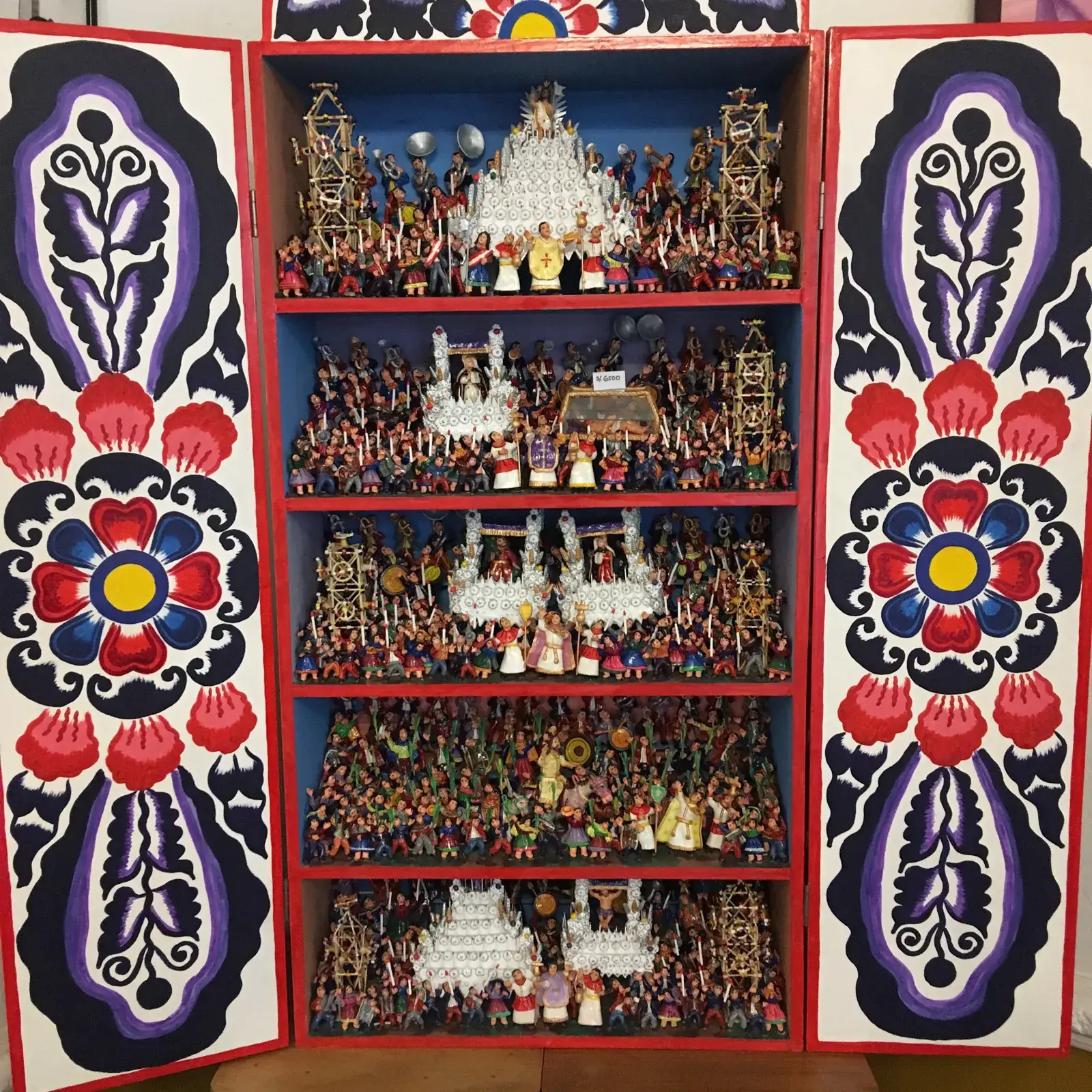
Peru's best-known crafts are tied to particular places: retablos from Ayacucho, Chulucanas pottery from Piura, carved mate burilado gourds from the central Andes, Pucará bulls from the Puno region, silver filigree and the geometric designs of the Shipibo-Konibo of the Amazon. Buy from makers or cooperatives, ask where an item was made, and never buy anything that may be a real pre-Columbian object, since exporting antiquities is illegal.
Crafts that belong to a place
Handicrafts in Peru are rarely generic. A bull for a rooftop, a painted box of figures or a carved gourd belongs to a village or a valley, and its form carries history. Some crafts descend from pre-Hispanic traditions, others from colonial workshops, and many have been shaped by modern tourism and by the export market. Knowing the origin turns a souvenir into something you can explain.
This page covers objects other than cloth. Weaving has its own guide in Andean textiles, and the wider story of religious painting is in the Cusco School. Major collections, which show what the best historic examples looked like, are described in museums in Peru.
Retablos from Ayacucho
A retablo is a portable wooden box with doors, filled with small painted figures. Its roots lie in the Spanish colonial portable altars brought to the Andes to teach Christianity, and in Ayacucho it was transformed into a form of storytelling. Early retablos showed saints and nativity scenes; later ones show village festivals, farming, markets and, in some famous examples, scenes of political violence and memory.
Figures are modelled from a paste often made with potato and plaster, then painted by hand. Workshops in and around Ayacucho produce them in every size, from matchbox miniatures to large boxes. The detail inside a good piece is the best clue to quality: faces, clothes and tiny animals should be individually shaped, not copied from a mould. Retablos travel well, but pack them carefully in hand luggage.
Pottery: Chulucanas and Quinua
Chulucanas is a town in the northern region of Piura whose potters make dark, polished ceramics with rounded forms and a distinctive negative-resist decoration. The technique uses natural materials to mask parts of the surface before firing, creating a smooth, shiny finish. It has roots in much older northern traditions and now supplies a lively export trade.
In the Ayacucho highlands, the village of Quinua is known for red clay figures, church models for rooftops and pieces for the village's ceramic tradition. Quinua is also close to the historic battlefield of Ayacucho, associated with the end of Spanish rule, which gives the village extra interest for history readers; see independence. Pottery is fragile, so ask the seller to wrap and pack pieces, and do not rely on thin newspaper alone.
Carved gourds, bulls and silver
The mate burilado, a gourd carved with a fine burin, is a craft of the central Andes, strongly associated with the Huancayo area. Artisans engrave scenes of village life, festivals and history, and sometimes darken the pattern with heat. Genuine pieces show crisp lines inside the shape of the gourd, while cheap ones are stamped or scorched by machine.
The Pucará bull, or *torito de Pucará*, is a ceramic bull named for a village in the Puno region. Pairs of bulls are placed on roofs in the highlands as protective symbols, often with a cross, and they are part of rural ritual as well as decoration. Silver work is also traditional, particularly filigree (very fine twisted silver wire) made in the Andes and on the north coast. Check that silver is marked, compare weights and ask whether a piece is solid or plated. Near the lake, Puno is a convenient place to find regional pieces.
Shipibo-Konibo designs
The Shipibo-Konibo people of the Ucayali region in the Peruvian Amazon are known for geometric designs, in dense interlocking lines called kené. They are painted on cloth and ceramics and embroidered on skirts. The patterns were recognised by the Peruvian state as cultural heritage, and for the community they express a way of seeing the world and, in some contexts, healing songs.
Pieces can be bought in markets in Pucallpa and in the Amazon city of Iquitos, and some Shipibo communities sell directly on the Ucayali. Look for items made by hand, with irregular, flowing lines; printed copies sold cheaply are common. Be aware that some sellers use sacred or medicinal associations for marketing, and do not assume every pattern can be photographed or copied. More about the peoples of Peru is in peoples of Peru.
Where to look and what to ask
Crafts are sold in three kinds of place. Producer villages and workshops, such as those around Ayacucho, Quinua and the Mantaro valley, offer the widest choice and the best chance to watch the work. City craft markets in Lima, Cusco and Puno bring many regions together, which is convenient but makes origin harder to verify. National and regional craft fairs, held around festivals, show the best pieces and often feature artisans who have won awards.
A few questions give most of the answer: who made it, in which village, from what material, and how long it took. A seller who can answer calmly is usually reliable. Timing matters too, because crafts are sold in volume around festivals and holidays; see festivals in Peru for the calendar logic. Allow time on a trip for a workshop visit rather than buying everything in the last hour at the airport.
Buying ethically
The aim is to put money in the hands of the maker. Buy at workshops, cooperatives, craft fairs and fair-trade shops where you can ask who made the piece, and avoid sellers who cannot say where an item came from. Be wary of "bargains" that undercut the price of hours of work. If you do negotiate, do it politely and accept that the first price for a hand-finished object often has little margin.
Think about the weight and the journey. Ceramics and gourds break, retablos can be damaged and silver is heavy. Ask for receipts and, for larger purchases, a note of the artisan's name; this helps with customs and later with insurance. Avoid items made from endangered animals or plants, such as feathers, shells, turtle products or wood from protected species, because these may be illegal to import.
Frequently asked questions
What is the best craft souvenir from Peru?
It depends on your taste and luggage. A small retablo, a carved gourd or a piece of Chulucanas pottery are distinctive and unlikely to be found elsewhere. Pick something made by a named artisan or cooperative.
Are Pucará bulls only decorations?
They are also protective charms traditionally placed on the roofs of houses in the southern highlands. Often they appear in pairs and with a cross, linking Andean and Catholic belief.
Can I buy handicrafts at markets in Cusco?
Yes, craft markets sell a wide range, from textiles to ceramics, but quality varies and many items are not made locally. Ask where a piece was made and compare several stalls before buying.
How do I know if a mate burilado is handmade?
Look closely at the lines. Hand-carved designs show small differences in depth and detail, while stamped or burned designs are uniform and shallow. Handmade gourds also cost more because the work is slow.
Can I bring ceramics through customs?
Modern ceramics are generally fine. Pre-Columbian objects are not allowed out of Peru, and your home country may restrict imports of cultural property. Keep receipts and, if in doubt, check with the Ministry of Culture before leaving.
Is it rude to bargain over crafts?
Polite bargaining is common in markets, but in cooperatives and workshops prices are often set. If you ask for a reduction, do so for a bulk purchase and never insist on a price below the cost of materials and time.
Where can I see Shipibo-Konibo art?
In Amazon markets such as Pucallpa and Iquitos, in museums with ethnographic sections in Lima and in some community-run visits along the Ucayali. Look for pieces with a named maker or association.