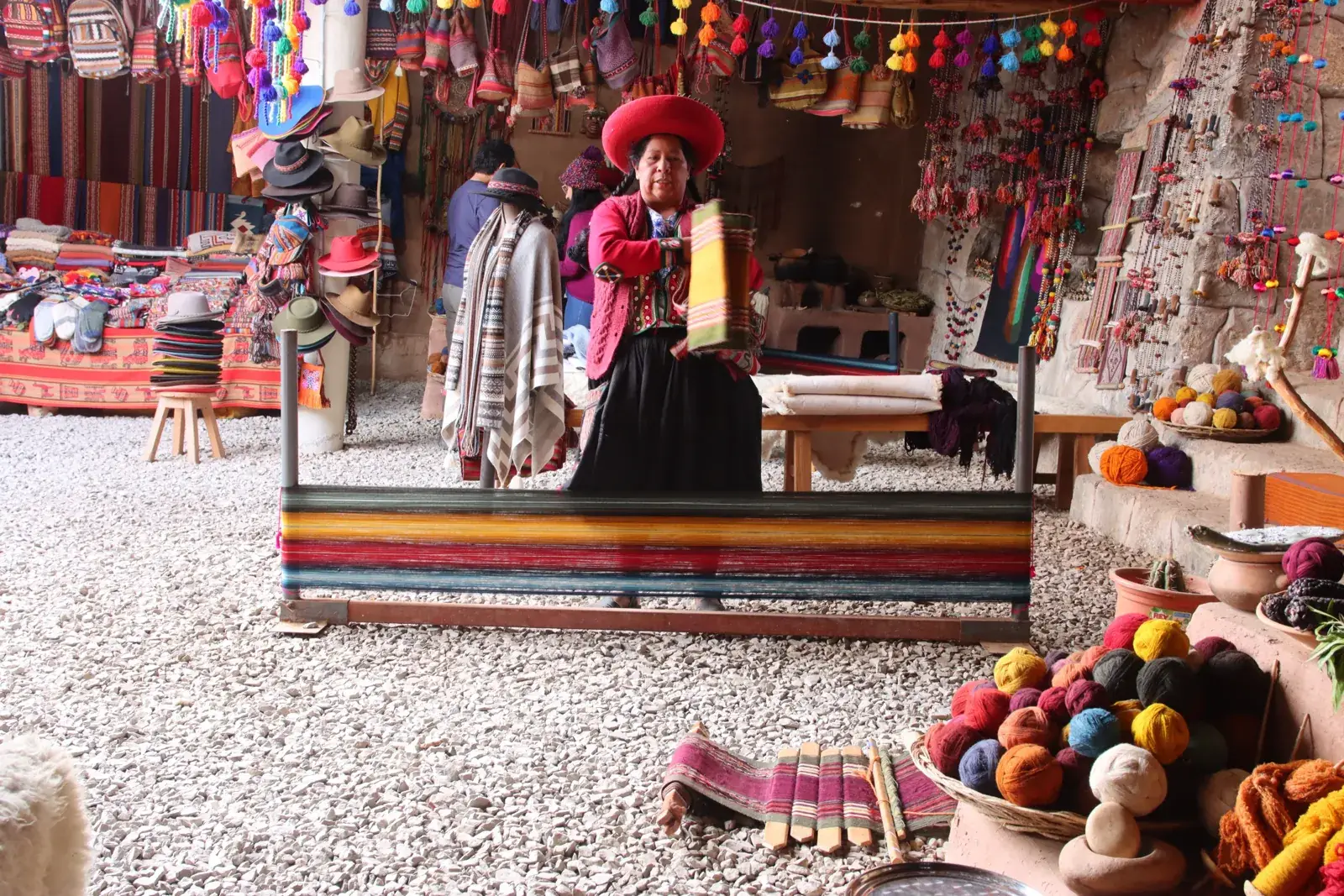
Andean textiles are woven or knitted from alpaca, llama, sheep's wool and, rarely, vicuña, often coloured with natural dyes and made on a backstrap loom. The best-known weaving communities visitors can reach are Chinchero in the Sacred Valley, Taquile on Lake Titicaca and Pitumarca near Cusco. A genuine handmade piece shows small irregularities, costs more than a factory item and is best bought directly from weavers or a cooperative.
Patterns are not decoration alone: in many communities they identify a village, a status or a story. Ask before photographing people in traditional dress.
An art older than the Incas
Weaving in the Andes is thousands of years old. Dry coastal conditions preserved cloth made by the Paracas culture on the south coast roughly two thousand years ago, and these embroidered mantles are among the finest textiles of the ancient world. The pre-Inca civilisations such as Nasca, Wari and Chimú all wove cloth of great skill, and under the Incas fine cloth called cumbi was more prized than gold in some contexts, given as tribute, offered in ceremonies and exchanged between rulers.
That importance did not disappear with the conquest. Today weaving remains part of daily life in many highland communities, where women, and in some places men, produce blankets, belts, bags, hats and the shawls used as carrying cloths. Museums in Lima and Cusco hold ancient pieces, which is useful context before you shop; see museums in Peru.
Fibres: alpaca, llama, sheep and vicuña
The fibre defines the feel of a piece. Alpaca is soft, warm and available in many natural shades from white to brown and black, and it is the most common choice for scarves, jumpers and blankets. Llama fibre is coarser and is used for rugs, ropes and sturdy bags. Sheep's wool is cheaper and widely used in community weaving, where it takes dye very well.
Vicuña is the finest fibre of all, taken from a wild relative of the llama that lives on the high plateau. It was once hunted close to extinction and is now protected; fibre comes from live animals that are rounded up and shorn in community events known as chaku. Real vicuña is very expensive, and a cheap item sold as vicuña is almost certainly something else. Labels such as "baby alpaca" describe a fineness grade rather than the age of the animal, and blends with acrylic are common, so ask what a piece contains.
Natural dyes and colour
Many communities still dye yarn with materials from their surroundings. Cochineal, a small insect that lives on prickly pear cactus, gives reds, pinks and purples depending on the mordant used. Indigo and local plants give blues and greens, and a range of leaves, roots, bark and lichens give yellows, oranges and browns. The combination of dyes with different wools gives the soft, layered tones that set natural-dyed pieces apart.
Chemical dyes arrived in the nineteenth century and are common today because they are cheap and bright. They are not "fake", and many excellent weavers use them, but natural dyes take much longer and the price reflects it. A demonstration in a weaving centre, where yarn is dipped and the colour changes as a lemon or mineral is added, is one of the easiest ways to understand the process, and a good place to ask which items in the shop really use natural colour.
How cloth is made: the backstrap loom
Most traditional weaving is done on a backstrap loom, with one end tied to a post or tree and the other to a strap around the weaver's waist. The weaver controls tension by leaning back, and the loom can be rolled up and carried. Wool is spun by hand, often with a drop spindle that women use while walking or minding animals.
A single small belt can take days, and a large blanket or a complex woven panel can take months. Techniques differ by place: some pieces are woven with figures in complementary-warp patterns, others are plain stripes, and some communities add embroidery or pompoms. Watching the process helps explain why a hand-woven item is priced far above a factory one. Visitors can see weaving at work in Chinchero, where cooperatives welcome groups, and in many villages along tour routes in the Sacred Valley.
Where to see weaving: Chinchero, Taquile, Pitumarca
Chinchero, a village above the Sacred Valley, is the best-known weaving centre for visitors, with demonstrations covering spinning, dyeing and weaving. Its Sunday market and Inca terraces make it a natural stop; see Chinchero.
On Taquile, an island in Lake Titicaca, textiles are woven and knitted under a community system, and men knit fine hats while women weave belts. The island's textile art was recognised by UNESCO as intangible cultural heritage. Details of getting there are in Taquile Island.
Pitumarca, a district in the Cusco region near the trail to Rainbow Mountain, has weaving associations known for bold patterns and community-run demonstrations. Smaller weaving villages exist across the Cusco and Puno regions, and Ayacucho and Huancavelica are also known for woven and embroidered work.
Reading the patterns
Patterns are a language. In Quechua the woven figures are called pallay, and they include zigzags, stepped lines, birds, llamas, flowers and mountains. Some communities use a particular design to mark where a person comes from, and the colours and layout of a hat, shawl or skirt can identify a village. Certain motifs are linked to the Inca squares called tocapu, though scholars still debate their exact meaning.
Be careful with simple explanations given in shops. A sales line that every symbol has a single fixed meaning is usually a simplification, and meanings differ between communities. A better approach is to ask the weaver or cooperative what a design means in their village. The links between textiles, ritual and landscape are explored in Andean beliefs, and cloth often features in celebrations described in festivals in Peru.
Handmade or machine-made?
Several signs help. Hand-spun yarn varies slightly in thickness, hand-woven edges are rarely perfectly straight, and patterns repeat with small differences. On the back, the weave is neat but not machine-uniform, and natural-dyed colours are often softer and vary from batch to batch. Machine-made pieces have exact repeats, thin synthetic-feeling yarn, and often an acrylic shine.
Weight and warmth tell you something too: genuine alpaca is warm without being heavy. Price is the other clue: a large, finely woven piece at a very low price is unlikely to be handwork. Do not rely on rubbing a flame against fibre in a shop; it is a poor test and not welcome. Instead ask where the piece was made, by whom and in what fibre. A weaver or cooperative can usually answer in detail, and many attach a card with the name of the community.
Frequently asked questions
What is the difference between baby alpaca and alpaca?
Baby alpaca refers to a fine grade of fibre, usually from the first shearing or from the softest parts of the fleece, not to a baby animal. Ordinary alpaca is a little coarser but still warm. Blends with sheep wool or acrylic are common, so check the label.
Is vicuña wool legal to buy in Peru?
Yes, when it comes from official, licensed sources using live shearing. Vicuña is protected, and export is regulated, so keep receipts and check your home country's customs rules. A very cheap vicuña item is probably not real.
Where is the best place to buy Andean textiles?
Weaving communities and cooperatives such as those in Chinchero, Pitumarca and Taquile let you buy straight from the maker. City markets and shops offer more choice but less certainty about origin. Compare quality before buying.
How can I tell if a textile uses natural dyes?
Colours tend to be softer and vary slightly between skeins, and a demonstration will show the dye materials. Ask the seller directly. Bright, uniform neon colours are chemical dyes.
Are textile demonstrations in the Sacred Valley worth visiting?
Yes, if you are interested in how yarn is spun, dyed and woven. They are short, usually include a chance to buy, and are easy to combine with a tour of the valley. You are not obliged to buy.
How should I care for an alpaca piece?
Wash gently by hand in cool water with a mild soap, press out water without wringing and dry flat away from direct heat. Store it clean with a cedar block or in a sealed bag to deter moths.
Can I take old textiles out of Peru?
Ancient and historic textiles are protected as cultural property and cannot be exported without permission. Modern, newly made items are fine. If a piece seems old, ask the seller for documents or skip it.