Peru was home to many advanced societies long before the Incas: Caral (from about 3000 BC), Chavín, Paracas, Nazca, Moche, Wari, Tiwanaku, Chimú and Chachapoya, among others. They left pyramids, citadels, textiles, ceramics and the Nazca Lines. Most sites lie on the north and south coasts and in the northern highlands, away from the Cusco circuit, and they pair well with a trip to Trujillo, Chiclayo or Nazca.
Caral and the first cities
Caral, in the Supe valley about 180 km north of Lima, is the best-known site of the Norte Chico tradition. Radiocarbon dates place its main building phase from about 3000 to 1800 BC, making it contemporary with early cities in Mesopotamia and Egypt. Visitors see stepped platform mounds, sunken circular plazas and residential quarters set in the desert.
What is striking is what is missing: no pottery, no clear signs of warfare and no writing, though a bundle of knotted cords found nearby has prompted debate about early record-keeping. Scholars still discuss how such a society was organised and how important fishing was to its economy. Caral can be visited as a day trip from Lima, and Lima's own pre-Hispanic pyramids, such as Huaca Pucllana, show the same adobe building tradition in the city itself.
Chavín: a religious centre in the highlands
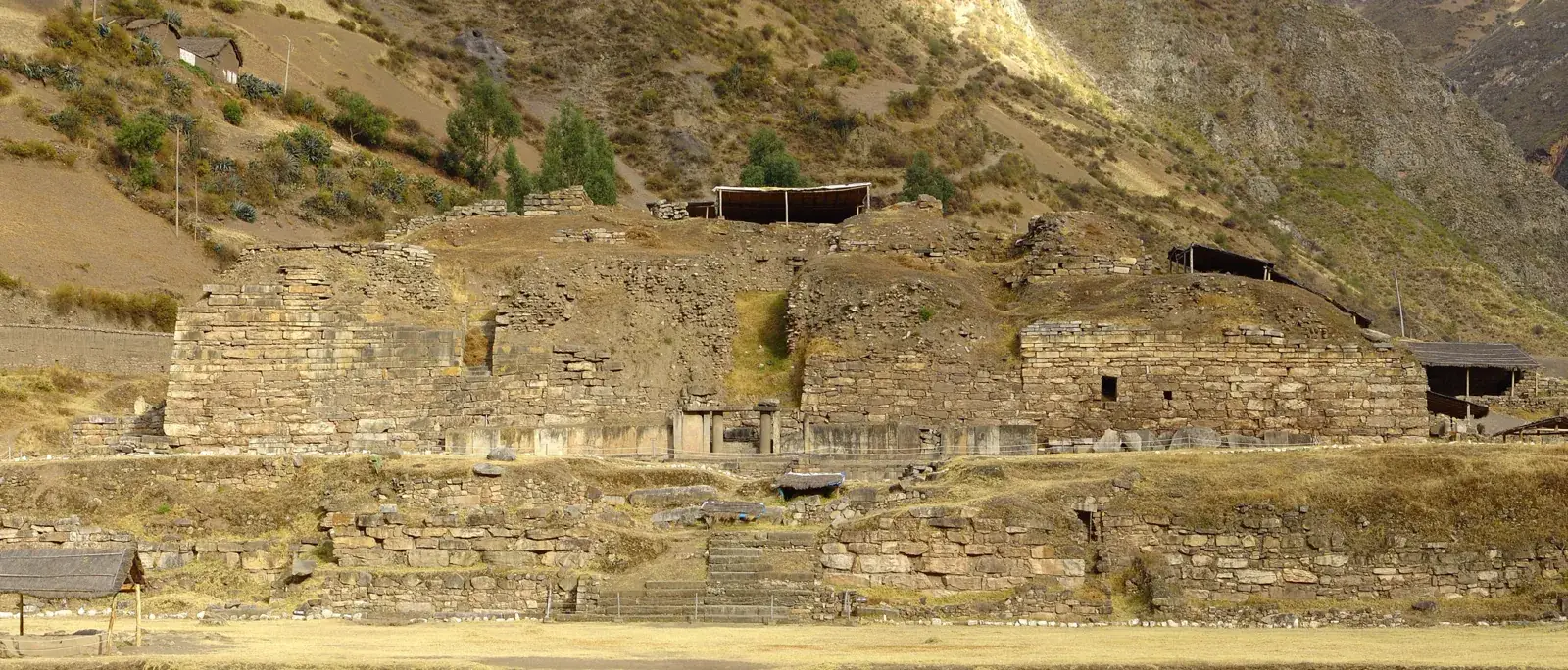
Chavín de Huántar, in the Ancash highlands, flourished from roughly 900 to 200 BC. It was a ceremonial centre rather than a city, with a stone temple complex whose interior is a network of narrow galleries, drains and chambers. At its heart stands a carved granite monolith called the Lanzón, depicting a fanged figure.
The site is UNESCO-listed, and the art style associated with it, with felines, raptors and serpents, spread widely across Peru. It is usually visited from Huaraz, as described in the Huaraz guide. The nearby museum holds carved stone heads, which once decorated the temple walls. The altitude is moderate for the highlands but still above 3,000 m.
Paracas and Nazca on the south coast
The Paracas culture (about 800 BC to AD 100) is famous for burial bundles wrapped in extraordinarily fine embroidered textiles, many of them now in Lima museums, and for skulls shaped in life. Most of the finds come from the desert peninsula that is now a nature reserve.
The Nazca culture followed, from about 100 BC to AD 800. Its polychrome pottery, underground aqueducts and above all the giant figures drawn on the desert floor, the Nazca Lines, have made it world famous. Researchers continue to debate the purpose of the lines, with theories involving water rituals, pilgrimage paths and astronomy; none is proven. Nazca's ceremonial centre at Cahuachi can also be visited, and the Chauchilla cemetery displays mummies in the open.
Moche and the north coast
The Moche (about AD 100 to 800) built enormous adobe pyramids, the Huaca del Sol and Huaca de la Luna, near modern Trujillo. Huacas de Moche retains some original painted friezes, and a site museum explains the findings.
Moche potters made stirrup-spout vessels with vivid portraits and scenes of hunting, ritual and warfare. In 1987, the undisturbed tomb of the Lord of Sipán was found near Chiclayo, with gold and silver ornaments and attendants, one of the richest Andean burials ever discovered. The finds are displayed in a museum in Lambayeque, and Sipán covers the excavated tombs. The Lady of Cao, a tattooed female ruler from the El Brujo complex, has altered ideas about women's power in this society.
Wari and Tiwanaku
Between about AD 600 and 1000, two expansive states shaped the highlands. Wari, based near modern Ayacucho, built planned administrative centres, roads and terraces across much of Peru. Its ruins at Wari and, further south, Pikillacta near Cusco show a rigid, geometric design. Wari textiles, with their abstract tapestry tunics, are among the most sophisticated made anywhere.
Tiwanaku, centred on the southern shore of Lake Titicaca in what is now Bolivia, extended its influence into southern Peru. Its monumental stonework and its raised-field agriculture were important, and the Peruvian shore of the lake has related remains. Both states collapsed around AD 1000, possibly because of drought, but their roads, terraces and organisational methods were later used by the Incas.
Chimú: the largest adobe city
After the Moche, the Chimú kingdom ruled the north coast from about AD 900 until it was conquered by the Incas in the 1470s. Its capital, Chan Chan, covers several square kilometres near Trujillo and is the largest adobe city in the Americas, inscribed by UNESCO. The walls of the restored Tschudi complex are decorated with fish, birds and waves in relief.
The Chimú were skilled metalworkers and had irrigation canals that watered desert fields. Inca conquerors took Chimú craftsmen to Cusco. Because adobe erodes easily, rain from El Niño events is a constant threat to the site, and visitors are asked to stay on paths and not touch the walls.
Chachapoya: the cloud forest people
The Chachapoya, "people of the cloud forest", lived in the eastern Andes of the Amazonas region from about AD 800 to 1470, when the Incas conquered them. Their stone citadel of Kuélap crowns a ridge above 3,000 m, enclosed by high walls and filled with circular stone houses.
Nearby, cliff tombs and the mummies of Leymebamba, now displayed in a local museum, show their funerary customs. Popular accounts sometimes call Kuélap a "lost city", but local people have always known it. The region is remote and best visited with several days around Chachapoyas, which is also the base for the Gocta waterfall.
Planning a pre-Inca trip
A north coast circuit from Trujillo to Chiclayo covers Moche, Chimú and Sipán in about four or five days, and can be linked to Chachapoyas. The south coast circuit joins Paracas, Ica and Nazca. Lima is the base for Caral, and the Lima museums give good overviews, as described in museums in Peru.
Check opening days before travelling, since some museums close on Mondays and site access changes with excavation and conservation work. Sun and wind are strong on the coast, so carry water and a hat. Hire a local guide where possible, because most sites carry little signage.
Frequently asked questions
Which pre-Inca site is best for a first visit?
Chan Chan with the Huacas de Moche gives the most complete picture in a single day from Trujillo. For a stand-alone sight, the Nazca Lines are the most famous, though they are seen mostly from above.
Is Caral worth the trip from Lima?
It is worth it for those interested in archaeology, because it shows the earliest monumental building in Peru. Expect a long day trip and an exposed desert site with little shade.
Who built the Nazca Lines?
They are attributed to the Nazca culture, with some earlier lines made by the Paracas. Their purpose is debated, and the lines are protected, so visitors may not walk on them.
Were the pre-Inca cultures conquered by the Incas?
Many were. The Chimú, Chachapoya and various highland peoples were absorbed into the empire in the fifteenth century, while the older cultures had already declined before then.
Can I see pre-Inca ruins in Lima?
Yes. Huaca Pucllana in Miraflores and the larger site at Pachacamac are both within the city area, and the museums have rich pre-Hispanic collections.
Is the Lord of Sipán really a king?
He was a high-status ruler and priest of the Moche, and the tomb is among the richest ever found in the Andes. Scholars use titles such as lord or ruler since the exact political role is inferred from the objects.
Are these sites accessible by public transport?
Most are reached from Trujillo, Chiclayo, Huaraz, Nazca or Chachapoyas by local transport or short tours. Remote sites such as Caral and Cahuachi are easier with a tour or hired car.