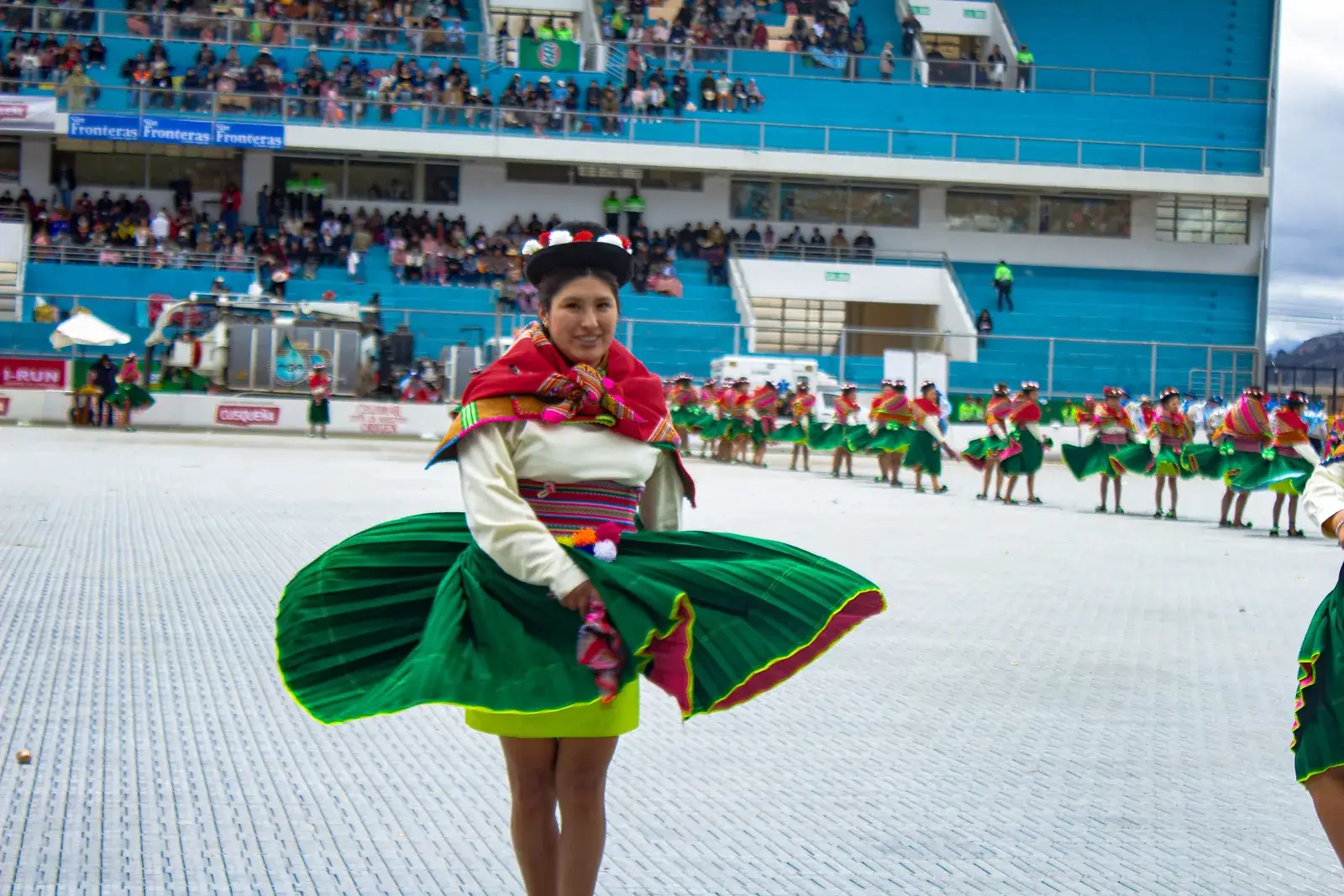
Peru has a festival almost every week somewhere, but a handful draw national crowds: Candelaria in Puno (February), Semana Santa (March or April), Qoyllur Rit'i (May or June), Inti Raymi and Corpus Christi in Cusco (June), Fiestas Patrias (late July), Carnival (February or March) and the Señor de los Milagros processions in Lima (October). Many mix Catholic feast days with older Andean ritual.
Dates for movable feasts change each year and local programmes are often fixed late, so check them locally. Cusco and Puno fill up for the big ones, and rooms and trains can sell out months ahead.
Inti Raymi and the June season in Cusco
Inti Raymi, the Festival of the Sun, is held in Cusco on 24 June, the time of the southern winter solstice. It is a staged reconstruction of an Inca ceremony: it begins at the Qorikancha, passes through the main square and ends at the fortress of Sacsayhuamán, where actors play the Sapa Inca and his court. The modern production dates from the 1940s and is based on colonial chronicles, so it is theatre inspired by history rather than an exact record. Scholars note that the original Inca rite was a far larger state occasion.
Seats in the stands at Sacsayhuamán are sold in advance, while the open slopes around the site can be watched without a ticket but get very crowded. The week around the date also brings parades and dancing in the centre. See Sacsayhuamán and Cusco for the setting, and book accommodation very early for this period.
Candelaria in Puno
The Virgen de la Candelaria festival in Puno is held in early February, with the main day on 2 February and celebrations running for about two weeks. Puno is often called the folklore capital of Peru: hundreds of dance troupes, brass bands and costumed groups parade through the streets and fill the stadium for a dance competition. Dances such as the diablada, morenada and caporales come from the Aymara and Quechua highlands, and many are shared with neighbouring Bolivia.
The costumes are the draw. Masks, embroidered capes and heavy beaded suits take months to prepare, and dancers perform for hours at nearly 3,800 m, so expect tired legs and a lot of dust. The festival is on UNESCO's list of intangible cultural heritage. February is the rainy season, so bring a waterproof, and treat the crowded streets with the usual caution over pickpockets. Combine it with the islands described in Lake Titicaca.
Qoyllur Rit'i: the pilgrimage to the snow
Qoyllur Rit'i, usually translated as Snow Star, is a pilgrimage held in the Sinakara valley beneath the Ausangate massif in the region of Cusco, in the weeks before Corpus Christi, normally late May or June. Tens of thousands of pilgrims walk to a sanctuary at about 4,700 m to honour the Lord of Qoyllur Rit'i, a Christ image painted on a rock, and to take blocks of ice from the glacier believed to carry blessing. Groups of dancers called ukukus, dressed as bear-like figures, climb to the ice at night and keep order among the crowd.
This is a religious event for Quechua communities, not a performance. It is also cold, high and hard to reach, with nights well below freezing. Visitors who go usually join an experienced operator and should photograph with restraint. The event has UNESCO recognition as intangible heritage. Compare the altitude with Ausangate, which shares the same mountain landscape.
Semana Santa and Corpus Christi
Holy Week in Peru is solemn rather than festive. In Cusco, the Señor de los Temblores, a dark crucifix associated with an earthquake in the seventeenth century, is carried through the centre on Easter Monday. Ayacucho is widely regarded as having the most elaborate Holy Week in the country, with a week of processions, carpets of flower petals and religious observances. Many Peruvians travel at this time, so buses, flights and rooms are tight.
Corpus Christi falls on a Thursday in late May or June, and in Cusco it is a major civic and religious event. Statues of saints and virgins from the parishes are carried to the cathedral in procession, then returned, accompanied by bands and dancers. The traditional dish of the day is chiri uchu, a cold plate that combines guinea pig, chicken, dried fish, sausage and seaweed. Details for each church differ, so ask locally for the route and timing; the Plaza de Armas is the focus.
Lima: Señor de los Milagros and Fiestas Patrias
In October, Lima turns purple for the Señor de los Milagros, the Lord of Miracles. An image of Christ painted by an Afro-Peruvian slave on a wall in the colonial period survived earthquakes and became the focus of one of the largest Catholic processions in the world. A heavy platform is carried through the city streets by relays of bearers, while women in purple dress, known as Nazarenas, sing and pray. The month is also the season of turrón de Doña Pepa, a sweet eaten around the procession.
Fiestas Patrias on 28 and 29 July mark independence, with military parades, fireworks and family trips; read independence for the background. Many offices close, and domestic travel peaks, so inter-city transport is busy. Expect Lima to be quieter on the day itself and busy at the weekend either side, and see Lima Historic Centre for where processions pass.
Carnival and village fiestas
Carnival arrives in February or early March and is celebrated very differently by region. In the Andes it involves water, flour, foam and paint thrown at passers-by, music and community dancing; in Cajamarca it is a large-scale event known for its water battles and satirical songs. Be ready to get wet and to protect cameras. Anyone who prefers to stay dry should avoid crowded plazas in the afternoon.
Beyond the national dates, nearly every village has a patron-saint day. The Virgen del Carmen festival at Paucartambo in July is one of the best known in the Cusco region, with masked dancers representing colonial and Andean characters. Fiestas in smaller places are real community occasions, with an elected sponsor who pays for food, music and drink. Visitors are usually welcome as observers, and a polite approach, a small purchase from local stalls and no intrusive filming go a long way. Read Pisac for a market village that hosts many such days.
Choosing a month
The dry season from roughly May to September suits the Cusco festivals, with June and July the peak. February brings Candelaria and Carnival in the rain, which makes mountain roads slower and trekking harder. October works well for Lima, with mild weather and the Lord of Miracles processions.
If you can fit one festival into a trip, pick the one that matches the region you already plan to visit. Cusco in late June and Puno in early February are the best known, but they are also the busiest and most expensive. Smaller fiestas often give a more personal view of local life for much less money. A month-by-month overview is in when to go, month by month, and holiday dates and closures are collected in festivals and public holidays.
Frequently asked questions
When is Inti Raymi?
Inti Raymi is held on 24 June each year in Cusco. The final ceremony takes place at Sacsayhuamán, and seats there are sold in advance. Open viewing areas on the hillside are free but crowded, so arrive early.
What is the biggest festival in Peru?
There is no single answer. Candelaria in Puno is the largest for folk dance, the Lord of Miracles in Lima is the largest religious procession, and Inti Raymi is the best known abroad. Qoyllur Rit'i draws the most pilgrims in the Andes.
Do I need tickets for Peruvian festivals?
Most processions and street dances are free to watch from the pavement. Stands for Inti Raymi, and some Candelaria seats, are ticketed and sell out well in advance. Check the official sale through the city or a trusted operator.
Is Carnival in Peru like Brazilian Carnival?
No. In Peru it is mostly an Andean and village tradition with water, paint and folk dances, not samba parades. Cajamarca and parts of the highlands hold the liveliest celebrations.
Can tourists join Qoyllur Rit'i?
Visitors can attend, but it is a religious pilgrimage at high altitude and in freezing conditions. Go with an experienced operator, acclimatise first and keep photography discreet. Follow local instructions on where not to go.
Which month has the most festivals in Peru?
June and July are the densest, with Corpus Christi, Inti Raymi, Virgen del Carmen and Fiestas Patrias. February is also busy because of Candelaria and Carnival. Small village feasts occur in every month.
Are shops and sights closed on festival days?
Often partly. On Fiestas Patrias and Holy Week days banks, some museums and many offices close, and long-distance buses fill up. Check opening on the days you plan to see sights, and buy tickets for transport early.