Peruvian music falls into three broad families: Andean (huayno, played on charango, quena, panpipes and harp), coastal creole and Afro-Peruvian (vals criollo, marinera, festejo, landó, played on guitar and cajón), and popular urban styles such as chicha and cumbia. The cajón box drum, invented on the coast, is now used far beyond Peru.
The easiest places to hear live music are the folk restaurants called peñas in Lima and Cusco, regional festivals, and the plazas of Puno, Cusco and Trujillo.
Andean music: huayno and its instruments
The huayno is the best known highland genre. It has a lively two-part structure, a dancing rhythm and lyrics about love, loss, migration and the land, often sung in Quechua or Aymara, sometimes in Spanish. Regions differ: the Ayacucho style is often lyrical, the Cusco style brighter, and the Puno style more brass-heavy.
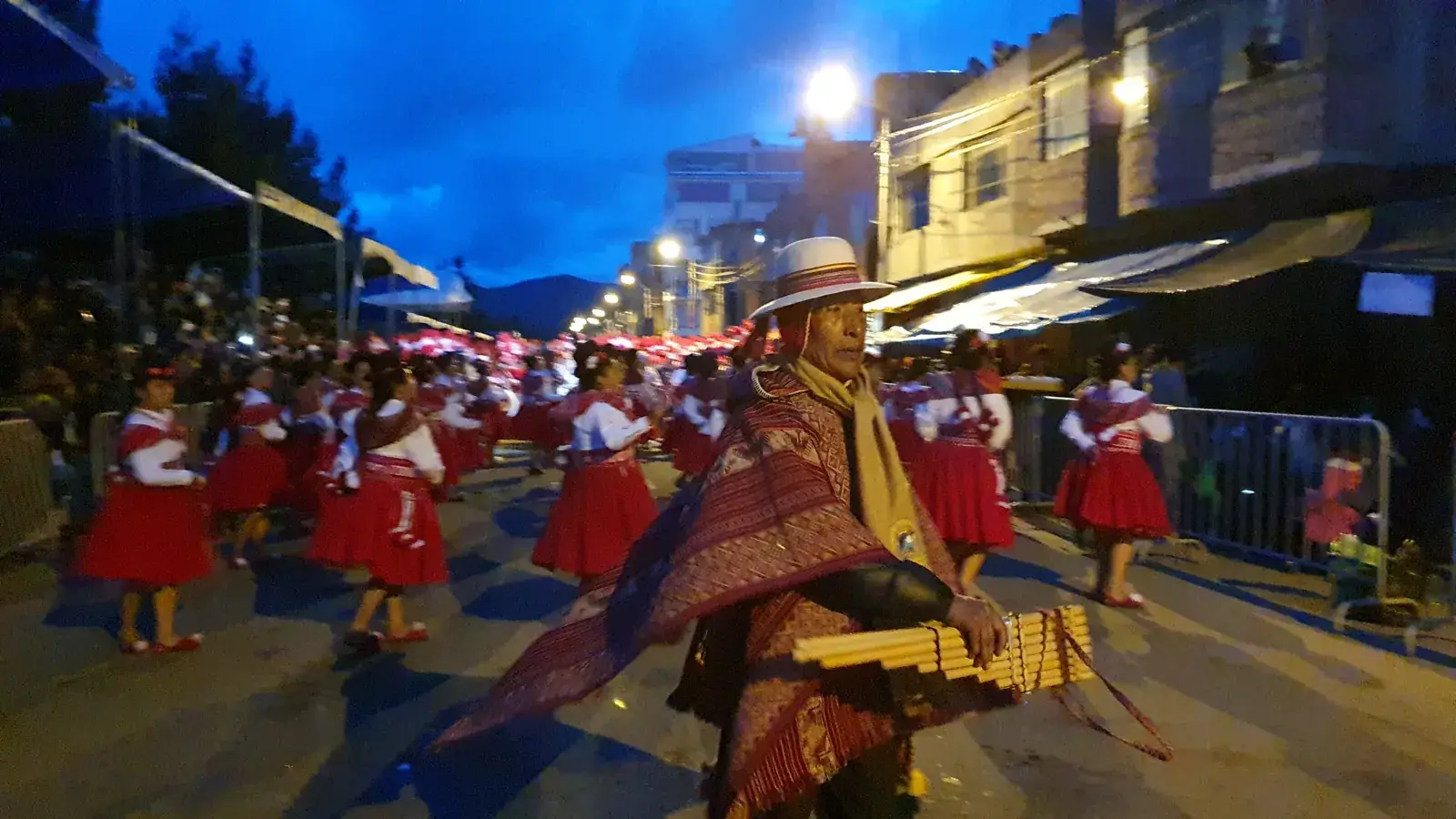
Typical instruments are the quena, an end-blown flute; the zampoña or siku, panpipes played in pairs by alternating players; the charango, a small string instrument with a body once made from an armadillo shell and now more often from wood; the harp and the violin in central Peru; and drums such as the bombo. The quena and panpipes are of pre-Hispanic origin, while the charango, like the harp and violin, shows the mixing of Andean and European traditions after the Spanish arrival.
Street bands playing the "Andean" sound for tourists are common, and the music can be repetitive, but a village band at a fiesta shows how varied it is. See Puno and Cusco for the settings.
Marinera, tondero and the coast
The marinera is the national dance. Two partners wave handkerchiefs and circle each other in a courtship display, to a rhythm in 6/8. The style from Trujillo is the most famous: the marinera norteña is more energetic and flirtatious, with dancers often barefoot and in straw hats, and is celebrated in a national contest in January in Trujillo. Lima has its own more formal version and the highlands another.
The tondero belongs to the far northern coast around Piura and shows Spanish and Indigenous influences. Dancers in the north wear straw hats, and horses sometimes accompany the performance, since the famed Peruvian paso horse is part of the culture of the area.
Marinera started as a dance called the zamacueca in the nineteenth century and was renamed in honour of the navy after a war with Chile. Performances are frequent in Trujillo, where dance schools and exhibitions are easy to find. The coastal rhythm links closely to the Hispanic past explained in the Spanish conquest.
Vals criollo and the creole tradition
Lima's vals criollo is a waltz with a Peruvian lilt: guitars, a cajón and often a singer who bends the beat. Lyrics are about neighbourhoods, nostalgia and love. The best-known name is Chabuca Granda, whose song "La flor de la canela" has become a standard of Lima. Other composers wrote about particular streets and districts, such as Barranco.
The creole tradition is tied to the working-class districts of Lima and the Callao port, where musicians gathered in courtyards (callejones). Today it is performed by trios and guitar groups at peñas criollas, restaurants with live shows and dancing, and at the Día de la Canción Criolla, a national date at the end of October. Atmosphere varies from touristy to local, so ask in your hotel for one popular with Peruvians.
Evenings in Barranco are a good starting point, since that district has a long association with the music and keeps many live venues.
Afro-Peruvian music and the cajón
Afro-Peruvian music grew out of the communities descended from enslaved Africans brought to the coast, mostly around Lima, Ica and Chincha. Its rhythms include the festejo, a fast, joyful dance; the landó, slower and swaying; and the zamacueca, a root of the marinera. Songs use call and response and often tell of daily life and resistance.
The cajón, a wooden box that the player sits on and strikes, was developed in these communities, where it replaced drums that were banned or unavailable. It was adopted into flamenco in the 1970s thanks to the guitarist Paco de Lucía, and it is now a common instrument worldwide. The singers Nicomedes Santa Cruz and Susana Baca helped bring the tradition to a wider audience; Baca later served as minister of culture.
The towns of El Carmen and Chincha, south of Lima, are known as centres of Afro-Peruvian culture and hold festivals. For the wider context of Afro-Peruvian communities, see the peoples of Peru, and look at Ica for the southern coast.
Chicha, cumbia and popular music
Chicha, also called Peruvian cumbia, appeared in the 1960s and 1970s when migrants from the highlands in Lima mixed Colombian cumbia, rock guitar and Andean melodies. Electric guitars with surf-like reverb and keyboards made the sound recognisable, and it became the music of urban migrants. Records from this period have found a new audience abroad, and the style has been revived by younger bands.
The name is shared with the maize drink described in chicha, and some historians connect it to the same working-class culture. Today the cumbia scene includes cumbia amazónica, from the jungle, and a wide variety of regional dance bands, with tropical rhythms that fill clubs and fiestas.
Radio, buses and markets across the country play a mix of huayno, cumbia, reggaeton and Latin pop. For visitors, a night out in Lima or a long bus ride is likely to include all of these in some form. Sound can be loud and late in the evening, so check noise levels when you choose a room near a venue.
Dances and costumes
Dance in Peru is closely tied to place and festival. In the southern highlands, the diablada (devil dance), the morenada and the caporales parade at festivals such as Candelaria in Puno, with elaborate masks and heavy costumes. In Cusco region, the Qhapaq Chuncho, Qhapaq Qolla and Contradanza at Paucartambo represent different characters, including colonial figures. In the Colca valley, the wititi is a courtship dance recognised by UNESCO.
Costumes are a craft in themselves: embroidery, beadwork, masks and hats are made by specialist workshops. Cloth patterns often identify the village of the dancer, which links to Peruvian textiles. Dances are not folklore for show; they are offerings to the saints and to the community, and dancers belong to brotherhoods who train for months. The dances are described in more detail in the context of festivals in Peru.
Where to hear and see it
Lima has the widest choice: creole peñas, Afro-Peruvian shows, concert halls and clubs, with Barranco and the centre as the usual areas. Cusco has folk evenings, many with panpipes and costumed dances, and village bands play at festivals in the Sacred Valley. Trujillo is the place for marinera in January. In Puno and the islands of Lake Titicaca, music appears in fiestas and community events.
Many tourist-oriented shows are short and choreographed, but they are reasonably priced and suit anyone with limited time. For something less staged, go to a local fiesta, a market day or a dance school open to visitors. Tipping performers, buying a recording directly from the musicians and asking before filming are good practice. Instruments sold as souvenirs vary in quality, so buy from a craftsperson and compare, as explained in crafts.
Frequently asked questions
What is Peru's national dance?
The marinera is widely regarded as the national dance. It is a courtship dance with handkerchiefs, performed in different styles in Lima, the north coast and the highlands. Trujillo holds a national contest each January.
What is a cajón?
A cajón is a wooden box drum on which the player sits and strikes the front face with the hands. It was developed by Afro-Peruvian communities on the coast and is now used worldwide, including in flamenco.
What does huayno sound like?
Huayno is a lively Andean song and dance form, usually in two repeated parts, with a bouncing rhythm. It is played with charango, quena, harp or violin and sung in Quechua or Spanish.
What are the panpipes called in Peru?
They are called zampoña or siku. Players often work in pairs, one playing the notes the other lacks, so the melody is built by two people.
Where can I see live folk music in Lima?
Peñas are restaurants with live criollo or Afro-Peruvian shows, and Barranco has many music venues. Ask your hotel for a venue favoured by locals and check showtimes and any cover charge in advance.
Is chicha music the same as chicha the drink?
They share a name but are different things. Chicha the music is a 1960s and 1970s mix of cumbia and Andean tunes. Chicha the drink is a fermented maize beverage.
Is the charango made from armadillo?
Traditional charangos were made with an armadillo shell as the body, but wooden bodies are now the norm. Avoid buying instruments made from protected animals, which can be illegal to take across borders.