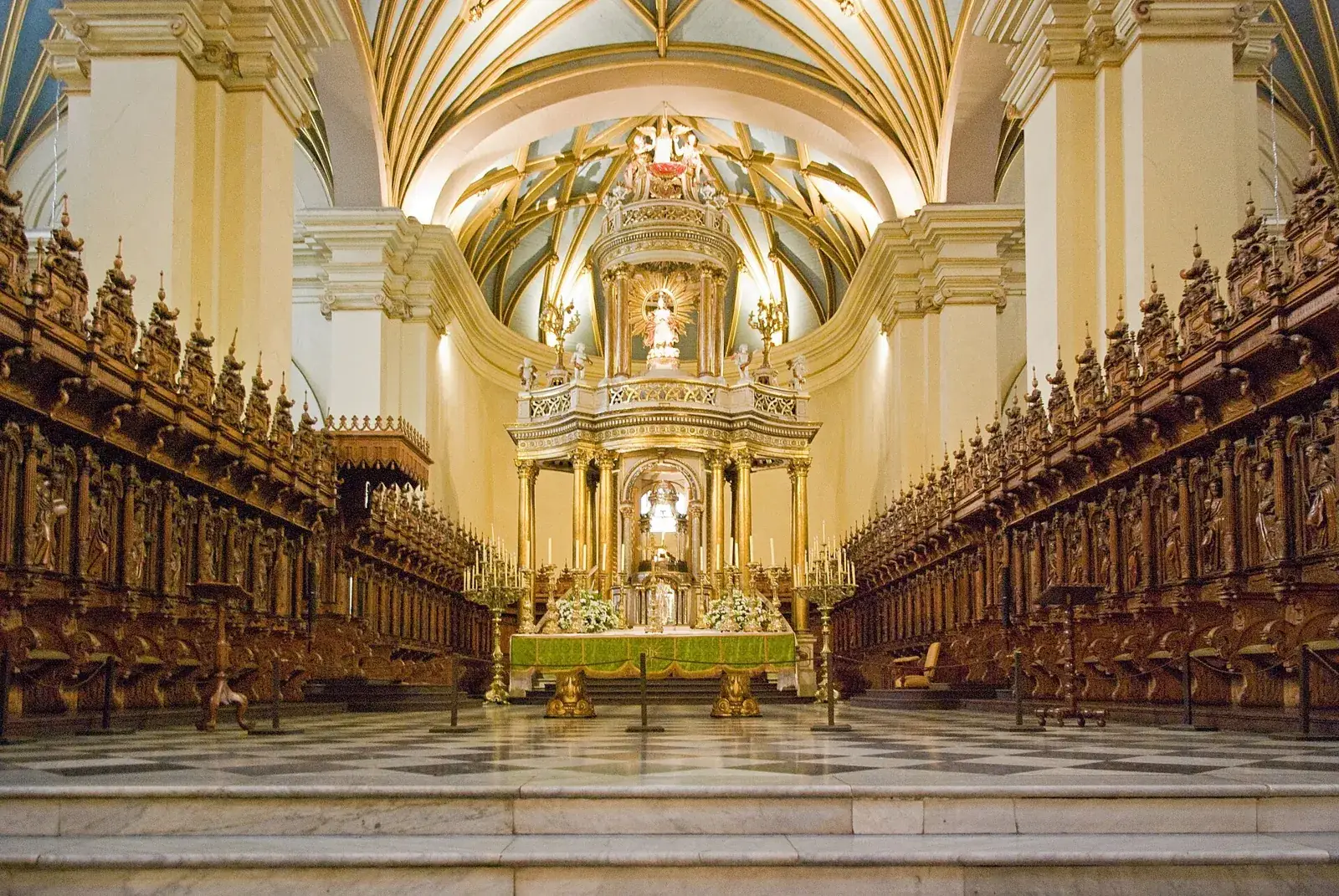
Lima Cathedral is the seat of the Archdiocese of Lima, on the eastern side of the Plaza Mayor, and is described as the oldest and largest church in Peru. Allow 45 minutes to an hour inside. The main things to see are the carved 17th-century choir stalls, the side chapels, the mosaic-covered crypt linked to Francisco Pizarro and the museum of religious art. Opening hours, ticket rules and which areas are open change, so check them locally on the day.
Map
What the cathedral is
The Cathedral Basilica of Lima is the main church of the capital and the seat of its archbishop. It stands on the eastern side of the Plaza Mayor, with the archbishop's palace beside it, and it is part of the UNESCO-listed historic centre. The historic centre page covers the whole district and how to move around it safely; this page is about the building itself.
It is dedicated to Saint John the Apostle and Evangelist, although for much of its history it was known as the church of the Kings, a reference to the name the Spanish gave the city. It was raised to the rank of minor basilica in 1921. Its importance for a traveller is double: it is a working cathedral, with services and local worshippers, and it is the most direct physical link in Lima to the Spanish conquest, because the man who founded the city is buried here.
Three cathedrals on one site
The present building is the third on the spot. Francisco Pizarro is said to have laid the first stone in 1535, the year he founded the city, on ground that earlier accounts connect with an Inca shrine and palace. The first church was small, and a second, still modest, was inaugurated in the early 1550s. By the 1560s the colonial authorities wanted something grander, and the architect Francisco Becerra, brought from Cusco, drew a plan in 1585 partly inspired by the cathedrals of Jaén and Seville.
Becerra died in 1605 with roughly half the work done. The first part of the third cathedral was inaugurated in 1604, the naves were consecrated in 1625, and the main entrance was finished in 1632 under the architect Juan Martínez de Arrona. Work on the structure and its fittings continued, in different hands, until the end of the 18th century, so the cathedral is a layered building rather than the product of a single plan. That is why a close look reveals late Gothic vaulting, Renaissance proportions, Baroque decoration and Neoclassical additions in one space. For the wider story of the style, see colonial architecture in Peru.
Tours and activities
Bookable online, chosen for their traveller reviews.
-
★ Top rated From €52 per person
-
★ Top rated From €85 per person
-
★ Top rated From €94 per person
-
★ Top rated From €55 per person
Earthquakes and rebuilding
Lima sits in one of the most active seismic zones in the world, and the cathedral has paid for it repeatedly. An earthquake in 1609 damaged the vaults of the completed section, another in 1687 caused heavy damage, and the great earthquake of 1746 nearly reduced the church to ruins. The viceroy ordered reconstruction in the late 1750s, following the old plans, and the work was directed by a Jesuit, Juan Rher.
The reconstruction is the reason the church has survived later shocks. The tall vaults are made of wood and quincha, a woven cane and mud technique that is light and flexible, and not of heavy stone, which would have been more likely to collapse. The bell towers were rebuilt between 1794 and 1797. A further earthquake in 1940 led to another restoration, and a major renovation was completed in 2004, four centuries after the first part of the present building was opened. Even so, the interior you see today reflects repeated repair, which is worth remembering when you read a guidebook that gives a single date for a chapel or altar.
The façade and the square
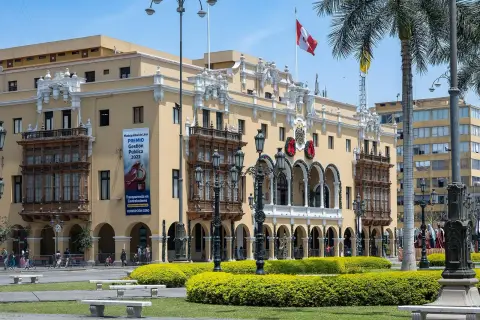
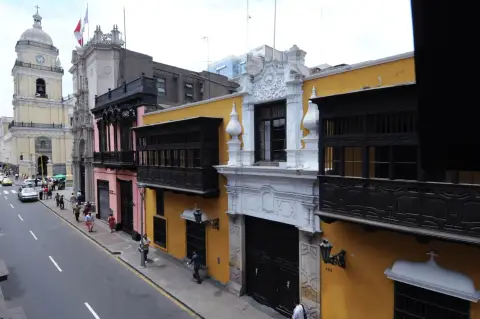
From the plaza the cathedral reads as a long Renaissance façade with Plateresque carving, three doors and two towers topped with slate spires. The central door, the Puerta del Perdón, is flanked by side doors, and statues of the apostles stand on the front. The coat of arms of Peru sits in the upper part, where an older emblem of the city once stood. Inside the towers are the cathedral's bells.
It is worth looking from a distance first. The plaza gives the best view of how the cathedral, the archbishop's palace with its carved wooden balconies and the nearby Government Palace form a single set piece. Lighting added to the exterior in the 2000s makes the evening view attractive, but the square is better visited by day, when it is busier and feels safer; see safety in Lima before planning a night walk. If you arrive around midday, the changing of the guard at the Government Palace may be taking place next door, though schedules vary.
Inside: naves, choir and chapels
The plan is rectangular and modelled on Seville Cathedral, with three main naves and further aisles where the chapels open. Along the side aisles are large paintings of the Stations of the Cross. The ceiling is the vaulted wood and stucco described above.
The highlight of the furnishings is the choir stalls, carved in the 17th century by the Catalan sculptor Pedro de Noguera from a design by Martín Alonso de Mesa. The backs are filled with figures of apostles, doctors of the Church, popes, bishops and virgin saints, and the bishop's seat carries a figure of the Redeemer. They are among the finest examples of colonial woodcarving in the country, and you can spend a quarter of an hour on them alone.
The side chapels each have a patron and a story: the chapel of the Peruvian saints, which honours Saint Rose of Lima and Saint Martin de Porres, the chapel of the Immaculate Conception with its original Baroque altar, and the chapel of Saint Turibius, which holds relics of the archbishop who ran the diocese in the late 16th century. Several carry tombs of archbishops and early city officials. Many altars were replaced by Neoclassical ones from 1804, so styles vary from chapel to chapel. For the painting tradition of the region, see the Cusco School.
Pizarro's tomb
Most visitors come for this. Just inside the entrance, in a chapel on the right, a small mosaic-covered crypt is identified as the resting place of Francisco Pizarro, who was killed in Lima in 1541. The tomb is decorated with scenes from the conquest, and inside the marble sarcophagus is a small chest said to contain earth from Trujillo, the town in Spain associated with him. For the background, read the page on the Spanish conquest.
The history of the remains is less tidy than the monument suggests. For many years a mummified body displayed in a glass case was shown to visitors as Pizarro's. In 1977, workers behind a wall in the crypt found a lead box inscribed as holding his head, and a coffin with a number of bones. Forensic study identified the bones as belonging to several people, including an adult male who was then identified as Pizarro. Not every account treats the identification as closed, so it is fair to say the remains are widely accepted as his rather than certain. Guides sometimes tell the story with more drama than the evidence allows, and it is the kind of claim worth checking if it matters to you.
Museum, sacristy and what else to see
A separate area of the cathedral works as a museum of religious art, with colonial paintings, sculpture and liturgical objects. The ante-sacristy has a set of paintings of the zodiac attributed to the workshop of the Bassano family, the sacristy has a large carved chest of drawers by Juan Martínez de Arrona, and the chapter house has portraits of the archbishops of Lima as well as items used by Pope John Paul II during his visits. The crypt of the archbishops lies beneath the presbytery.
How much of this you can enter depends on the day and on the ticket, so ask when you arrive. Photography rules also vary by area, and flash is usually discouraged, so look for signs. If you want to understand the art in context, Peru's museums gives a wider view of where to see colonial and pre-Columbian collections in the capital.
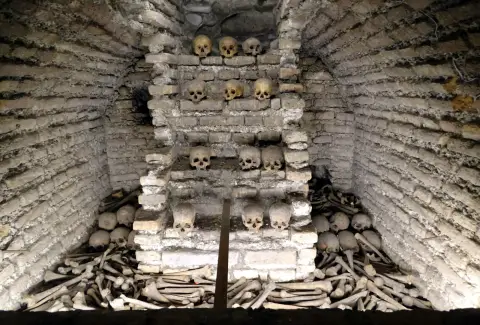
Do not confuse this church with its neighbours. The convent of San Francisco, a short walk away, has its own library and burial vaults; the San Francisco catacombs are a different visit with different ticketing, and the two combine well on a morning in the centre.
Practical advice for visiting
The cathedral is a place of worship, so dress modestly with covered shoulders and avoid hats. Visits are limited during services, and on feast days or Sundays the access arrangements can differ from a normal weekday. Opening times and entrance conditions are not fixed, so look at the cathedral's official notices or ask your hotel before you set out.
Morning is the best time: the light on the façade is good and the plaza is calmer than at midday. Keep to the usual precautions in the square, where pickpocketing and unofficial guides are the main risks; scams in Peru lists the patterns. Be polite about photographing worshippers, and follow the rules in etiquette in Peru.
For planning, a good rhythm is the plaza and cathedral first, then the convent of San Francisco, and lunch in the centre. A guided tour from Lima tours can add background on the history, but a guide is not necessary for the building itself. For other ideas in the city, see things to do in Lima, and consider a base in a quieter district, as covered in where to stay in Lima.
Where to sleep
-
Find hotels
Miraflores
Easy first base: restaurants, parks and the cliff-top walk
-
Find hotels
Barranco
Art, nightlife and a seaside feel, quieter by day
-
Find hotels
San Isidro
Calm business district with parks, close to Miraflores
-
Find hotels
Historic Centre
Colonial sights on the doorstep, busy by day and quiet at night
Frequently asked questions
Is Lima Cathedral worth visiting?
Yes, if you are interested in colonial history or religious art. The choir stalls, the chapels and the tomb linked to Pizarro justify an hour, and it sits next to the main sights of the historic centre.
How long does a visit take?
Plan 45 minutes to an hour. Allow longer if you want to study the choir stalls, walk through the museum and see the crypt without hurrying.
Is Pizarro really buried in Lima Cathedral?
A crypt in the cathedral is identified as his tomb, and remains found there in 1977 were identified as his. The history of the body over the centuries is complicated, so it is safest to say the remains are widely accepted as Pizarro's.
Do I have to pay to enter?
Visitors have normally bought a ticket for the cathedral and its museum, but prices and what is included can change. Check at the entrance or on the cathedral's official notices before you go.
What should I wear?
Dress modestly: covered shoulders and knees are respectful, and hats should be removed inside. Sandals are fine, but avoid beachwear.
Can I visit during Mass?
Services are held in the cathedral, and tourist access is usually limited while they take place. If you want to attend, go quietly and do not photograph the congregation. If you want to look around, come at another time.
Is the cathedral earthquake-proof?
Not in the modern sense, but it was rebuilt after the 1746 earthquake with light wood and quincha vaults that cope better with shaking than stone. It has been repaired several times since, most recently in a major restoration completed in 2004.