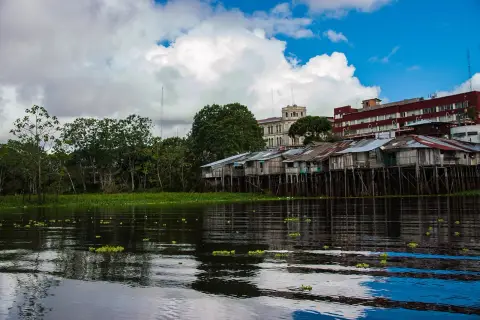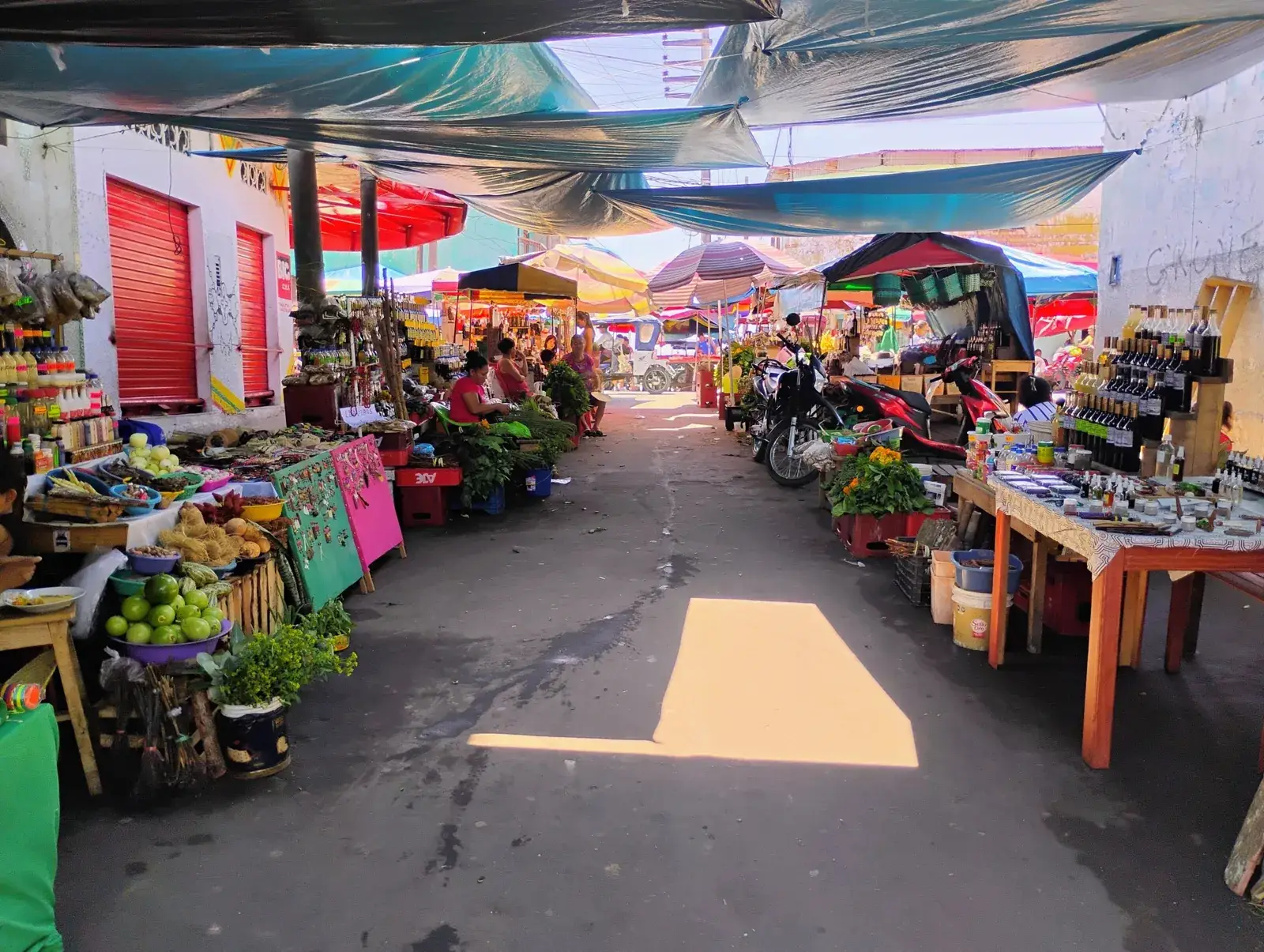
Belén is the large riverside market of Iquitos and, below it, a neighbourhood of houses on stilts and rafts beside the Itaya River. It is the most vivid place in the city for river fish, jungle fruit, cooked local food and herbal remedies. Go in the morning, in daylight, with little cash and no valuables, and preferably with a local guide, especially for the lower, floating part. Do not buy wild animals or their parts: some of the trade here is illegal.
Map
What Belén is
Belén is a district of Iquitos on the low ground beside the Itaya River, in the south-east of the city. Two things share the name. The upper part is a busy market area of lanes, covered stalls and warehouses, where food, goods and river cargo change hands every day. The lower part is a residential quarter whose wooden houses stand on stilts or float on rafts, and which is often nicknamed the "Venice of the Amazon".
It is one of the poorest parts of Iquitos, and it is also where much of the city buys its fish, fruit, plantains and everyday goods. That mix explains both the appeal and the caution: this is a working market and a place where people live, not a staged attraction. Treat it that way and the visit is far more rewarding.
Because Iquitos has no road connection to the rest of Peru, as the Lima to Iquitos page explains, much of what is sold here arrives by river, and the market is the clearest place to see how the city is supplied.
The river and the floating houses
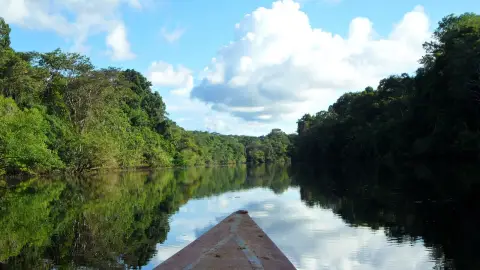
The lower quarter is built for a river that rises and falls by several metres over the year. In the high-water months, broadly from around December to May, the streets become waterways and people move by canoe, while the houses on rafts lift with the water. In the low-water months, broadly June to November, the same houses settle onto mud and parts of the quarter can be crossed on foot. Dates shift from year to year, so ask locally rather than relying on a calendar.
This changes what you see. At high water you visit by boat and see the quarter from the water, which is the classic image. At low water you walk through it and see how the structures are built, but the experience is closer to a muddy settlement than to a water-town.
Houses are homes. Ask before photographing a person or a doorway, do not point a camera into a house, and do not treat the residents as scenery. Fires have damaged parts of Belén in the past, and the quarter is crowded and made largely of timber, one more reason to move with care.
Tours and activities
Bookable online, chosen for their traveller reviews.
-
From €54 per person
What you see and eat in the market
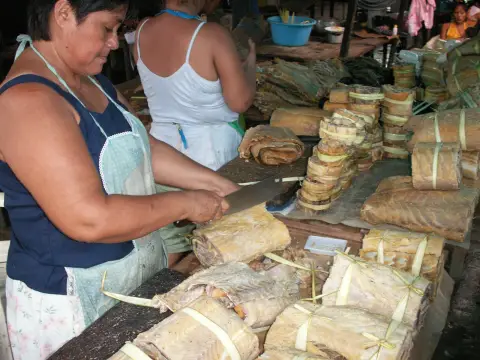
The strongest sections are the fish and fruit lanes. River fish are sold whole, filleted or dried and salted, among them the huge paiche, one of the largest freshwater fish in the world, along with piranha and other species you will not find on the coast. Fruit stalls carry camu-camu, aguaje, cocona and other Amazon fruit, and bundles of leaves such as bijao, used to wrap steamed rice dishes.
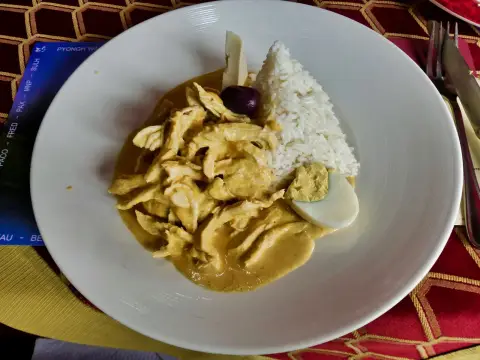
Cooked food is sold at stalls and counters. Look for juane, rice with chicken or fish steamed in a leaf, and tacacho con cecina, fried plantain with cured pork, and for fruit juices pressed to order. The wider range of dishes is covered in eating in the Amazon.
Choose busy stalls, eat food that is cooked hot in front of you, and drink only bottled or treated water, as set out in water and food safety. Market food is a classic cause of upset stomachs for visitors, so go slowly on the first day.
Tobacco is also sold in bulk as rolled cigars and bundles, and rows of herbal remedies fill one lane. These are part of ordinary local life, and sellers are used to curious visitors who ask politely.
Wildlife for sale: what is reported and what you should do
This is the uncomfortable side of Belén and it deserves a plain statement. A 2024 scientific study that monitored the market over about a year, published in Frontiers in Conservation Science, called Belén the largest open wildlife market in the Peruvian Amazon. It recorded dozens of species on sale, mainly wild meat such as lowland paca, peccary and caiman, along with river turtles, boas, parrots and some pets, and a share of decorative, spiritual or medicinal products. The authors noted that Peruvian law prohibits selling wildlife without legal origin or permits, that enforcement appeared weak, and that the trade took place openly. Journalists have also reported turtle eggs, and animal skins and teeth, offered at the market.
What this means for you is simple. Do not buy live animals, meat or eggs from protected species, skins, teeth, shells, feathers or other wildlife products, however casually they are offered. Buying feeds the trade, and taking such items across a border can be a crime. Do not photograph or pay for a photograph with a captive animal.
You are not expected to confront sellers or to act as an inspector. If you want to report something, ask a reputable local operator or the tourist office which authority to contact, and see responsible travel for the broader principles. Do not buy herbal products presented as hallucinogenic remedies from a stall either.
Going with a guide, by canoe or on foot
A local guide is strongly worth having here. A good one knows which lanes are safe at which hour, explains what you are looking at, introduces you to the stall owners and makes photography less awkward. In high-water months, guided visits to the lower quarter are usually made by canoe, and short boat trips to the floating houses are commonly offered as an add-on to city tours.
Ask what is included, how long the visit lasts and how the guide behaves around residents. Visits of roughly an hour or two are typical, but confirm that on the day. Agree the price before you set out, and choose operators who treat the neighbourhood respectfully rather than as a spectacle. The city tour options are summarised on tours from Iquitos.
If you go on your own, stay on the main market lanes and treat the lower quarter as the limit unless a local companion takes you further.
Getting there, timing and what to wear
Belén lies a short distance from the central plaza and riverfront, and a motorbike taxi or a normal taxi is the usual way to reach it, as for most journeys in the city. Agree the fare before you start. Hotels listed on the where to stay in Iquitos page can tell you the current fare and the best entrance.
Go early. Fish is unloaded and produce is freshest in the morning, and the market winds down in the afternoon, so finishing by late morning also avoids the worst of the heat. Opening times and the busiest days are not fixed, so ask your hotel or guide.
Wear closed shoes that can get muddy or wet, light long clothes, a hat and sun protection, and carry a small waterproof bag. The air is hot and humid all year, and the lanes are slippery after rain. Bring small notes and coins in soles, as larger notes are hard to change, and read money in Peru before you set out.
How long to allow and what to combine it with
One to two hours is enough for the market lanes and a snack, a little longer if you add a canoe trip to the floating houses. Treat it as a morning visit rather than a full day.
It combines well with a walk along the riverfront and the plaza, then a rest in the afternoon, when the heat is highest. Most travellers fit it into one of their nights in the city before or after a jungle trip, either to a lodge or to the Pacaya-Samiria reserve. If you are short of time, Belén is the single best way to see everyday Amazon life in town.
Anyone planning to go on to a lodge should buy nothing perishable here and should check health and vaccines well before the trip. Read the Iquitos guide for the rest of the city.
Where to sleep
-
Find hotels
Iquitos centre
Plaza and riverfront for lodges, tours and restaurants
-
Find hotels
Amazon lodges
Jungle stays with meals, guides and excursions, reached by boat
Frequently asked questions
Is Belén Market safe for tourists?
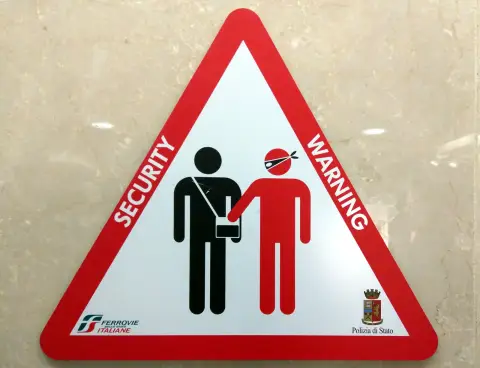
It is a crowded working market where petty theft is the main risk, and the lower floating quarter is the area where a guide helps most. Go in the morning, carry little, and avoid the deep alleys alone. See safety in Peru.
What is the best time to visit Belén?
Morning, when fish is unloaded and produce is fresh, and the heat is more bearable. The floating houses are best seen by canoe during the high-water months, roughly December to May, though dates vary.
Can I visit the floating houses of Belén?
Yes, usually by canoe in high-water months, with a local guide, and often as an add-on to a city tour. In low water the quarter can be walked, but only with local company. Always ask before photographing residents.
Is it true that wildlife is sold at Belén Market?
Yes. A 2024 study called it the largest open wildlife market in the Peruvian Amazon, with wild meat, river turtles and other species on sale, and law enforcement appeared weak. You are not required to act, but you should not buy any of it.
Is it illegal to buy bushmeat or turtle eggs there?
Peruvian law prohibits selling wildlife without legal origin or permits, and protected species are covered. Rules for local communities differ from those for visitors, so the safe rule is to buy none of it and to read responsible travel.
What should I eat at Belén?
Try juane, tacacho con cecina and fresh juices made from fruit such as camu-camu or aguaje, from busy stalls where food is cooked hot. Drink bottled water. Eating in the Amazon lists more dishes.
Do I need a guide for Belén?
It is not compulsory, but it is advisable, particularly for the lower quarter, for context and for safety. A guide also makes photography and conversation with residents easier. Compare options on tours from Iquitos.