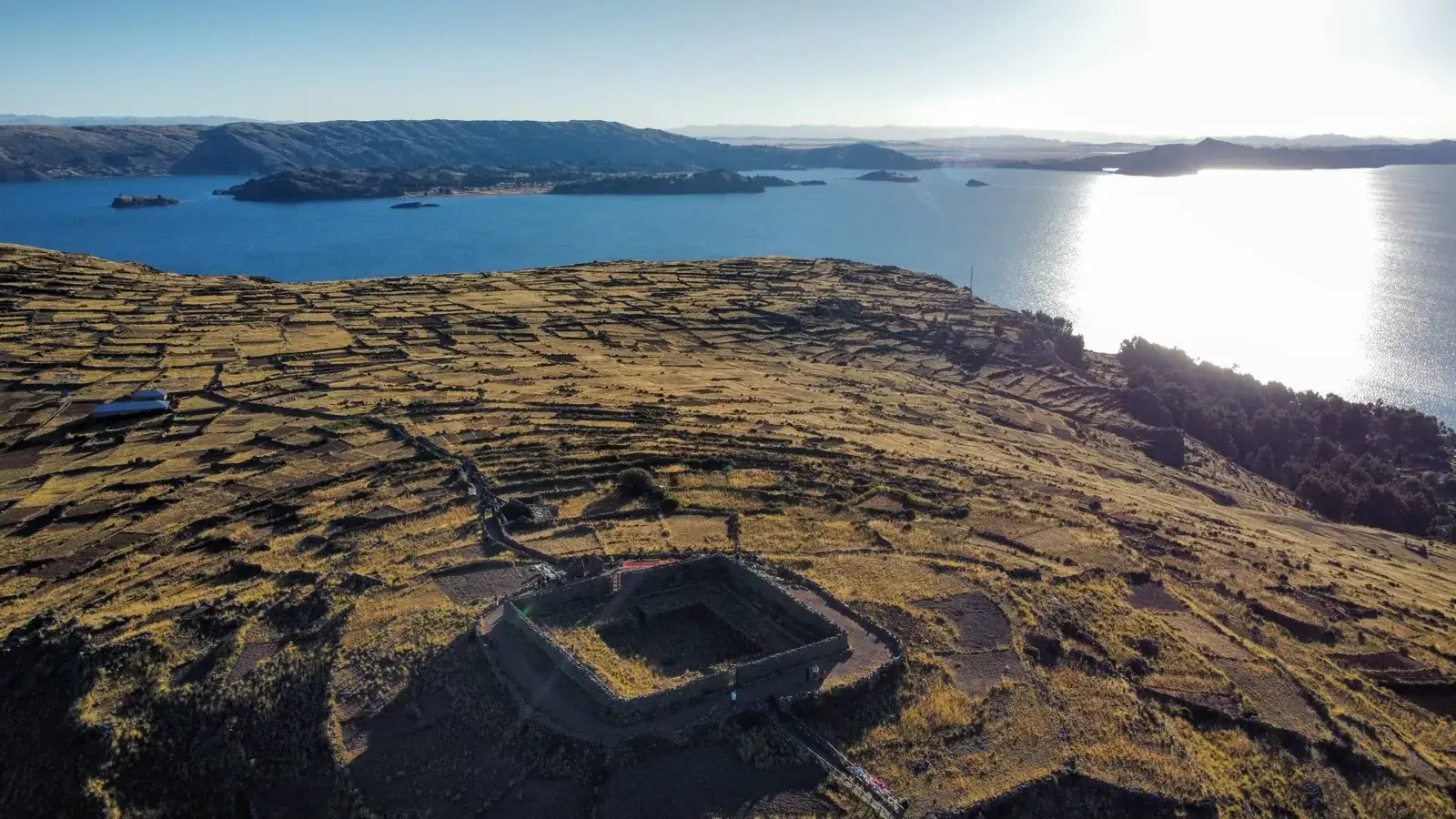
Amantaní is a farming island on the Peruvian side of Lake Titicaca, with no hotels: visitors sleep in family homes arranged through a tour. Stay one night if you can. The main sights are the two hilltop temples of Pachatata and Pachamama, a sunset climb at about 4,000 m, and an evening of food, music and dress with your host family. Book through an operator from Puno, bring warm clothes and a torch, and arrive acclimatised.
Map
What Amantaní is
Amantaní is a roughly circular island of about 9 square kilometres on the Peruvian side of Lake Titicaca, home to a few thousand people who speak Quechua and live mainly from farming. The hillsides are cut into terraces worked largely by hand, with potatoes, quinoa, wheat and other vegetables, and sheep grazing the slopes. Most houses are built of adobe, and the island has no cars.
It is often described as the quieter neighbour of Taquile. It has no hotels and no large landing-stage tourism: what visitors come for is a night in a family home, a walk on the terraces and a view over the lake from the top. Amantaní is also called the island of the kantuta, the national flower that grows on it, and the contrast between the dry brown slopes and the very blue water is what most people remember.
The two temples
The island has two peaks, Pachatata ("father earth") and Pachamama ("mother earth"), and on top of each stands a stone temple whose origin is linked to pre-Inca and Inca peoples. Visitors usually climb one of them in the late afternoon to watch the sun go down over the lake, with the stepped fields below and, on a clear evening, the snow peaks of the Cordillera Real in Bolivia far off to the south-east.
The temples are generally kept closed through the year, so the visit is about the walls, the summit and the view rather than anything inside. They open for the annual feast around 20 January, when the islanders split into two groups, one for each peak, and a runner from each hill races to meet in between. Tradition says that if the Pachamama side wins, the harvest will be good. The climb is short but steep and happens at around 4,000 m, so go slowly and carry a layer for the descent in the dark.
The homestay
Overnight stays are organised through tour operators in Puno, which place groups with families in rotation. The host family must set aside a room for guests, and the rooms are simple: a bed with plenty of blankets, thick adobe walls, and often a shared bathroom and cold water. Do not expect heating or reliable electricity, and bring a torch.
Meals are cooked by the family, usually soup, potatoes, rice, cheese or an egg dish and herbal tea, with a vegetarian choice if you ask your operator beforehand. In the evening many communities hold a small party, offering visitors local clothes to wear and a turn at the dancing. It is touristy in format, but it is also the one moment when the family and the guests share the same room. Guests traditionally bring practical presents such as cooking oil, rice or fruit, or school supplies for the children, rather than sweets. Ask your operator what is useful, and read responsible travel before you go.
Getting there from Puno
Amantaní is reached only by boat from the harbour at Puno, and the crossing takes a few hours, longer in a slow ferry than in a fast launch. Almost everyone goes on an organised trip, which usually stops first at the Uros islands and then continues to Amantaní for the night. The next morning the group often goes on to Taquile before returning to Puno in the afternoon.
You can in principle travel independently by arranging a boat at the harbour and contacting the island community, but the homestay system is run through the community and the operators, so for a first visit the organised option is easier. Check what the price includes, in particular the boat, the room, the meals and any community entrance fee, and ask how many people will share the host family. For the road side of the journey, see Cusco to Puno.
How long to stay
One night is the standard and the best choice: you arrive in the afternoon, climb for sunset, eat with the family and leave after breakfast. A day trip is possible in principle, but it skips the sunset and the evening, which are the reasons to come. A second night adds little unless you want to walk the island and see farming life at a slower pace.
Plan the rest of your Lake Titicaca time around the island. A common arrangement is the boat out on the first day with the Uros and Amantaní, then Taquile and the return on the second, and an afternoon at Sillustani after that. If you prefer to keep a base in town, compare the choices on the where to stay in Puno page and the shorter options on things to do in Puno.
Altitude, cold and what to bring
The lake sits at about 3,810 m, and the island paths and temples are higher, so Amantaní is a place for people who have already spent a day or two in Puno or Cusco. Sunburn is strong during the day, and the night is cold in every season, especially in the dry months. Read about altitude sickness first if you have just arrived from the coast.
Bring a warm hat, gloves and a fleece or down jacket, sun protection, a torch, water, snacks and a small amount of cash in soles for crafts and tips, as described in money in Peru. Keep your overnight bag small, as you carry it up from the landing by hand, and leave the rest in Puno. The packing list covers the layers you need at this height.
When to go
The dry season, roughly May to September, gives clear skies and the sharpest sunsets, but also the coldest nights, which can fall below freezing. The wetter months, from roughly November to March, are greener and warmer, with cloud and afternoon storms that can spoil the sunset climb. Weather can change within a few hours at this height.
Feast days bring colour but also crowds. The island festival around 20 January falls in the rainy season, while Puno's Candelaria celebrations in February draw many visitors to the lake and make boats and rooms harder to find. Check dry season for how the months compare, and book ahead in July and August.
Crafts and visiting respectfully
Islanders are known for their textiles and, to a lesser extent, ceramics, and women often offer hand-knitted alpaca hats and woven goods at the end of the stay. Buying directly from the maker is the clearest way of leaving money on the island, and prices are better when you take your time. See souvenirs for what to look for in alpaca.
Ask before photographing people, especially children and older women, and do not hand out sweets. Greet people in Spanish or Quechua, and accept that your hosts may speak little Spanish, so a few words from Spanish phrases help. Treat the evening as a visit to someone's home, not a performance, and be on time for meals.
Frequently asked questions
Is Amantaní worth staying overnight?
Yes, if you want more than a boat stop. The overnight stay gives you the sunset from a temple, an evening meal with a family and a quiet island at night. A day visit misses most of that.
Are there hotels on Amantaní?
No. Visitors sleep in rooms set aside in family homes, arranged through operators in Puno. Rooms are basic, with thick blankets and usually no heating.
Amantaní or Taquile for an overnight stay?
Amantaní is quieter and is better known for homestays and sunsets, while Taquile is known for its textile tradition. Most organised trips combine both, sleeping on Amantaní and visiting Taquile the next morning.
How high is Amantaní?
The lake is about 3,810 m, and the temples on the two peaks are around 4,000 m. The climb is short, but it is hard if you are not acclimatised.
Do I need cash on the island?
Yes, bring small notes and coins in soles for crafts, drinks and tips, because there are no cash machines. Confirm in advance what your tour price already includes.
What should I give my host family?
Practical food such as rice, cooking oil or fruit, or school supplies, are usual. Avoid sweets, since dental care is limited. Your operator can tell you what is appropriate.
Can I visit the temples any time?
You can climb to the summits and see the temples from outside, but they are generally closed during the year and open for the annual feast around 20 January. Go up in the late afternoon for the sunset, and carry a torch for the way down.