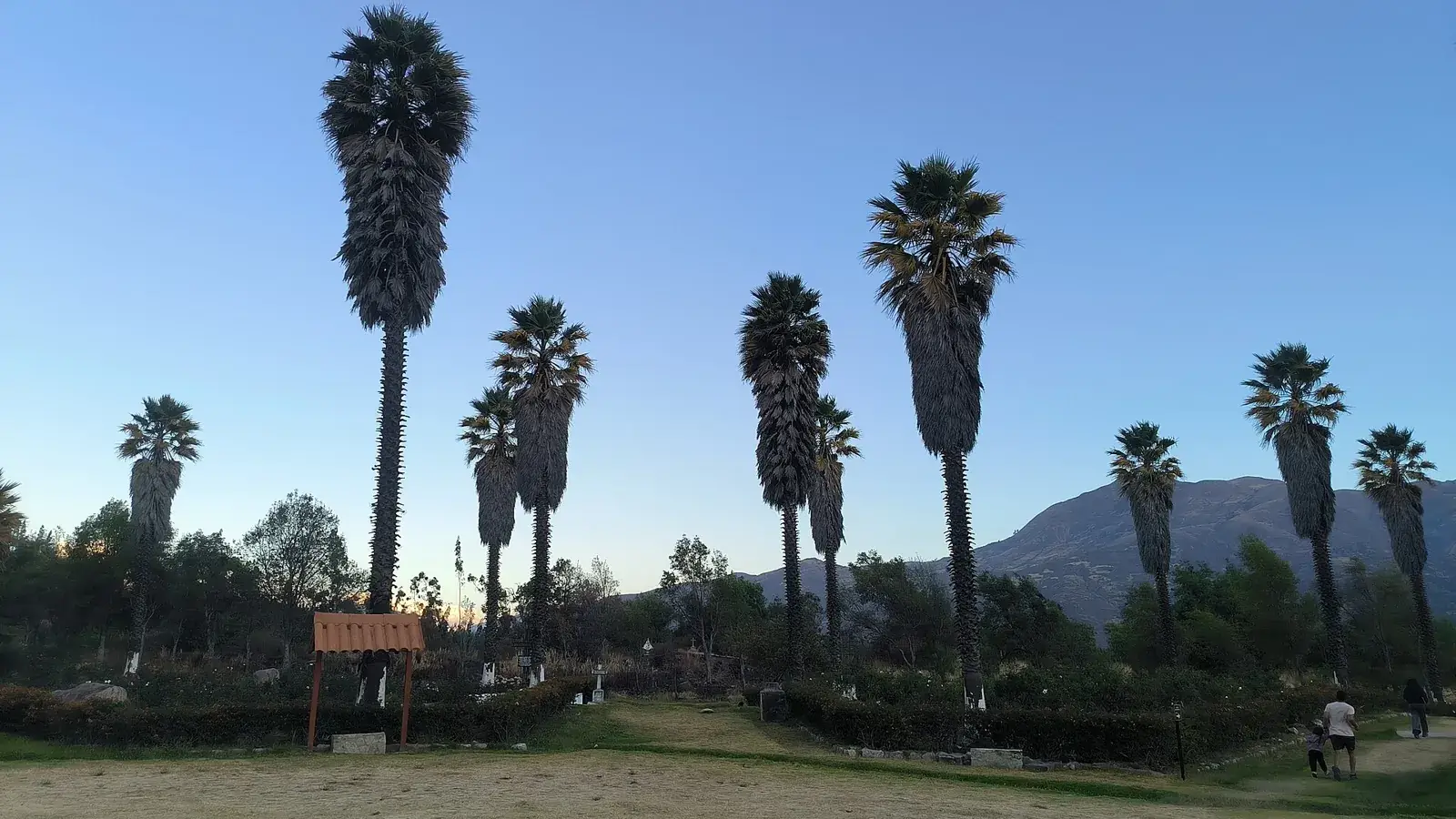
The Yungay Memorial, known locally as the Campo Santo, is the site of the old town of Yungay, buried on 31 May 1970 by an avalanche set off by an earthquake. It is a cemetery and a place of remembrance, not an attraction in the usual sense. It lies about 57 km north of Huaraz and is easy to combine with the Llanganuco lakes. Allow one to two hours, enter quietly, dress modestly and treat the grounds as a burial place.
Map
What this place is
The Campo Santo of Yungay is the buried site of the old provincial town, in the Callejón de Huaylas valley, below the northern face of Huascarán. After the disaster the Peruvian government declared the area a national cemetery and forbade excavation, so what visitors walk through is not a ruin to explore but a field above the place where thousands of people were buried. It is administered as a memorial, with paths, small garden areas and individual markers placed by families.
Treat it the way you would any cemetery. Many Peruvians come here to remember relatives, and the people who run the site and live nearby may be survivors or have lost close family. Go for what the place is, keep your voice low and ask before photographing anyone. It is a very different kind of stop from the lakes and viewpoints elsewhere in the Cordillera Blanca, and many visitors find it the most affecting part of a trip to the region.
What happened on 31 May 1970
On the afternoon of 31 May 1970 a magnitude 7.9 earthquake struck off the coast near Chimbote and Casma, and was felt strongly across the Ancash region. The shaking brought down a large mass of rock, ice and snow from the north face of Huascarán. Sources give different volumes, but all describe tens of millions of cubic metres. The mass travelled roughly 15 km down the mountain and the valley in a matter of minutes, picking up water and mud on the way.
The avalanche buried Yungay, much of the nearby village of Ranrahirca and several smaller settlements. Commonly cited figures put the dead in Yungay at around 20,000 people, within an earthquake that killed an estimated 70,000 across the region. Those who lived were mostly people who happened to be on the highest ground in town, at the cemetery hill and the stadium. Figures vary between sources, so treat any single number as an estimate. The earthquake is still the deadliest in Peru's recorded history, and in 2000 the country made 31 May a day of education and reflection on natural disasters.
Tours and activities
Bookable online, chosen for their traveller reviews.
-
Day trip From €29 per person
Cordillera Blanca
Laguna 69 Hike from Huaraz via Llanganuco Valley
What you see on site
The grounds are open and green, with gravel paths between rose beds, crosses, small chapels and plaques left by relatives. A group of tall palm trees is one of the first things visitors notice and is associated with the old town's main square; the exact count and age depend on the source, so do not rely on a figure. A large statue of Christ with open arms stands on a rise at the edge of the site, looking over the plain where Yungay was.
A path leads up to the cemetery hill, the highest ground of the old town and the place where survivors reached safety. From here you can see how the avalanche came down from Huascarán and how close the mountain is, with its twin summit often clear in the early morning. Look for information signs, which describe the event in Spanish and sometimes in English. Wear sturdy shoes, since the paths are uneven, and bring a hat for the sun.
Getting there from Huaraz
Yungay is about 57 km north of Huaraz on the main road through the Callejón de Huaylas, and the memorial lies a short distance (reported as about 1.5 to 2 km) from the rebuilt town of Yungay. From Huaraz, shared minibuses (combis) run north along the valley through the day, and taxis or private drivers can be hired. Allow roughly an hour or a little more each way, depending on stops and traffic.
The simplest option is a tour. Many full-day trips to the Llanganuco lakes and the start of the Laguna 69 trail pass through Yungay, and some include a stop at the Campo Santo. If you go on your own, ask the driver to wait or arrange a return time, since onward transport from the site can be sporadic late in the afternoon. The things to do in Huaraz page shows how this fits with other outings, and Huascarán National Park explains the entrance fee that applies for the lakes beyond.
Best time and how long to stay
Plan on one to two hours at the memorial, longer if you read the displays and walk up to the cemetery hill. The site generally opens in the morning and closes in the afternoon, with a small entrance charge, but hours and fees change, so check locally. A morning visit gives better light on Huascarán, which is often clearer before midday, and the dry season from about May to September gives the most reliable views of the mountain.
The anniversary of the disaster, 31 May, falls right in the start of the dry season. Local ceremonies and offerings take place around that date, and the memorial can be crowded with families. Visit on another day if you want a quieter experience. Mornings are also easier at this altitude, since Yungay sits at about 2,500 m, lower than Huaraz, and most people find it comfortable. See altitude sickness if you have just arrived from the coast.
Visiting with respect
Keep to the paths and do not step on or move markers, flowers or offerings. Do not climb on crosses or monuments, and avoid loud music or drones, which would be out of place and may be restricted. Photography of the landscape and the memorial is usually welcome, but do not photograph mourners, or take selfies that treat the site as a backdrop.
General guidance on behaviour is in Peru etiquette. Children can visit, but prepare them in advance, since the subject is serious and the site is a burial ground. If a local guide tells their own family's story, listen without asking for details they have not offered. Buying a drink or a craft item from local sellers is an easy way to support the community.
Combining it with the Cordillera Blanca
The memorial works well as the first or last stop of a day in the north of the range. Going in, it sets the scene: seeing the mountain from the buried town makes the Llanganuco valley more than a pretty drive, and gives context to the stories drivers and guides tell. Coming back, it is a calm place after a long, strenuous day on the trail.
A typical plan is the lakes in the morning and Yungay in the afternoon, or the reverse, with lunch in the modern town. If you are acclimatising, the memorial is a gentle, low-altitude excursion that works as a rest-day outing, as explained in acclimatising for treks. It also suits visitors who are not trekking, such as families and older travellers. For multi-day plans, Santa Cruz and other routes start in the same corridor, and where to stay in Huaraz helps you choose a base. General precautions are in safety in Peru.
Frequently asked questions
Is the Yungay Memorial worth visiting?
Yes, if you are in the Cordillera Blanca and are comfortable visiting a cemetery. It explains the human side of the region's mountains and the 1970 disaster, and it is easy to add to a trip to the Llanganuco lakes. It is not a place for entertainment.
How far is Yungay from Huaraz?
About 57 km by road along the Callejón de Huaylas, roughly an hour or a little more each way. Combis and taxis run from Huaraz, and many lake tours pass through the town.
How long should I spend at the Campo Santo?
One to two hours is enough for the paths, the Christ statue and the cemetery hill. Add time if you want to read every sign or sit quietly. It rarely needs more than half a day, even with lunch in town.
How many people died in Yungay in 1970?
Commonly cited figures are around 20,000 in Yungay, with an earthquake toll of an estimated 70,000 across Ancash. Estimates differ between sources, and only a few hundred people in Yungay survived, mostly on the highest ground.
Can I take photos at the memorial?
Photographs of the grounds and landscape are generally accepted. Do not photograph mourners or ceremonies without permission, and avoid drones. Treat the site as you would any cemetery.
Is there an entrance fee?
A small fee is usually charged, but the amount and hours can change, so confirm locally. Park fees for Huascarán National Park are separate and apply to the lakes, not the memorial.
Can I visit without a tour?
Yes. Combis from Huaraz go to Yungay and the memorial is a short distance from the modern town, so you can go independently. Check the last return time, since late-afternoon transport is limited.