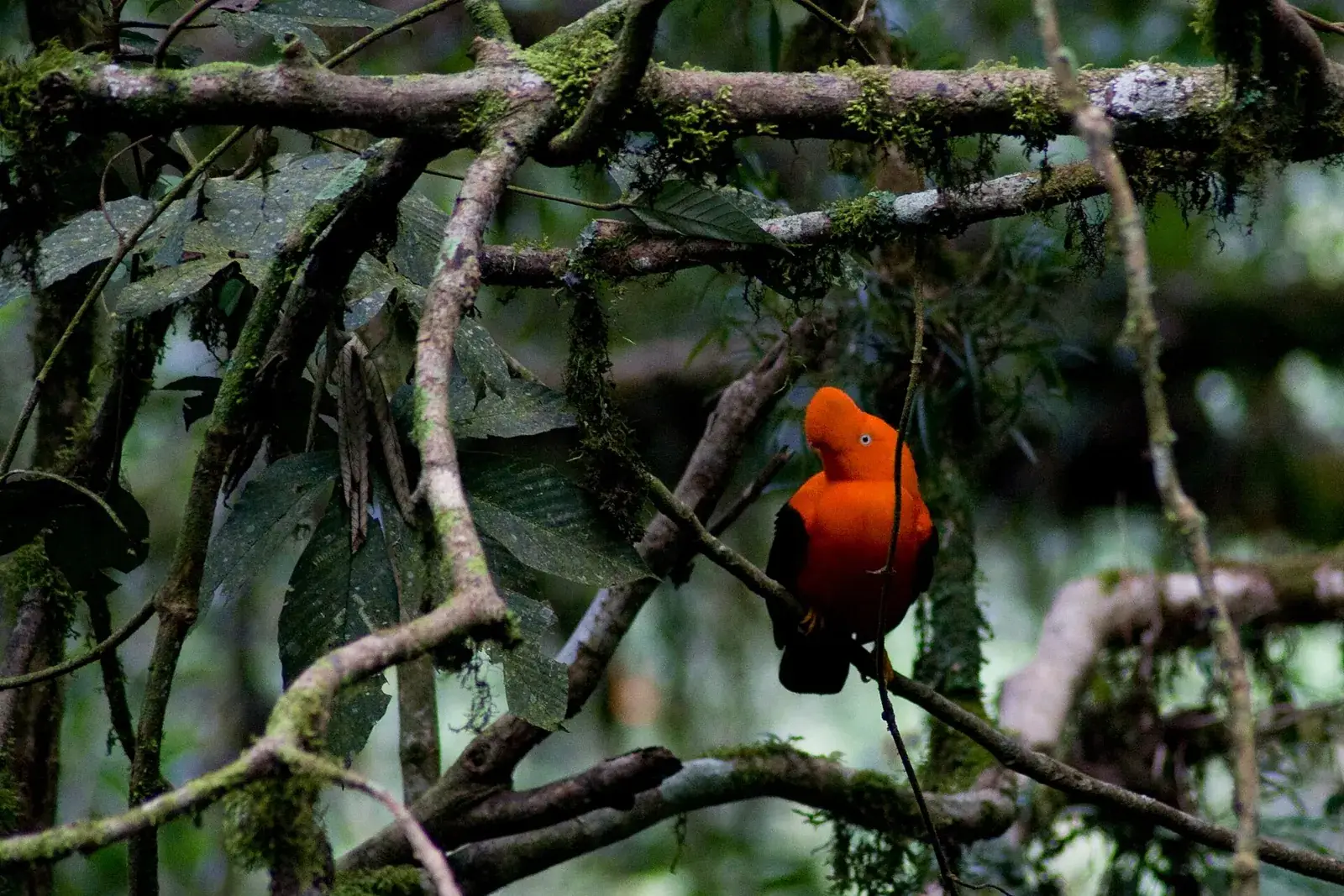
A lek is a traditional display ground where male birds gather to compete for females, and the Andean cock-of-the-rock is one of the most striking species to do it. In the Manu cloud forest, on the road that descends from Cusco towards Pilcopata, several leks are visited from a simple hide at first light. Plan on an early start, a short walk, and about an hour of watching. It suits almost anyone who can tolerate a damp forest path, but the birds are wild, so a good show is likely rather than guaranteed.
Map
What a lek is, and who the bird is
The Andean cock-of-the-rock (*Rupicola peruvianus*) is Peru's national bird, and the male is easy to recognise: a bright scarlet or orange body, black wings and tail, and a rounded, disc-like crest that hides most of the bill. Females are a plain brown and much smaller in the crest. It is a medium-sized bird, roughly 32 cm long, which surprises people who expect something larger from the photographs.
A lek is a communal display site. Males return to the same patch of forest, often a few trees around a stream or a steep bank, and perform for visiting females. Rival males face each other, bow, jump, flap their wings and call, and the intensity depends partly on the light. The females watch from the shade and choose a mate; the males play no part in nesting. The female alone builds a nest of mud and saliva on a rock face or cave entrance, which is where the name comes from.
This page deals with the display itself. For the park as a whole, its zones and why access is controlled, see Manu National Park.
Where the leks are
The species lives in cloud-forest ravines and along forested streams, mostly between about 500 and 2,400 m. In the Manu area the best-known leks are on the Kosñipata side of the Andean slope, along the road that drops from the Paucartambo highlands towards Pilcopata and the Alto Madre de Dios river. This is the same descent described in Cusco to Manu.
Several lodges and viewing sites along the road keep a hide near a known lek, usually a short and well-trodden walk from the road or from the lodge. Which sites are active, how many males gather and who may use the hide changes from year to year, because leks can shift when trees fall or a landslide alters the slope. Treat any site named in a brochure as a starting point and ask your operator or lodge which lek is currently in use.
Leks are also known in other cloud-forest areas of Peru, but this is the one that most travellers meet, because it sits directly on the overland route into Manu.
What you see and hear
Visitors sit quietly on benches or on the ground in a hide, facing a clearing of branches a short distance away. The first sign is often sound rather than colour: a harsh, rising squawk repeated by several males, followed by a deeper grunting call. Then the birds appear, orange against the dark green, and begin their displays.
A typical sequence is a male perched upright with the crest fully fanned, then a hop, a bow and a burst of wing beats, sometimes with two or three males doing it at once. Most displays take place on low perches within a few metres of the ground, which makes the birds easier to see than many forest species. A good morning may show a handful of males and a brown female watching from higher up.
Binoculars help, but they are not essential. For photography, the main difficulty is light. The forest is dim at dawn, so fast lenses, a high ISO and patience matter more than a long zoom. Keep movement and noise to a minimum, and do not use flash, which can disturb the birds.
Best time of day and year
Display activity is at its best at dawn and in the early morning, and many guides also mention a quieter spell towards dusk. Plan to be in the hide before first light, which in practice means breakfast by torchlight and a short walk in the dark. By mid-morning the birds often disperse to feed on fruit, and the lek is quiet.
The season is less clear-cut. Sources give different breeding periods for different regions, and for southern Peru they do not agree, so no single month should be treated as the right one. Males display in much of the year in places where they are used to being watched, and the dry months, roughly May to October, are the easiest time to travel on the road itself. In the wetter months, roughly November to March or April, rain at dawn can reduce the show and the road may be affected by landslides.
Whatever the month, a single visit is a chance, not a promise. Spending two mornings in the area improves the odds noticeably.
Getting there from Cusco
From Cusco the drive to the lek area is part of a longer journey. The road passes through Paucartambo, crosses a high pass and then descends through cloud forest, a trip that takes most of a day on narrow, partly unpaved road. Leks are usually visited on the first morning after the descent, from a lodge in the cloud forest, or as a short stop on the way down.
You can reach the area independently by hiring transport or using local services to the Pilcopata end of the road, and staying at a lodge. Entering the reserved zone of the park, further down the river, is a separate matter that needs an authorised operator, as explained on the Manu page. For a stand-alone lek visit, a two- or three-day trip focused on the cloud forest is a realistic format, and some operators offer exactly that.
Journey times, road conditions and the availability of buses or shared taxis change often, and the road can close after heavy rain. Confirm the current situation with the lodge or operator before you set out.
Effort, altitude and weather
The walk to the hide is usually short, often 10 to 20 minutes on a forest path that can be steep, muddy and uneven. The lek itself sits in cloud forest at roughly 1,200 to 1,600 m, so it is lower than Cusco and the altitude is not a concern there, although the pass you cross on the way down is far higher. If you have just arrived from the highlands, see altitude sickness before the journey.
The forest is damp. Even in the dry season, early mornings can be cool, misty or drizzly, and the path stays wet. Wear waterproof boots with a good grip, a light waterproof jacket and quick-drying layers, and carry a head torch for the dark approach. Insect repellent is sensible. The packing list covers the basics.
Lowland disease risks begin further down the slope, and the cloud-forest road is itself remote. Speak to a doctor or travel clinic early; health and vaccines is a starting point.
Who it suits and how to behave
The lek is one of the easiest wildlife experiences in Manu to enjoy. It needs no boat, no long hike and little experience, which makes it a good choice for first-time birdwatchers, families with older children and anyone who finds a full expedition too demanding. Serious birders will want a guide who knows the current lek and can also find other cloud-forest species, since the area is rich in tanagers, hummingbirds and other birds.
The usual rules apply. Stay on the path, keep voices low, and do not play recorded calls to draw the birds closer, which stresses them during the display. Follow the hide's rules about arrival time and group size, which exist to keep the lek in use. Responsible travel covers wildlife etiquette more generally.
If you have more time, the lek combines well with the wider Manu journey: it can be the first stop on the way down, before the lowland sections described in Manu National Park.
Combining it with other plans
Because the display is over by mid-morning, the rest of the day is free for other things. In the cloud forest this usually means walking the road or forest trails, watching birds from the lodge terrace, or continuing the descent towards Pilcopata and the river. A longer Manu trip then continues by boat to the lowland forest.
If the lowland rainforest is the goal rather than this one bird, Tambopata is an easier base, reached from Puerto Maldonado, and does not include a cloud-forest lek. Where to go in the Amazon compares the options, and is the Amazon worth the time is useful before committing days to a long route. For a full outline of a jungle trip, see the Amazon itinerary.
Frequently asked questions
What is a lek?
A lek is a display ground where males of a species gather to compete for females. The Andean cock-of-the-rock uses the same patch of forest year after year, which is why guides can take visitors to a known spot.
What time should I be at the lek?
Before first light. The birds are most active at dawn and in the early morning, and activity drops by mid-morning. Operators and lodges set the exact departure time, so ask the evening before.
Am I sure to see the birds?
No. They are wild birds, and weather, season and disturbance all affect the display. Many visitors see several males, but a second morning improves the chance. Distrust anyone who promises a guaranteed sighting.
Do I need to book a Manu tour to see them?
Not necessarily. The cloud-forest leks are on the road outside the reserved zone, so lodges and operators can arrange a short visit. Entering the reserved zone further down the river does need an authorised operator; see Manu National Park.
How long does the display last?
A visit to the hide usually lasts about an hour, sometimes a little more. The walk to and from the hide is extra, so allow a whole morning.
Can I photograph the cock-of-the-rock?
Yes, but the forest is dim at dawn, so use a fast lens or a high ISO setting. Avoid flash, keep still, and follow the guide's instructions about where to sit.
What should I wear and bring?
Waterproof boots, quick-drying layers, a light rain jacket, a head torch, insect repellent and binoculars if you have them. The packing list has the longer version.