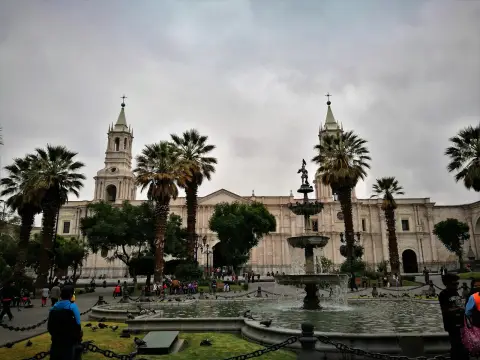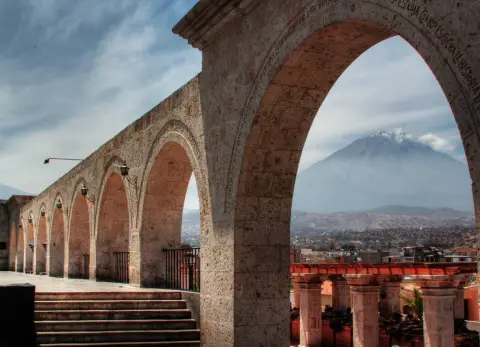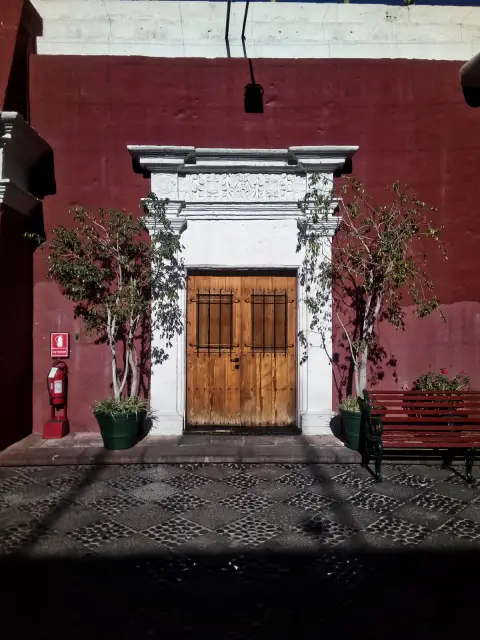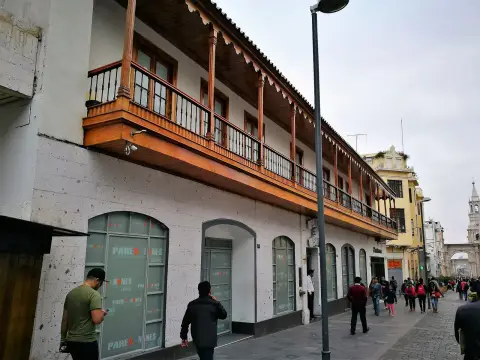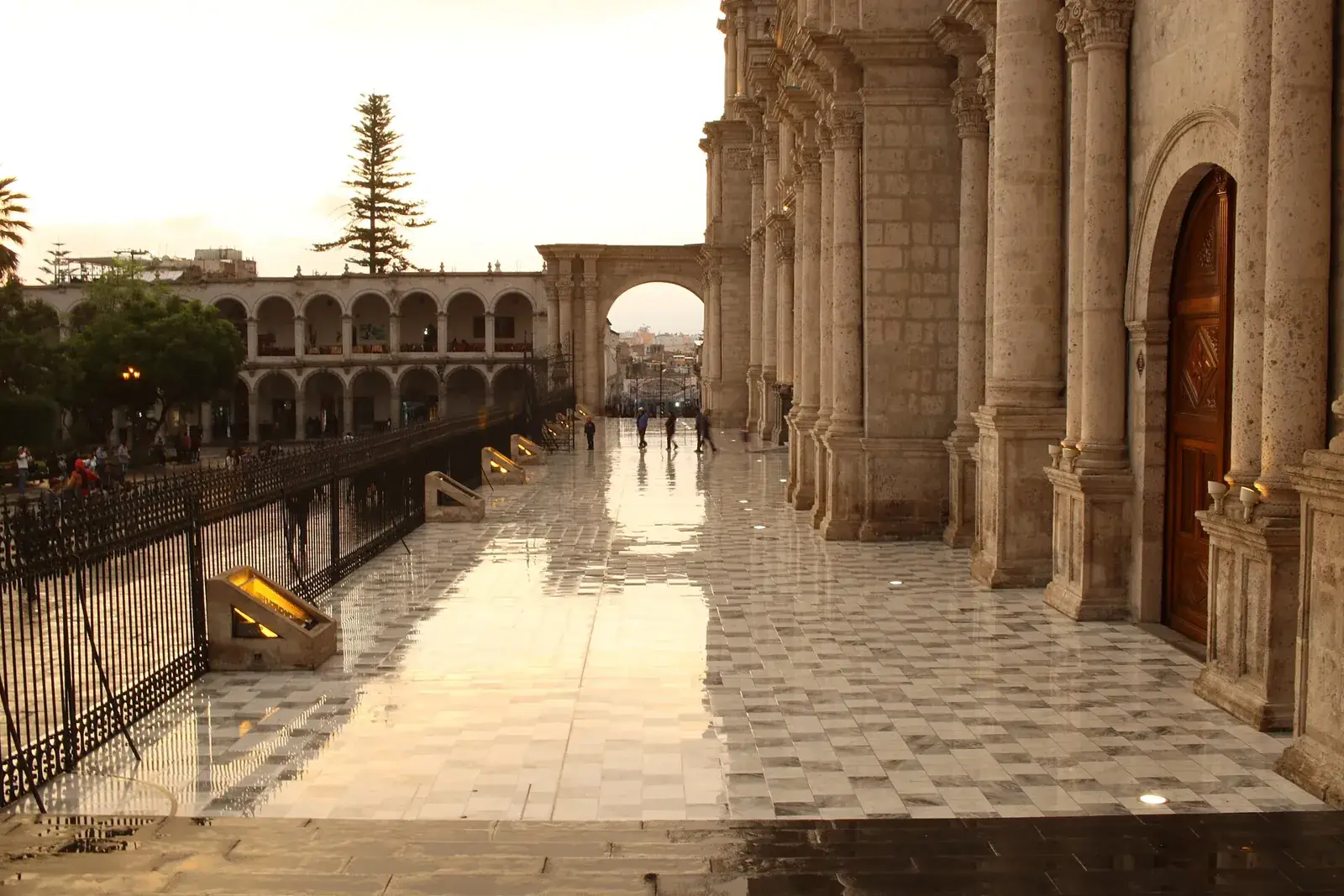
The Basilica Cathedral of Arequipa is the church that fills the whole northeastern side of the Plaza de Armas. It is built mainly of pale volcanic stone and has been damaged and rebuilt several times since the city's founding in 1540. Outside, the long colonnaded frontage is the main sight; inside, the organ, the carved pulpit and the marble altar reward a visit of 20 to 40 minutes.
Opening hours, ticket rules and any access to the towers or roof change, so check on the day. It is a working church, so dress modestly and avoid services if you only want to look.
Map
What the cathedral is
The Basilica Cathedral of Arequipa is the seat of the city's archdiocese and one of the most recognisable buildings in southern Peru. It stands on the northeastern side of the Plaza de Armas, and unlike most colonial cathedrals, which face a square with a single front, it stretches along the entire length of the plaza. The result is a long, low-rising wall of pale stone with a colonnade at street level and two slender towers at the ends.
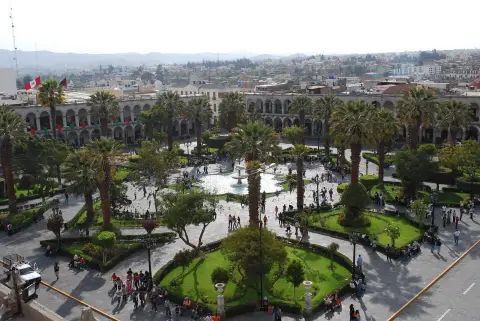
This page is about the building itself. For the square, its arcades, the balconies and the view of El Misti, read the Plaza de Armas page; for the wider city, start with Arequipa.
The cathedral is a working church, not a museum. Masses, baptisms and processions set the rhythm of the day, and the people sitting in the pews outnumber the sightseers at most hours. That affects how you visit more than anything else in this guide.
Fires, eruptions and earthquakes
Work began in 1540, the year the Spanish founded the city, and the history since then is mostly a story of rebuilding. According to the usual account, an earthquake in 1583 destroyed the first progress, and around 1600 the eruption of the Huaynaputina volcano and further tremors damaged a nearly finished structure. The church was reported complete in 1656, only to be shaken again in the following years.
The most dramatic episode came in 1844, when a fire destroyed vaults, pillars, paintings and sculptures. The rebuilding was directed by the bishop of the time, with an engineer in charge of the technical work. Then, in 1868, an earthquake brought down the towers, part of the portal and several altars. The towers were rebuilt taller and slimmer, which is why they look so thin today, and the atrium was widened by removing market kiosks that had grown up in front.
The southern Peru earthquake of 2001 partly collapsed the left tower and left the right one unstable, and repairs followed. What you see is therefore a layered building, not a single colonial design, and the dates in guidebooks vary a little between sources.
Tours and activities
Bookable online, chosen for their traveller reviews.
-
Day trip From €38 per person
-
Day trip From €16 per person
-
Day trip From €58 per person
-
From €9 per person
Stone, columns and the frontage
The walls are built mainly of sillar, the pale volcanic stone that gives Arequipa its White City nickname, while the roof vaults are of brick, a combination that suits a region of frequent tremors. The frontage is described as having seventy Corinthian columns, three portals and two large side arches. The style is mixed: the Renaissance and neoclassical vocabulary of the columns and pediments sits next to Gothic touches, which reflects the repairs of different centuries.
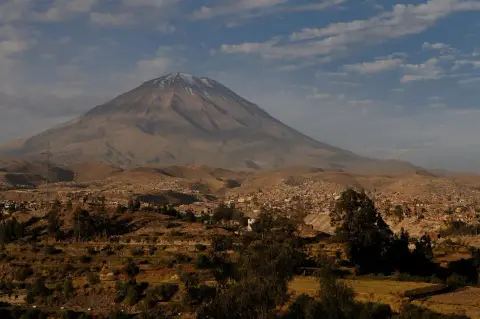
Spend a few minutes outside before going in. Walk the length of the colonnade, then cross the plaza and look back from the middle, where the proportions make sense: the towers frame the building, and on clear days the volcano sits behind the roofline. The light is softest in the late afternoon, when the stone turns cream and the shadows of the columns lengthen.
Inside, the plan is a Latin cross with three naves. The space is more sober than the richly painted churches of Cusco, partly because so much of the original decoration was lost in the fire of 1844.
What to look for inside
The interior is known for a few imported pieces. The best known is the organ, built in Belgium and often described as one of the largest in South America. A pulpit carved in oak and made in Lille, France, shows Christ defeating the serpent and is usually the first thing guides point out. The main altar is of Carrara marble, and a chandelier is said to come from Seville. Wooden figures of the twelve apostles, also from Belgium, line the nave.
A side chapel dedicated to the Lord of Great Power (Señor de la Gran Potencia) draws local worshippers and often has candles and flowers; keep your voice low there and do not photograph people praying.
Treat the exact inventory with some caution. Accounts of the furnishings differ in details such as makers' names, and the altars and objects on display can change with restoration. If a particular piece matters to you, ask staff or your guide on the day. A short visit usually covers the nave, the pulpit, the organ and the altar; a slow one adds the chapels and the details of the carved stalls.
Visiting: times, tickets and manners
Opening arrangements change between seasons, services and years, and the entrance rule has varied between free entry to the nave and a ticketed visit that includes other parts. Ask at the door, or check with your hotel, before planning around it. Some visits have included access to areas beyond the nave, but do not count on that without confirmation.
Dress as you would for any church: covered shoulders and knees are the safe choice, and hats come off inside. Photography is usually allowed in the nave without flash, but not during services, and tripods are a different matter. Silence matters more than the rules suggest; see etiquette in Peru for general guidance on behaviour in churches and at religious events.
If you only want to see the outside, you do not need a ticket: the colonnade and the plaza are open at all hours. If you want the inside to yourself, aim for mid-morning on a weekday, avoiding Sunday mornings and the days around the main religious holidays listed in festivals and holidays.
How long, and what to combine it with
Allow 20 to 40 minutes for the interior, a little more if you stay for the organ details or a quiet sit. The cathedral fits easily into a walk around the centre, starting at the plaza and moving outward.
The nearest pairing is the Jesuit church of La Compañía, a few steps from the square, which is smaller and richer in carved stone. After that, the usual next stop is the Santa Catalina Monastery, a short walk away, which needs two to three hours on its own. For a viewpoint and a different angle on the city, Yanahuara is a short ride across the river, and the Juanita Mummy Museum adds a pre-colonial counterpoint to the Spanish history.
For a whole-city plan, see things to do in Arequipa. If you are choosing between Arequipa and other bases, is Arequipa worth it compares them.
Getting there and moving around
If you are staying in the historic centre, the cathedral is a short walk. The places to stay near the Plaza de Armas make it the first thing you see on arrival, and the square is the simplest orientation point in the city. From other districts, a taxi to the plaza is the usual choice; agree the fare before you get in or use a taxi app.
Arequipa sits at about 2,330 m. That is high enough to notice on stairs after arriving from the coast, but far gentler than Cusco; if you are coming from Lima, a slow first afternoon is enough. See altitude sickness for the general advice.
The sun is strong, the air is dry, and the stone reflects light, so bring sun protection even for a short stroll. At night the plaza is lit and busy, but the usual city precautions apply: read safety in Peru for the basics on pickpockets and taxis.
Access and accessibility
The plaza is flat and paved, and the cathedral's main doors open from the colonnade, so the approach is easy for most visitors. Inside, the floor is generally level along the nave, but steps, thresholds and chapels may limit access in places, and the stone floors can be slippery when wet from shoes after rain.
Visitors with limited mobility should ask staff at the door which parts are reachable, and avoid peak service times when aisles are crowded. For a broader look at what to expect, see accessible travel in Peru.
Families do well here for a short stop, as children tend to enjoy the size of the organ and the carvings, but the quiet rules apply and a service in progress is not a time for exploring. A good plan is to see the interior first, then let the plaza do the work of releasing everyone's energy.
Where to sleep
-
Find hotels
Plaza de Armas and historic centre
Colonial core within walking distance of the main sights
-
Find hotels
San Lázaro
Old narrow lanes close to the main square, with character and lower prices
-
Find hotels
Yanahuara
Residential quarter with views of the volcano and good restaurants
-
Find hotels
All of Arequipa
Compare every area and price level in one search
Frequently asked questions
Is Arequipa Cathedral free to enter?
Arrangements have varied, and the rule on the day is what counts. Standing outside under the colonnade costs nothing, but the interior has at times been ticketed or limited to certain hours. Ask at the door or at your hotel.
How long does a visit take?
Most people spend 20 to 40 minutes inside. Add time if you want to sit through part of a service or look closely at the organ and pulpit.
Why is the cathedral so long?
It occupies the whole northeastern side of the Plaza de Armas, so it presents a long frontage instead of a single facade. That layout, plus the repeated rebuilding after earthquakes, gives it its unusual shape. The Plaza de Armas page covers the square around it.
Can I take photographs inside?
Usually yes in the nave without flash, but not during services, and rules on tripods and video differ. Do not photograph people praying, and follow the signs.
What should I wear?
Covered shoulders and knees are the safe choice, as in any church. Take off hats inside. In the sun you may want a layer to put on and off between the plaza and the cooler interior.
Is it worth going inside if I have limited time?
If you have under an hour in the centre, the exterior and the plaza matter more. If you have half a day, add the cathedral interior and then the Santa Catalina Monastery, which is the bigger sight.
Has the cathedral been damaged recently?
The 2001 southern Peru earthquake damaged the towers, and repairs followed. Restoration work can close parts of the building, so some areas may be covered or fenced off when you visit.