Choose Cusco if this is your first trip and you want Machu Picchu, the Sacred Valley and Inca history. Choose Arequipa if you have a few spare days, dislike altitude, or want a colonial city with a volcano backdrop and the Colca Canyon nearby. If you have only one slot in your plan, Cusco is the one most visitors regret skipping.
The criteria
These two cities are rarely true alternatives, but they compete for the same scarce days, so it helps to compare them on the same terms.
Time: Cusco needs two to three days for itself, and most visitors add a trip to the Sacred Valley and Machu Picchu. Arequipa works well in one to two days, with a third if you add a Colca Canyon excursion.
Altitude: Cusco sits at about 3,400 m, high enough that most people feel it. Arequipa is at about 2,350 m, which is noticeable on the first day but far easier on the body.
Effort: both are walkable, but Cusco has steep streets and thin air. Arequipa is flatter in the centre.
Cost level: both are mid-range by Peruvian standards, and Cusco tends to be a little pricier in high season because of the tourism pressure.
Crowds: Cusco is one of the busiest destinations in the country from May to September. Arequipa is calmer for most of the year.
Season: Cusco is best in the dry months, but Arequipa is also dry and sunny for most of the year, which makes it a useful fallback when the Andes are wet.
Risk: Cusco carries altitude issues and, in the rainy season, occasional mountain road or rail disruption. Arequipa has fewer practical risks, though the area is seismically active and the volcanoes are monitored.
What each city offers
Cusco is the old Inca capital, with Inca stonework under colonial churches, a lively market and a long list of ruins above town. More importantly, it is the gateway to the Sacred Valley, Machu Picchu, the Inca Trail and the high-altitude day hikes. Almost everything a first-time visitor comes to Peru for starts from here, which is why there is more to say about Cusco than about most places.
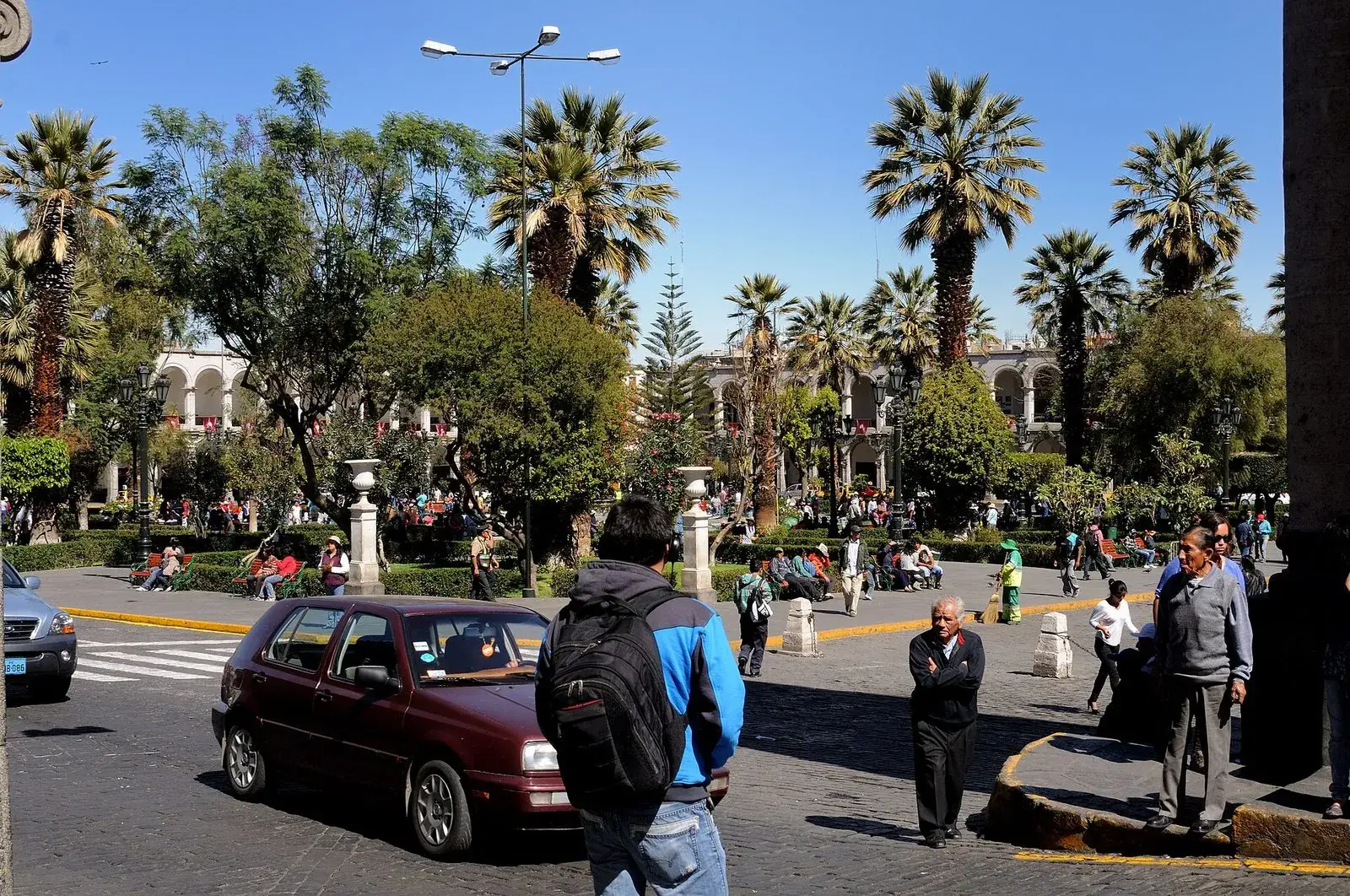
Arequipa is a colonial city built largely of pale volcanic stone, with a large convent complex, a handsome main square and a reputation for some of Peru's best regional cooking. Its main draws are the city itself, the views of the surrounding volcanoes, and the Colca Canyon, which is a long day trip or an overnight excursion. For the city in detail, see Arequipa.
Atmosphere and the feel of the streets
Cusco is compact, dense and layered. Inca walls form the base of many buildings, plazas fill with tour touts and processions in the evening, and the pace is brisk because so many visitors are passing through on a tight schedule. The centre can feel crowded and commercial in high season, and the hillside neighbourhoods reward a walk if you have the breath for it.
Arequipa feels more like a working provincial capital with a confident local culture. Its pale stone arcades, courtyards and rooftop terraces make it an easy city to linger in, and the cone of Misti volcano looks down on the main square on a clear day. Evenings are relaxed, lunch is a serious meal, and the city is less dominated by a single tourist circuit, even though its best-known sites, such as the Santa Catalina Monastery, are well visited.
Food and daily life
Both cities eat well, with different emphases. Cusco's food ranges from market stalls and simple set lunches to inventive restaurants that rework Andean ingredients such as quinoa, native potatoes and alpaca. For the dishes worth looking for, see Cusco food.
Arequipa is known for a stronger regional identity at the table, built around chillies, cheese, river shrimp and slow-cooked stews, often eaten at a long lunch in a traditional restaurant. See the Arequipa food for what to order. If food is the deciding factor, the two cities are close enough that Arequipa's edge is a matter of taste rather than quality.
For everyday comfort, both have a wide range of places to stay, and Arequipa's lower altitude means you are more likely to sleep well and have an appetite from the first evening.
Getting between them
Cusco and Arequipa are far apart by Andean standards. The usual options are a long bus journey, often run overnight or across a long day, or a flight, which may involve a connection depending on the season and the airline. Plan on losing most of a day either way. For the options and what to check, see Cusco to Arequipa.
Many travellers avoid a direct crossing and instead pair Cusco with Lake Titicaca and Puno on the way south, then continue to Arequipa. That is a natural loop for anyone with ten days or more, and it breaks the journey into shorter legs. The southern loop itinerary shows how the pieces fit together. If you are weighing Puno against Arequipa for the same slot, see Puno or Arequipa.
Day trips and what lies beyond
Cusco's surroundings are the richest in Peru for visitors: the Sacred Valley, Moray, the Maras salt pans, the Inca fortress at Ollantaytambo, and the train to Machu Picchu are all within reach, as are the long-distance treks. If you are spending several days in the region, there is more to do than most people expect.
Arequipa's great excursion is the Colca Canyon, famous for its depth and for condors that ride the morning thermals at the best-known viewpoint. It is usually done on a tour or by a long, independent journey, and deserves at least one night rather than a rushed day. See the Colca Canyon and the tour or independent. Volcano hikes also leave from Arequipa for those who want a high-altitude challenge from a lower base.
Verdict by traveller type
First-time visitors with a week or less: Cusco, and use the remaining time on the Sacred Valley rather than adding Arequipa. The extra flight or long bus ride rarely pays off on a short trip.
Visitors with ten days or more: add Arequipa, particularly if you also plan Lake Titicaca, since the three work together as a southern loop.
Anyone worried about altitude: Arequipa is the easier city, but you cannot reach Machu Picchu from it, so it does not replace Cusco.
Food-focused travellers: Arequipa has a slight edge for regional dishes, though Cusco has plenty of good places too.
The answer changes if you have already seen Machu Picchu, or if your priority is hiking and landscapes rather than heritage, in which case Arequipa and the canyon may suit you better. If you are still unsure whether Arequipa earns a place at all, read is Arequipa worth it.
Frequently asked questions
Can I see both Cusco and Arequipa in one trip?
Yes. They are linked by a long bus journey or a short flight, and many southern Peru itineraries pair them with Lake Titicaca. See the route for the options.
Which is better for first-time visitors?
Cusco, because it is the base for Machu Picchu and the Sacred Valley. Arequipa is a rewarding addition rather than a substitute.
Which city is better if I get altitude sickness easily?
Arequipa is much lower and most people adapt there with little trouble. If Machu Picchu is a priority you still need to pass through the highlands, so read altitude and consider sleeping lower in the Sacred Valley first.
How many days do I need in each city?
Two to three full days in Cusco is a sensible minimum before side trips, and one to two in Arequipa. Add a night if you want to see the Colca Canyon properly.
Is Arequipa warmer than Cusco?
Daytime temperatures in Arequipa are generally mild and sunny, with strong sun at its altitude, while Cusco has cold nights and mornings all year, especially in the dry season. Pack layers for both.
Is it worth flying between them?
If you are short of time, a flight saves most of a day compared with the long bus, though routes and schedules change. If you have time, a stop at Puno and the lake breaks the journey and adds a highlight.
Is Cusco too touristy compared with Arequipa?
Cusco has more visitors and more souvenir pressure in the centre, but the old city is still worth the time. Walking a few streets away from the main square usually brings calmer areas.