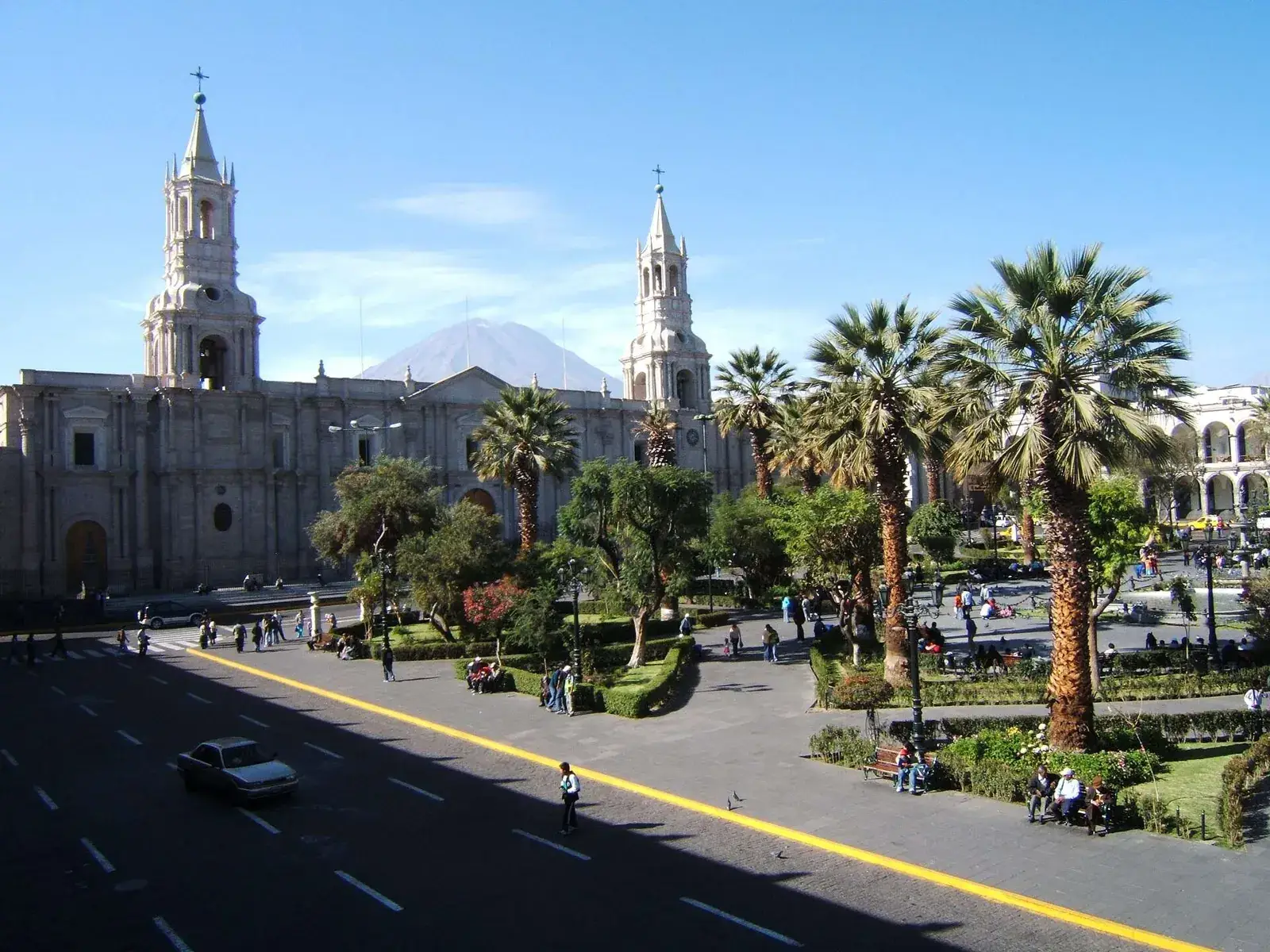
Between Cusco and Arequipa the choice is a long bus or a flight that may connect in Lima. The bus covers roughly 500 km in about 10 to 12 hours, crossing high passes above 4,000 m, and is usually done overnight. A direct flight, where one operates, takes about an hour, but schedules are limited. Plan the descent: Arequipa is about 1,100 m lower than Cusco.
The overland route
The road leaves Cusco south-east, follows the same valley as the Puno road for a while, then branches west through Sicuani, Espinar and the high mining country before descending towards Arequipa. The distance is about 500 km, and the journey takes roughly 10 to 12 hours. The road crosses several passes above 4,000 m, and conditions vary: cold, wind, hail or snow can appear at altitude, and in the rainy season there are landslides. The land is mostly wide open plateau with distant volcanoes, then a long descent towards a desert valley.
Most buses depart in the evening and arrive at dawn. Day services exist and give you the scenery, though they are less common.
By air
Direct flights between Cusco and Arequipa have been operated by some airlines at certain periods, taking about an hour. They are not offered all year, and fares are not always lower than via Lima. If no direct flight is available, you would fly Cusco to Lima and Lima to Arequipa, which takes a day with the connection. For this pair the bus holds up better than elsewhere, because the alternative is also slow.
Domestic flights explains how the Lima hub works and why a connection can swallow the time saved. Do not assume a direct flight exists on your dates.
Where to break the trip, and which direction
Arequipa is far lower, so going from Cusco to Arequipa means descending, which relieves headaches and poor sleep. In the other direction, you climb back to 3,400 m, and spending a few days in Arequipa first is helpful. From Arequipa, travellers often continue to the Colca Canyon or Puno. A stop on the road itself is not common, apart from a rest at one of the towns along the way.
If you prefer to split the journey, a stop at Sicuani or at a town on the plateau is possible, but accommodation and services are basic and onward buses are not always frequent. Most travellers prefer to go through in one go and spend their time in the two cities.
Day bus or night bus
A day bus lets you see the plateau, the volcanoes and the wide skies of the southern highlands, and keeps you off the road in the dark. It arrives in the evening in Arequipa, which gives you a normal bedtime but costs a day. A night bus saves daylight hours for sightseeing, and arrives at dawn, but the mountain section is cold, bumpy and difficult to sleep through.
If you choose a night service, pick a company with a reliable record and a comfortable seat class, and carry warm clothes in your hand luggage, since the hold is not accessible. Long-distance buses explains the seat classes and what to look for in a company.
Arriving in Arequipa
If your bus arrives at dawn, expect to wait for hotel check-in. Ask your accommodation whether you can leave your bag and have breakfast, or whether an early check-in is possible for a fee. Taxis at the terminal are plentiful, but agree the fare before leaving; taxis and ride-hailing explains how.
At about 2,300 m, Arequipa feels easy after Cusco, and you can walk and sightsee comfortably. For the main sights, see Arequipa; Cusco and Arequipa helps if you are deciding how long to spend in each.
Fitting it into a southern loop
Cusco to Arequipa is one link in a classic southern circuit. From Lima, many travellers fly to Cusco, spend time in the Sacred Valley and Machu Picchu, move to Puno for Lake Titicaca, then cross to Arequipa and fly back to Lima. Others do it the other way around, starting with Arequipa and finishing in Cusco.
Southern Peru loop sets out the options and the number of days required. Whichever direction you choose, remember that each overland leg costs most of a day, so count the days carefully when you plan.
Frequently asked questions
How long is the bus from Cusco to Arequipa?
Roughly 10 to 12 hours, commonly overnight.
Is there a direct flight from Cusco to Arequipa?
Sometimes, depending on the airline and season. Otherwise you connect through Lima.
Which direction is easier?
Cusco to Arequipa: you lose altitude, which most people find easier.
Can I see anything on the bus?
On a day bus you cross high plateau with distant volcanoes, herds of camelids and small villages. At night you see little, so the scenery is a reason to choose a daytime departure.
Should I go via Puno instead?
You can, as many travellers do, going Cusco to Puno and then Puno to Arequipa. It takes longer but breaks the journey. See Cusco to Puno and Arequipa to Puno.
Are there strikes on this route?
The southern highlands see occasional protests and blockades. Keep a day of slack. Strikes and road blockades explains how to plan.
Can I take a taxi or private car from Cusco to Arequipa?
It is possible but expensive for such a distance. For a group, it may be worth asking for a quote, with the stops and the departure time agreed in advance.