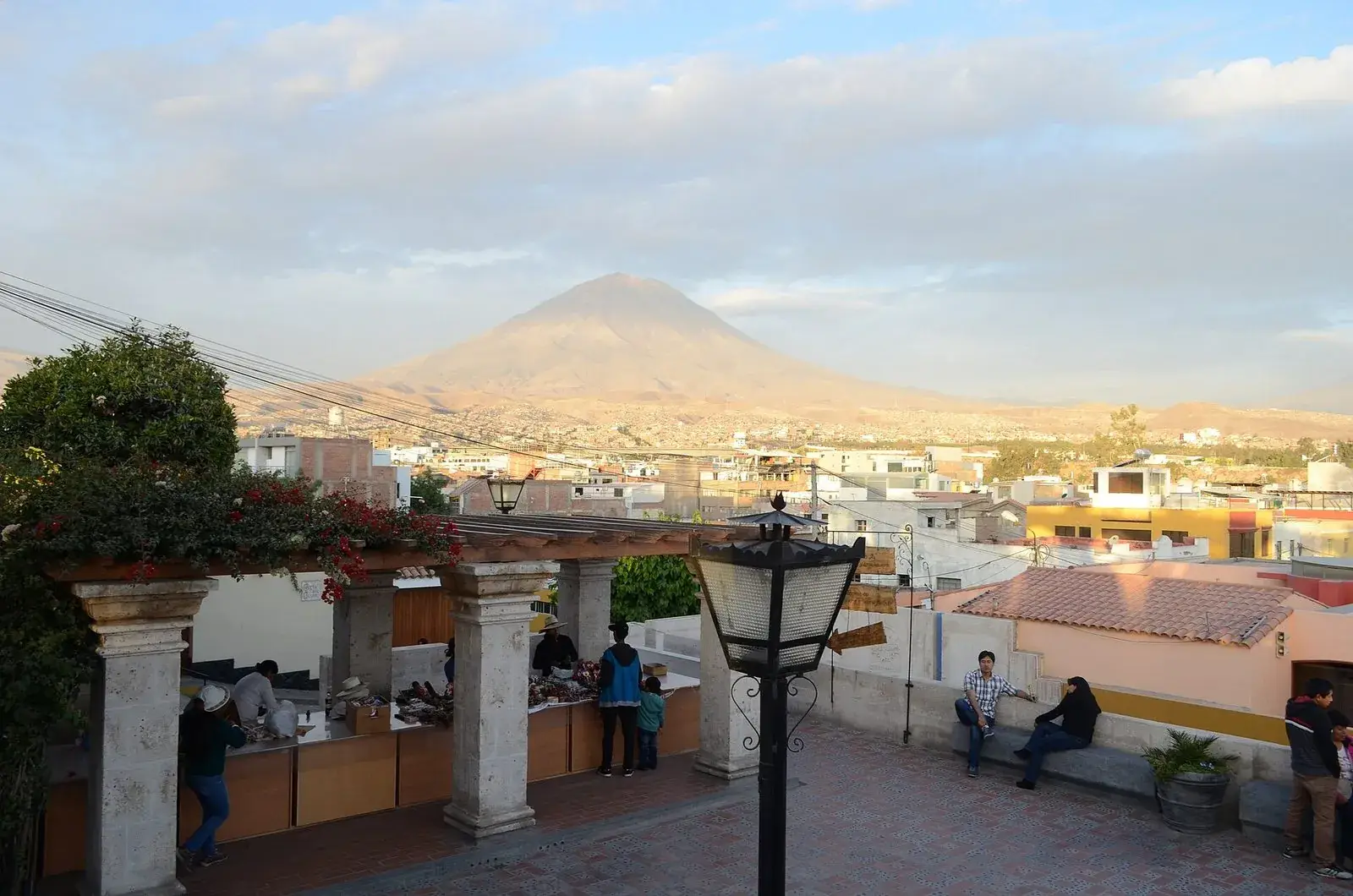
If you only want a pleasant city with good food and architecture, choose Arequipa. If you want Lake Titicaca, the floating Uros islands and Taquile, you need Puno, since the lake is the reason to go, not the town. Most southern routes use both, and the choice only bites when time is short.
The criteria
Time: Arequipa works in one to two days, with extra time if you add the Colca Canyon. Puno is usually one to two nights, with a lake excursion on one of the days.
Altitude: Puno sits at about 3,800 m on the shore of Lake Titicaca, higher than Cusco, and most people feel it. Arequipa is at about 2,350 m, far more comfortable.
Effort: Arequipa is a walkable city. Puno is low-key but cold, and the thin air makes even gentle walking tiring at first. Boat trips on the lake involve little physical effort.
Cost level: both are modest in price by Peruvian standards, with Puno on the simpler side for accommodation and Arequipa offering a wider range of restaurants and hotels.
Crowds: Arequipa is busy with visitors but relaxed. Puno is quiet outside festival periods, with visitor numbers concentrated on the lake tours.
Season: the dry months, roughly May to September, bring clear skies and very cold nights in Puno. Arequipa is sunny for most of the year. The rainy season affects both less than it affects Cusco, though Puno can be cold and damp.
Risk: altitude is the main issue in Puno. See our health note below.
What each gives you
Arequipa is known for its white volcanic-stone buildings, its large convent and its setting beneath three volcanoes. It has a strong food culture and a relaxed pace that many visitors find a pleasant break after the intensity of Cusco. It is also the base for the Colca Canyon, and for the city in detail, see Arequipa.
Puno itself is a modest working city, with a lively main street and a few churches. The real draw is the lake: boat trips to the Uros floating islands and to Taquile, plus the ancient tombs at Sillustani nearby. The lake is wide, high and bright, and the culture of the surrounding communities is distinct from that of Cusco. See the Lake Titicaca for the full picture.
The lake tours: what to expect
Most visitors see Lake Titicaca on an organised boat trip from Puno, and it helps to arrive with realistic expectations. A half-day tour usually covers the Uros reed islands, which are built from totora reeds and now host a tourism-based community. A full-day trip adds Taquile, an island known for its textile traditions, with a walk uphill and lunch included in many packages.
Some travellers find the Uros visit commercial, with sales of crafts and a short demonstration. Others enjoy the setting and the chance to see how the reed islands are made. A homestay on Taquile or a quieter island is a more immersive alternative, but it involves simple conditions and a cold night at altitude.
Read the Uros Islands and the Taquile before deciding how much time to spend on the water. For the burial towers as a half-day add-on, see Sillustani.
Arequipa beyond the main square
Arequipa rewards a slow day. The Santa Catalina Monastery is the standout sight, a walled complex with painted lanes and courtyards that takes a couple of hours to explore properly. The main square, the cathedral and the covered market add a morning, and a viewpoint over the volcanoes at sunset makes a good end to the day.
Evenings are for a long dinner; regional dishes feature chillies, cheese and slow-cooked meats, and the best places are often traditional restaurants that serve lunch. For what to order, see Arequipa food.
For a bigger outing, the Colca Canyon is the obvious choice, and there are volcano climbs for strong hikers who have acclimatised. Do not combine a high volcano with the first day after a long journey from the coast.
Getting between them and onward
Puno and Arequipa are linked by a long road journey, usually by bus over high plateau, with a flight option that may involve a connection. Plan on most of a day in transit; see Arequipa to Puno for the options. Puno is also the usual stop between Cusco and Arequipa, with a separate Cusco to Puno route that is a long but scenic ride.
For this reason, the two cities fit into a southern loop. Starting in Cusco, then Puno, then Arequipa lets you descend gradually, which is easier on the body than heading up. Those continuing to Bolivia will pass through Puno on the way to the border.
If your route does not require Puno, you can see the lake on a different part of your journey, but you cannot see it from Arequipa as a day trip.
Verdict by traveller type
Travellers who like cities, food and architecture: Arequipa.
Those drawn by culture, landscape and the lake: Puno, even if the town is plain.
Those sensitive to altitude: Arequipa, or do Puno briefly and after acclimatising elsewhere.
Short trips of a week: skip both unless they sit on your route; Cusco and the Sacred Valley will use your time better.
The answer changes if you are travelling overland between Cusco and Arequipa, or to Bolivia, since Puno lies naturally on that line and one night there may be enough. Some visitors find the lake tours more touristy than they expected, so read about the islands before deciding. For a longer view of Arequipa, see is Arequipa worth it.
Frequently asked questions
Can I visit Lake Titicaca from Arequipa?
Not easily as a day trip. Puno is the base, and the journey between the two is long. Plan it as part of a route rather than an excursion.
Which one has better food?
Arequipa has the stronger reputation for regional dishes, though Puno has its own lake fish and highland specialities.
How many nights do I need in Puno?
One night allows a half-day lake tour and an easy evening. Two nights lets you do a full-day trip to Taquile or add Sillustani without rushing.
Is Puno safe and pleasant to walk around?
The centre is used to visitors and is generally fine by day, with the usual city precautions at night. The cold and the altitude are bigger issues for most people.
Should I take the bus or fly between Puno and Arequipa?
The bus covers the high plateau by day and is cheaper, while a flight saves time but may include a connection. Consider how each fits your plan.
Can I skip Puno and still see Lake Titicaca?
You can reach the lake from other points, including on the Bolivian side, but Puno is the main base on the Peruvian shore. See the Lake Titicaca for options.
Do I need a warm jacket in both?
Yes, but especially in Puno, where nights can be freezing in the dry season. Arequipa is milder but has a strong sun and cool evenings.