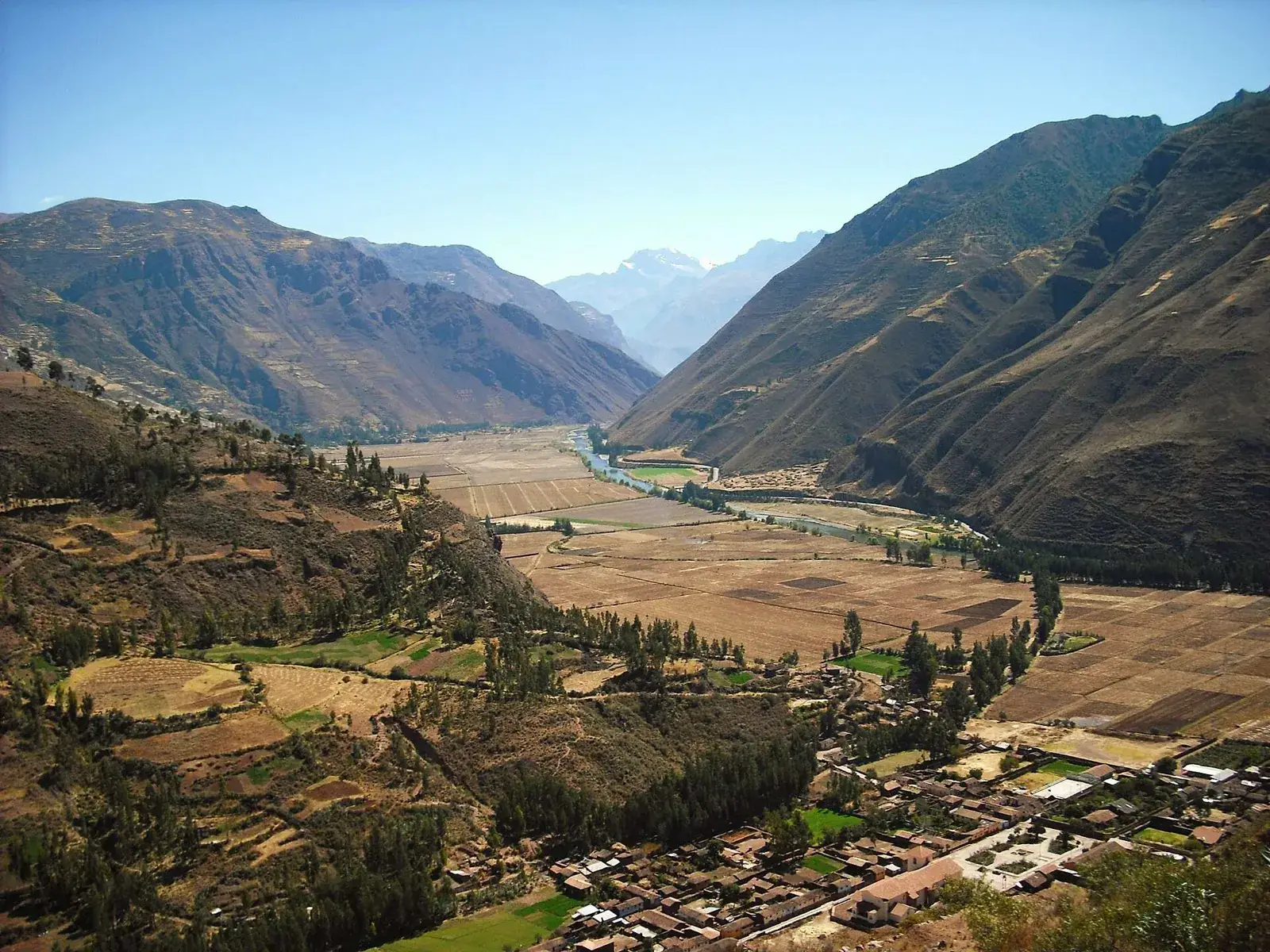
From Cusco the Sacred Valley is easy and short: Pisac is about an hour away, Urubamba roughly 1.5 hours and Ollantaytambo about two. Shared vans are the cheapest option, a taxi or private driver is the most flexible, and a guided day tour is the easiest way to see several sites. The valley is several hundred metres lower than Cusco, so it is also a good place to sleep first.
The geography in brief
The valley of the Urubamba River runs north-west from Cusco. There are two ways in. The eastern entry goes down through Pisac, then along the valley floor through Calca and Urubamba to Ollantaytambo, about 60 to 70 km from Cusco. The other leaves the city to the north-west, climbs over the Chinchero plateau and drops to Urubamba, which is the quicker way to the central and lower valley. Cusco is at about 3,400 m, Pisac and Ollantaytambo are roughly 2,800 to 3,000 m, and the road between Cusco and the valley passes through high points above 3,500 m.
Each town of the Sacred Valley is described in turn, and Pisac and Ollantaytambo cover the two ends of the main road.
Shared vans and buses
Minibuses and shared vans (collectivos) leave Cusco for Pisac, Urubamba and onward, and vans link the valley towns with each other. They are the cheapest option and the way most local people travel. They leave when full, can be crowded and have little space for large bags. To go from Cusco to Ollantaytambo you may change vehicles in Urubamba. Departure points move, so ask at your hotel which place to use.
Collectivos and combis explains how the system works, what a fair fare looks like and the safety points to bear in mind. If you carry a big pack, a taxi is usually the more comfortable choice.
Taxis, drivers and tours
A private taxi or driver is worth the extra cost for a group or for a day that includes several stops, such as Chinchero, Moray, the Maras salt pans and Ollantaytambo, which the shared vans do not serve well. Agree the route, waiting time and fare before leaving. Guided day tours, available in Cusco, bundle transport, entry coordination and a guide, which is simplest if you have little time. Note that many sites in the valley require the Cusco tourist ticket, so check it before you buy.
Sacred Valley toursexplains what the common day tours include, and taxis and ride-hailing covers how to agree a fare with a driver.
By train
The Machu Picchu trains leave from Ollantaytambo, and some services start from the Cusco area, so for Machu Picchu you normally reach Ollantaytambo by road first. There is no passenger train along the valley for day-to-day travel. If you are going from Cusco to Machu Picchu, leave enough time for the transfer to Ollantaytambo before the train, and do not plan a tight connection.
Trains in Peru covers the services, and how to get to Machu Picchu shows how the road and the rail legs fit into the whole trip.
Which option for which traveller
A solo traveller on a budget with a light bag should take the shared van, and accept the wait. A couple or a small group with a few stops in mind will find a private driver barely more expensive per person than several separate vans and taxis, and much more comfortable. Anyone with limited time and little desire to plan should take a guided tour, which removes the logistics.
If you are heading to Machu Picchu, travel to Ollantaytambo the day before the train rather than on the morning itself, unless the timetable clearly allows it. A buffer costs one night; a missed train costs far more. Machu Picchu trainsexplains how to match the road leg to the departure.
From the airport straight to the valley
Because Cusco's airport is on the same side of the city as the main road to the valley, many hotels in Urubamba and Ollantaytambo offer a pre-booked pick-up directly from the terminal. This avoids a trip through central Cusco with luggage and brings you to a lower altitude within a couple of hours of landing.
For the practical points: where to wait, what to avoid and how long the drive takes, see Cusco airport. Confirm the pick-up with the driver the day before, and give your flight number so they can follow delays.
Strikes, rain and timing
Roads in the valley are generally good, but landslides and local protests can interrupt traffic, especially in the rainy season. Allow extra time on days when you have a train or a flight, and ask your hotel about the road situation before you set off.
Traffic builds up in the morning and early evening around Cusco, so a departure straight after breakfast is usually smoother than one at midday. If you plan several sites in a day, start early: the sun is kinder at altitude, and most of the sites are quieter before the tour buses arrive.
Frequently asked questions
How long does it take to get from Cusco to Ollantaytambo?
About two hours by road, a little longer by shared van with changes.
Is it better to take a tour or go independently?
A tour is convenient for first-time visitors with limited time. Independent travel is cheaper and more flexible, but takes some planning.
Can I do the Sacred Valley in a day trip from Cusco?
Yes, a long day covers a few sites. Staying one or two nights in the valley allows a calmer pace.
Where do the shared vans leave from?
From stops and yards in Cusco that change over time and are not always marked. Ask your hotel for the current place, and confirm the destination with the driver before boarding.
Can I take luggage on a shared van?
Small bags fit, but large rucksacks may be refused or strapped outside. If you carry a lot, take a taxi or a pre-booked transfer instead.
Do I need the tourist ticket for the Sacred Valley?
Many sites in the valley require the Cusco tourist ticket. Check what your plan covers before buying, and keep it with your passport.
Is the road to the Sacred Valley safe?
The main roads are paved and used heavily by tours and locals. The usual risks are crowded vehicles and fast driving; avoid night journeys on minor roads and heed safety advice.