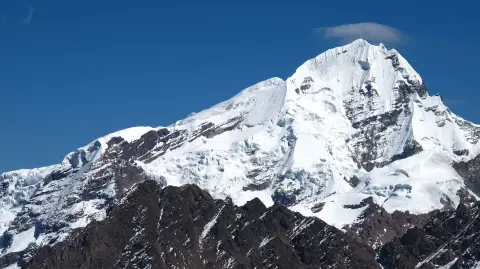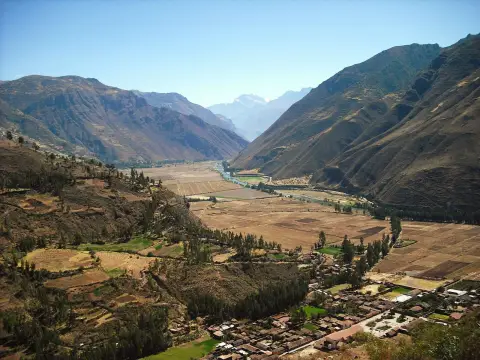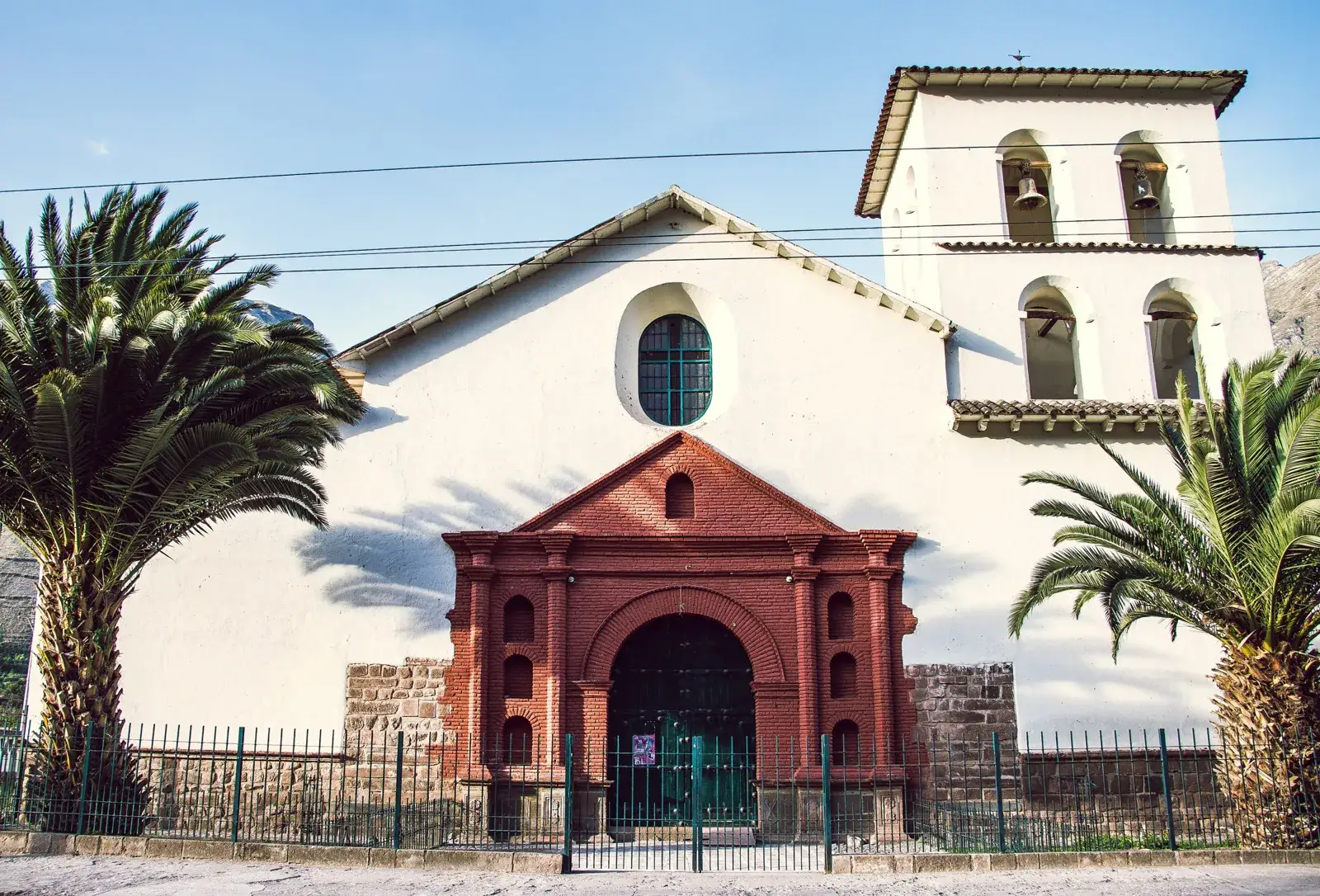
Yucay is a small village on the floor of the Sacred Valley, at about 2,860 m, between Urubamba and Ollantaytambo. It stands on land that belonged to the Inca elite, and it keeps the palace of Sayri Túpac, a colonial church and a shady plaza. A visit takes one to two hours on foot, so it works best as a gentle stop on the way along the valley or as a quiet place to stay, not as a full-day excursion.
Map
What Yucay is
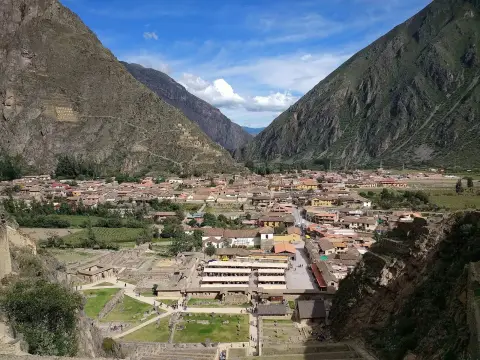
Yucay is a village in the central part of the Sacred Valley, in Urubamba Province, a short distance along the valley from the larger town of Urubamba. It sits on the valley floor at roughly 2,860 m, a little lower than Cusco and in a more sheltered, greener setting, with the Urubamba River close by and terraced hillsides rising above the houses.
It is not a major sight in the way that the big Inca complexes are. There is no ticketed citadel and no crowd. What Yucay offers is a compact village where Inca, early colonial and rural Andean life sit side by side: an Inca-period palace, a colonial church between two open spaces, narrow streets with adobe walls, and fields that still produce maize. For many visitors it is the most relaxed corner of the valley, which is why several lodges and guesthouses are found here.
A royal estate, then a colonial grant
The history of Yucay is tied to land. In Inca times the central valley was a favoured area for the estates of rulers and noble families, close to Cusco and mild enough to grow maize at scale. Sources link Yucay to the estate of the emperor Huayna Cápac, whose lands are described as running for many kilometres along the valley. His palace complex of Quispiguanca is placed in the northern part of present-day Urubamba, not in Yucay itself, and little of it remains above ground.
After the Spanish conquest the estate changed hands. In the middle of the 16th century the Inca Sayri Túpac, a descendant of the imperial line, came to an agreement with the Spanish authorities and was given the lands of Yucay along with other privileges. He built a palace here and lived on the estate for a short time before his death. Accounts differ on exact dates, so treat the sequence as a general outline.
This background explains why a village of this size has such solid stone and adobe buildings, and why Yucay is often described as a place where the Inca and colonial worlds overlap.
Tours and activities
Bookable online, chosen for their traveller reviews.
-
From €107 per person
Sacred Valley
Private Sacred Valley Day Trip with Local Guide
-
From €107 per person
Sacred Valley
Moray and Maras Day Tour from Ollantaytambo to Cusco
-
Day trip From €62 per person
Sacred Valley
Moray ATV Tour from Cusco with Salt Mines and Tasting
-
From €65 per person
Sacred Valley
Private Half-Day Maras and Moray Tour from Ollantaytambo
The palace of Sayri Túpac
The palace of Sayri Túpac stands near the centre of the village and is the main historical reason to stop. It is a modest building by the standards of Cusco: walls that combine Inca stonework with adobe, doorways and niches in the Inca manner, and an interior that has been adapted over the centuries. Some descriptions mention a well-preserved pre-Hispanic ceramic oven in the grounds, which is easy to overlook without a guide.
Do not expect carefully curated displays. The interest lies in the masonry, the proportions of the openings and the sense of how an Inca noble family lived once the political order had changed. Visiting arrangements for the building, including opening times and whether any fee applies, are not always clear, so ask locally or at your accommodation before you walk over. If it is closed, the exterior and the surrounding streets still show the layout of the old estate.
The plaza and the church
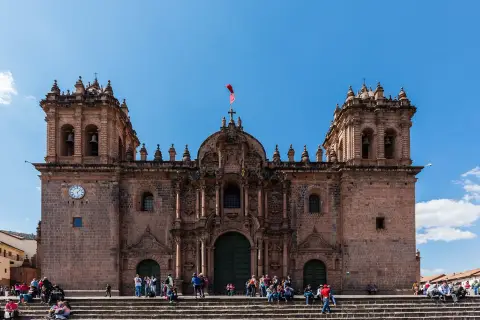
The centre of Yucay is arranged around a colonial church that stands between two open spaces. The church is dedicated to Santiago Apóstol and is generally dated to the 17th century, built on or beside earlier foundations; sources vary on the date and on the details. The facade is simple, and the interior holds altars and religious paintings of the kind found in village churches across the Cusco region. Opening hours are irregular, and the church is mainly open around services.
One of the plazas carries the name of Manco Cápac II, another Inca of the post-conquest period. The plaza is the natural place to sit for a while: there are benches, mature trees, and a view of the hills behind the roofs. Local residents use it as a meeting point, which makes it a pleasant place to see ordinary village life, particularly in the late afternoon. Keep voices low near the church and ask before photographing people.
Terraces and walks around the village
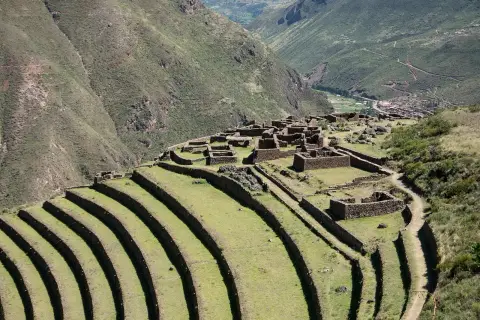
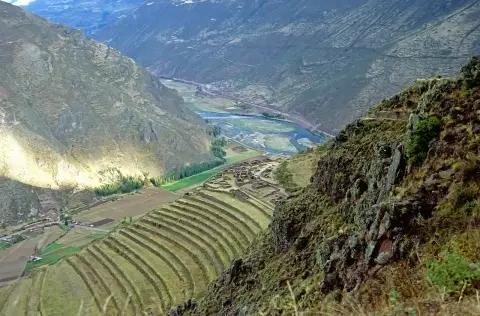
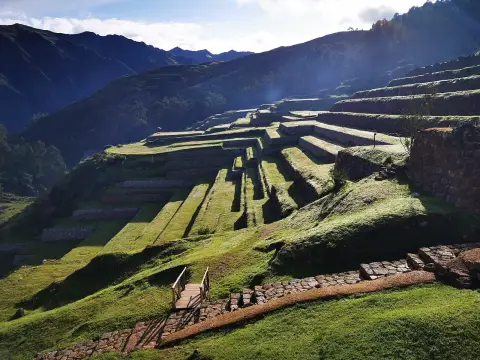
Above and around Yucay are agricultural terraces, many still cultivated. They are not as large or as well restored as those at Pisac or Ollantaytambo, but they are free of crowds, and a short climb up the stone steps gives a view along the valley and across the river. Some stretches of Inca wall stand along the lanes at the edge of the village.
The flat valley floor makes Yucay good for easy walking. Quiet roads and field tracks lead towards Urubamba in one direction and towards Huarocondo and Ollantaytambo in the other, and a walk of an hour or two is enough to feel the rhythm of the valley without a serious climb. Stay on tracks, close farm gates behind you and do not walk through crops. Dogs guard some properties, so keep a distance and do not feed them.
How to get there
Yucay lies along the main valley road, roughly an hour and a half by road from Cusco in normal conditions, depending on traffic and the route. The usual way is to reach Urubamba by bus, colectivo or private transfer and continue by taxi or shared van, which is short and inexpensive. Cusco to the Sacred Valley explains the options in more detail. If you have booked a lodge here, ask whether it arranges the transfer, because this removes the last stage of the journey.
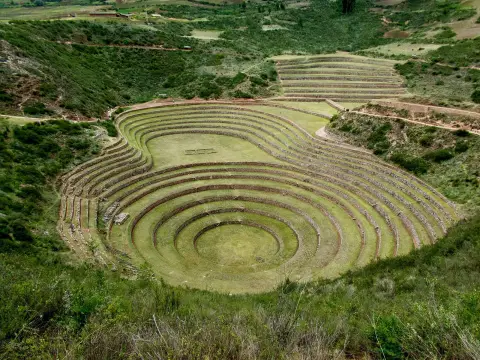
Independent visitors can combine Yucay with a half-day around the central valley. A common loop takes in Moray and the Maras salt mines in the morning and ends with a walk in Yucay, or begins here and continues on to Ollantaytambo. Sacred Valley tours lists the standard formats, although most tours pass through Yucay without stopping.
Staying in Yucay
Yucay is better known as a place to sleep than as a sight, and that is the best way to experience it. The valley floor is lower than Cusco, the air is warmer and the nights are quieter, so many travellers use it to adjust to altitude before or after the city. Where to stay in the Sacred Valley compares Yucay with Urubamba, Ollantaytambo and Pisac, and explains how to choose between them.
From a base here, day trips are simple: Ollantaytambo and its train station are close, Chinchero and Moray are reachable by taxi, and Pisac with its market is further back towards Cusco. The village has few restaurants, so check meal arrangements with your host. If you arrive straight from sea level, spend the first day at a gentle pace and read about altitude sickness.
When to go and what to bring
The dry season, roughly May to September, has clear skies, cool mornings and warm afternoons, and is the easiest time for walking. In the rainy season, roughly November to March, afternoon showers are common, tracks can be muddy and the hills are very green. Yucay is quiet in any season, although national holidays and village festivals bring more local visitors.
Bring sun protection, a hat and water, even for a short stroll, because the sun at this altitude is strong. A light jacket is useful in the evening. Shoes with a grip help on the stone steps and the field paths. The village is small and cash is useful for taxis and small purchases, so withdraw money in Urubamba or Cusco beforehand.
Plan your time sensibly. One to two hours covers the palace, the plaza and the church, and a half-day allows a walk on the terraces. Anything longer is really a decision to stay overnight.
Where to sleep
-
Find hotels
Urubamba
Central, with the most choice and the easiest road links
-
Find hotels
Ollantaytambo
Inca town with the trains to Machu Picchu
-
Find hotels
Pisac
Market town with a citadel above it, closest to Cusco
-
Find hotels
Yucay
Quiet and green between Urubamba and Ollantaytambo
Frequently asked questions
Is Yucay worth a visit?
Yes, if you like quiet villages and unhurried history. It has no major monument, but the palace of Sayri Túpac, the church and the terraces fill an easy half-day. If you are short of time, prioritise Ollantaytambo or Pisac first.
How far is Yucay from Urubamba?
It is a short drive along the valley, a matter of minutes by taxi or shared van. The two places are close enough that many people treat them as one area when choosing where to stay.
How long do I need in Yucay?
One to two hours is enough for the palace, the plaza and the church. Add another hour or two if you want to climb to the terraces or walk the field tracks along the river.
Who was Sayri Túpac?
He was an Inca ruler of the generation after the Spanish conquest, who agreed a settlement with the colonial authorities and received the lands of Yucay. He is associated with the palace in the village. Dates in different sources do not always agree.
Can I visit Yucay without a tour?
Yes, and that is the easiest way. Reach Urubamba by bus or colectivo, then take a short taxi ride. The village is small enough to cover on foot, and most Sacred Valley tours do not stop here.
Is there an entrance ticket for Yucay?
The village itself is open, and the palace has been described as free to enter. Rules for small sites change, so confirm locally rather than relying on a printed guide.
Is Yucay a good base for the Sacred Valley?
It suits travellers who want calm, gardens and a lower altitude than Cusco, with taxis for day trips. It is less convenient than Ollantaytambo for an early train. The stay page compares the options.