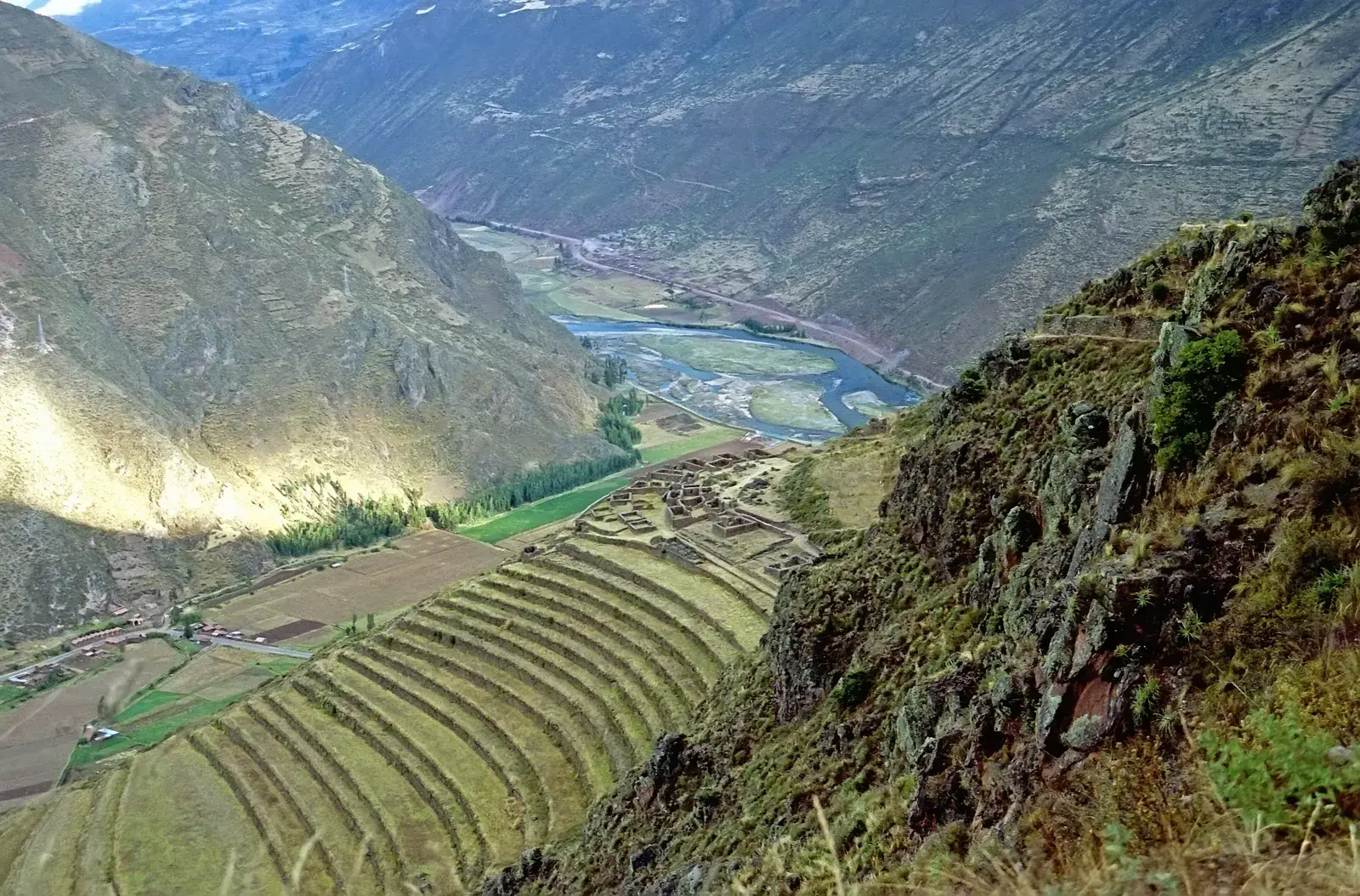
Stay in Ollantaytambo if you are catching the train to Machu Picchu, in Urubamba or Yucay for space, gardens and a central position, and in Pisac if the market and the nearby ruins are your priority. The valley floor is several hundred metres lower than Cusco, which makes it a gentler place to sleep for your first nights.
Most people base themselves in one town and travel to the others by taxi or collectivo.
Why sleep in the valley
The Sacred Valley follows the Urubamba river northwest of Cusco, between the city and the Machu Picchu train line. It lies at roughly 2,800 m or lower, compared with 3,400 m for Cusco, so sleep tends to be easier and the climate milder. For people who are nervous about altitude, it is common to spend the first nights here and visit Cusco afterwards. See altitude sickness to understand why this ordering helps.
The valley is also a better place for a slow stay: gardens, farm views, walking trails and mountain light. Roads are straightforward, with the main route running along the valley floor, so moving between towns is easy by taxi or shared van.
The broader picture, including the sights and the best order for a visit, is on the main Sacred Valley, and the comparison of the valley or Cusco as a base weighs the trade-offs for different trips.
Ollantaytambo: the practical choice
Ollantaytambo is a living Inca town with stone-lined streets, a large fortress on the hill and the departure point for most trains to Machu Picchu. Staying here saves the early drive from Cusco and puts you steps from the station. It suits one night before or after Machu Picchu, or a longer base for walks in the surrounding hills. See Ollantaytambo for the town and fortress in more detail.
The town is lively with tourists during the day and peaceful at night, though the railway and early departures mean some noise. Streets are cobbled, so wheeled luggage is awkward. Check where the property is relative to the station and the main square.
If your train leaves at an early hour, a night here is far more relaxing than a pre-dawn transfer from Cusco. See trains to Machu Picchu to understand how the services work and what to book first.
Urubamba and Yucay: space and calm
Urubamba is the largest town in the central valley and has shops, restaurants and transport links, making it practical for a longer stay. Many larger lodges and guesthouses with gardens lie on the roads just outside, in and around Yucay, a smaller village with an old colonial plaza.
This stretch suits families and those who want a quiet base with room to relax. The compromise is that you will need a taxi to reach most sights, and there is less atmosphere in the town itself than in Ollantaytambo or Pisac.
Because it sits in the middle of the valley, Urubamba is also a useful hub: Pisac is a drive in one direction, Ollantaytambo in the other, and the high plateau with Moray and Maras climbs from the south side. Ask your host to help arrange a driver for the day.
Pisac and the upper valley
Pisac sits at the Cusco end of the valley, famous for its craft market and for the Inca terraces above the town. It has a relaxed, craft-oriented feel and a growing number of guesthouses. Staying here lets you see the ruins early, before the tour buses arrive, and visit the market on a quieter day.
It is also the closest of the three bases to Cusco, which is useful if you plan to split your time. The trade-off is the distance to Ollantaytambo and the train, so plan around the transfer if you have an early service.
Smaller villages in the upper valley, away from the main road, offer a very quiet stay with farm views, though services are limited and you will depend on a taxi. Ask how far the property is from the nearest restaurant before booking.
Choosing by trip type
One night before Machu Picchu points to Ollantaytambo. A relaxed three- or four-night stay suggests Urubamba or Yucay, with day trips by taxi. Markets, crafts and early ruin visits fit Pisac. Couples looking for gardens and quiet usually prefer the central valley, while hikers who want to walk out of the door tend to like the edges of Ollantaytambo.
Families should consider ease of access: flat sites, gardens and on-site meals help, because restaurant choice is thinner outside the main towns. Travellers on a budget will find simpler guesthouses and hostels in Pisac and Ollantaytambo, while larger, more expensive lodges cluster around Urubamba. The comparison with Cusco as a base shows how the choice shifts if you want a livelier evening.
Getting around the valley
Taxis and shared vans, known as collectivos, link the main towns along the valley floor, and the route is simple to follow. Fares are modest but vary, so agree the price before you set off. For sites off the main road, such as Moray and Maras, hire a taxi for a few hours or join a guided outing. See Cusco to Sacred Valley for the first transfer and how to arrive without losing a day.
Public transport is cheap but stops early in the evening, so plan the return from dinner. If you are carrying luggage, ask your accommodation to arrange the pick-up from the airport or bus stop.
Practical checks
Nights are cooler than the daytime sun suggests, so ask about heating. Check whether the property is on the valley floor or higher up, since steep access roads can be rough after rain. If you are catching an early train, confirm breakfast times or ask for a packed one, and agree your transport in advance.
In the rainy season, landslides can affect the roads and the railway, so keep your plans flexible when booking non-refundable rooms. See Machu Picchu logistics to understand what to arrange and in which order.
Where to sleep
-
Urubamba
Central, with the most choice and the easiest road links
The central town of the valley, with supermarkets, restaurants and the widest choice of hotels, from simple rooms to resorts and quiet lodges in the surrounding fields. The road links to Pisac, Ollantaytambo and Moray are the easiest.
Keep in mind: It is a practical base rather than a pretty town, and the best hotels sit outside the centre, so you will want a taxi.
Find hotels → -
Ollantaytambo
Inca town with the trains to Machu Picchu
A living Inca town with stone-paved lanes, a large fortress above it and the station for trains to Machu Picchu. Small hotels and hostels line the old streets. The best choice if you take an early train.
Keep in mind: It is a small town with little nightlife, and the lanes around the station and the fortress are busy in the morning.
Find hotels → -
Pisac
Market town with a citadel above it, closest to Cusco
The market town closest to Cusco, with an Inca citadel above it. The market is liveliest on Sunday. It suits a first night after arriving from Cusco and travellers interested in crafts.
Keep in mind: Market days bring day trippers, and it is the farthest town from the Machu Picchu trains.
Find hotels → -
Yucay
Quiet and green between Urubamba and Ollantaytambo
A small village between Urubamba and Ollantaytambo with a colonial square, gardens and a few hotels. It suits slow stays, couples and travellers who want quiet.
Keep in mind: There is almost nothing to eat or do beyond the hotels, so arrange transport in advance.
Find hotels →
Hotels on the map, with prices
Frequently asked questions
Is the Sacred Valley a better base than Cusco?
For altitude, space and a calmer pace, often yes. For nightlife, museums and tour choice, Cusco is stronger.
Where should I stay before Machu Picchu?
Ollantaytambo puts you closest to the train. Urubamba and Pisac work too, with a longer transfer.
Do I need a car in the valley?
No. Taxis and shared vans link the main towns, and guided tours handle the more remote sites.
How many nights should I spend in the Sacred Valley?
Two nights is a sensible minimum, three or four if you want to walk, visit more than one town and rest before or after Machu Picchu. Split nights between two bases if you want a different feel at each end.
Can I walk between the valley towns?
Some sections can be walked, but the towns are far apart and the main road is busy. Local guides can suggest safer trails, and short walks near each town are more realistic than linking them on foot.
Is the valley warm enough to swim?
Days are mild and sunny, but nights are cold and few places have heated pools. Check before packing swimwear and bring warm layers for evenings.
Are there good places to eat outside the towns?
Lodges usually serve meals, and some run restaurants open to non-guests, though choice is thinner than in Urubamba or Cusco. Ask your host to recommend and book a place, especially in the evening.