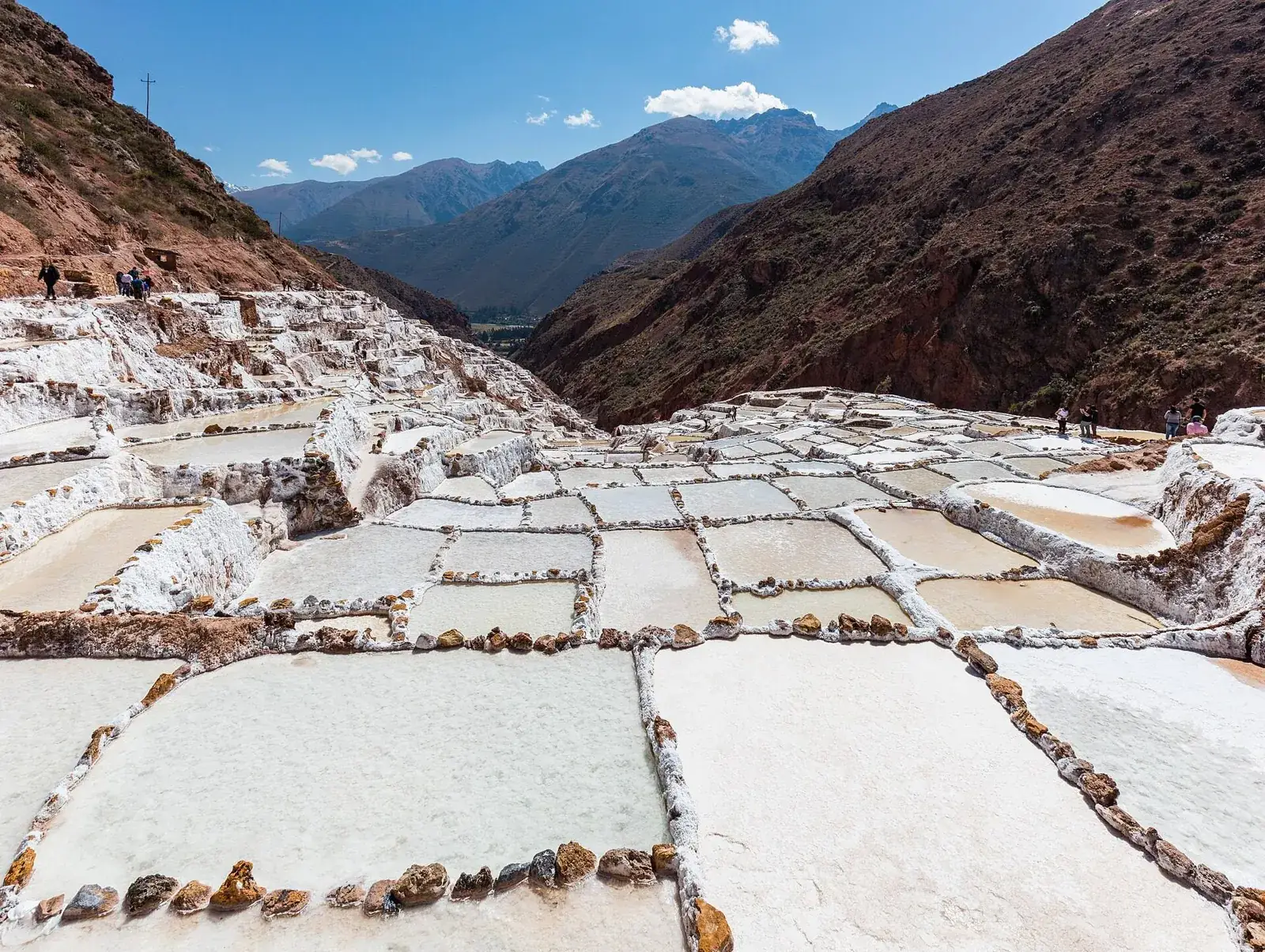
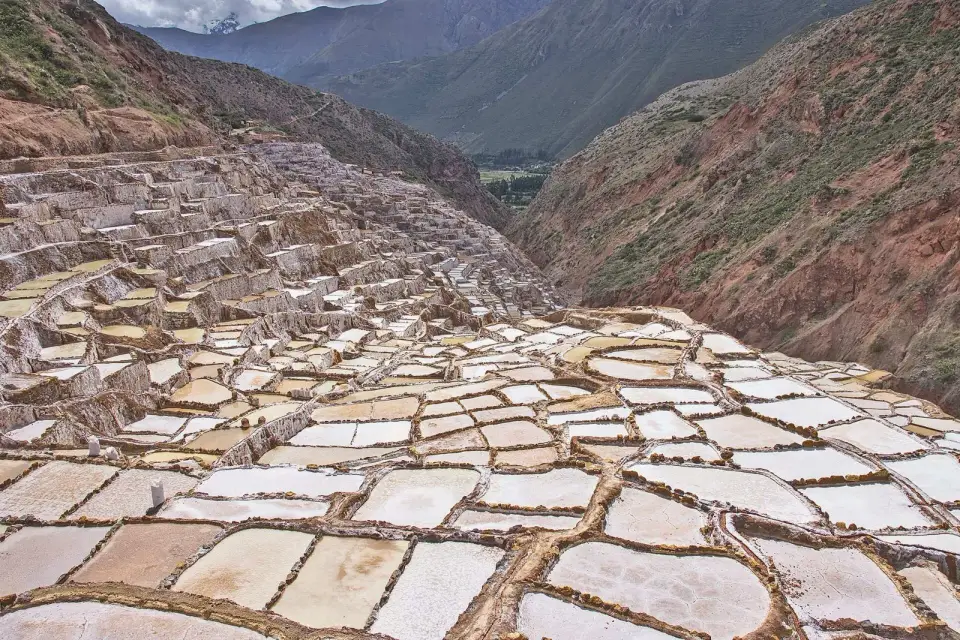
The Maras salt mines, known locally as Salineras, are thousands of small terraced pans on a steep hillside above the Sacred Valley. A salty spring feeds them, the water evaporates in the sun, and families harvest the salt left behind. Allow about an hour, go on a dry day, and combine the visit with nearby Moray. The pans are a working site, so respect the restrictions on walking on them.
Map
How the salt pans work
The pans are fed by a natural spring that emerges high on the slope and carries a high concentration of dissolved salt. The water is channelled into the pans through small canals. When a pan is filled with a shallow layer, the sun and dry air evaporate the water over days, and a crust of salt remains. It is scraped out and the pan is filled again.
The system is laid out as a patchwork of white, pink and brown rectangles, which gives the hillside its distinctive look. Pans are generally managed by local families, who belong to a community organisation. Salt production here is generally linked to pre-Hispanic times, though the exact age of the arrangement is not something to state with certainty.
Seeing the site
From the viewpoint at the top, the whole slope opens out in a bowl of pans. From there a path goes down alongside them. Visitors are generally asked not to walk on the pans or touch the water, since the salt is a food product and the structures are delicate, so stay on the marked paths.
Light matters here. Dry sunny days make the salt bright white; on wet days the pans can look dull, and the paths are muddy. Late morning and afternoon are common times for tour groups, so early starts can be quieter. Rain can also disrupt production, since the pans have to dry.
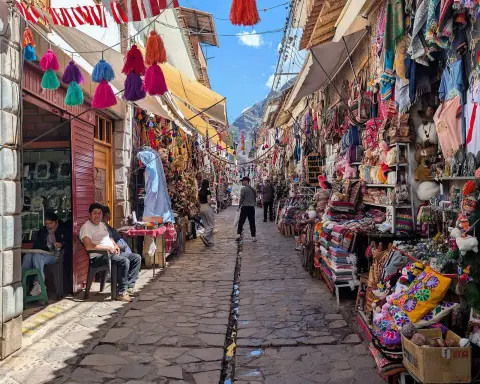
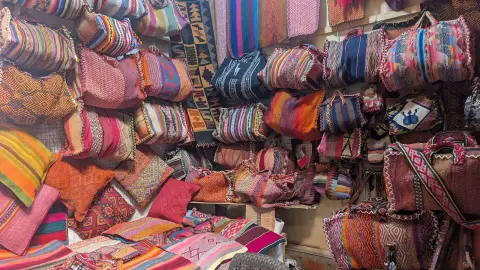
A short visit is enough for most people, about an hour including time at the viewpoint and in the small shops at the entrance. These sell salt in different forms, including bath salts and flavoured salts. Prices are not fixed and quality varies, so compare before buying.
Tours and activities
Bookable online, chosen for their traveller reviews.
-
From €107 per person
Sacred Valley
Private Sacred Valley Day Trip with Local Guide
-
From €107 per person
Sacred Valley
Moray and Maras Day Tour from Ollantaytambo to Cusco
-
Day trip From €62 per person
Sacred Valley
Moray ATV Tour from Cusco with Salt Mines and Tasting
-
From €65 per person
Sacred Valley
Private Half-Day Maras and Moray Tour from Ollantaytambo
The harvest and the people behind it
The salt pans are not a museum piece but a working livelihood. Families look after their own pans, topping up the water, watching the crust form and gathering the salt when it is ready. The work follows the weather: the dry season, roughly May to September, is the most productive period, while heavy rain dilutes the pans and slows the process.
What you see as a visitor is only a glimpse. Much of the activity happens quietly and early, and the people on the paths are working rather than performing. Treat them as you would workers anywhere: do not step into their pans, do not reach to touch the salt without invitation, and ask before photographing individuals.
If you buy salt at the entrance, you are supporting a community enterprise in a general sense, but do not assume every product carries a certification or a particular origin. See souvenirs to understand how to judge quality and how to ask sensible questions about where something was made.
Combining it with Moray and other stops
The salt pans and Moray are only a short drive apart, so tours nearly always join them. The usual route comes up from the valley by road from Urubamba, and the route can also be done in the opposite order, so ask how your operator arranges the day.
Some visitors walk between Maras town and the pans, or between Moray and the salt mines, on rural paths. This is possible but exposed to sun and altitude, and the route is not always obvious, so only attempt it if you are comfortable with navigation.
A typical full-day circuit adds a market village or an archaeological site in the valley. Pisac and Ollantaytambo are the usual candidates. See Sacred Valley tours to understand how operators combine them.
Practical details for a comfortable visit
The footing is the main practical issue. Paths run beside stone channels and between pans, and they are uneven. Wear shoes with a decent grip rather than sandals, particularly after rain, when the clay surface becomes slick. Keep children close, since there are drops between levels.
Bring sun protection. The salt reflects light strongly, and the altitude intensifies the sun, so sunglasses, a hat and sunscreen are worth carrying even on a cool day. Carry water, as the site is exposed and shade is limited.
There are basic facilities near the entrance, but do not count on much beyond small shops and stalls. Carry small notes in soles for purchases, since not every seller will have change. The site is at an altitude comparable to the nearby plateau, so people who are still adjusting should take the descent and climb slowly and read our altitude advice before the trip.
Using Maras in a Sacred Valley plan
Maras suits travellers who want a shorter, scenic outing rather than a day of heavy walking. It fits well on the day after you arrive in the valley, when you want to see something without a steep climb, and it pairs naturally with a night in a valley base. See Sacred Valley stay to compare the towns you can use for that.
If you are based in Cusco, a half-day tour is a sensible way to see Maras and Moray together, leaving the afternoon free. Travellers with more time may prefer to hire a driver and add a stop or two at their own pace.
Whichever way you go, keep expectations realistic. The pans are best appreciated as a visual spectacle and a small piece of living tradition, not as a place with long explanations. An hour is usually enough, and a longer stay is only worthwhile for photography in good light.
Where to sleep
-
Find hotels
Urubamba
Central, with the most choice and the easiest road links
-
Find hotels
Ollantaytambo
Inca town with the trains to Machu Picchu
-
Find hotels
Pisac
Market town with a citadel above it, closest to Cusco
-
Find hotels
Yucay
Quiet and green between Urubamba and Ollantaytambo
Frequently asked questions
Can I walk on the salt pans?
Visitors are generally asked to stay on the paths and not to walk on the pans or touch the water. Follow the signs and instructions on the day.
How long do I need?
About an hour is enough for the viewpoint, a walk down along the paths and a stop at the shops.
Is it worth going in the rainy season?
You can, but the pans look best in dry weather, and rain can interrupt production and make paths slippery.
Can I buy salt at Maras?
Yes, there are small shops at the entrance selling salt in several forms, including flavoured and bath salts. Prices are not fixed, so compare a few stalls. Check the packaging, as quality and origin vary.
Is the Maras salt edible?
The salt from the pans is produced as a food product and is sold as such, but bath salts and craft products are different items. Read the label or ask the seller which is which before using it in cooking.
Is the walk from Maras to Moray a good idea?
It can be a pleasant rural walk, but it is exposed, the route is not always obvious and the altitude adds effort. Consider doing it only with a guide or a reliable map. Most visitors prefer to drive.
Can I visit Maras on my own?
Yes, with a taxi or hired driver from Urubamba or Cusco. Agree the price and waiting time in advance, and confirm whether the driver will also take you to Moray.
What should I wear and bring?
Bring a hat, sun protection, water and shoes with grip, because paths are uneven and can be slippery. A light jacket is useful for wind. Small notes in soles help for the shops.