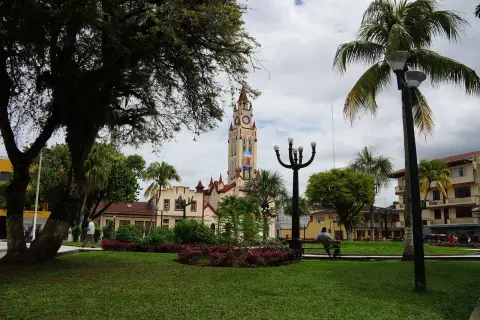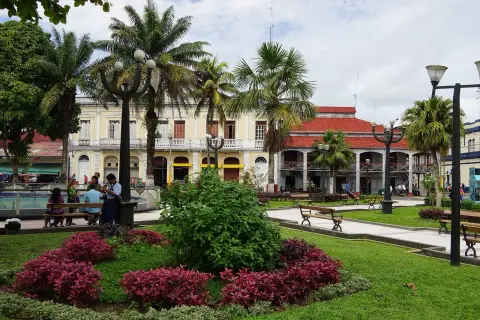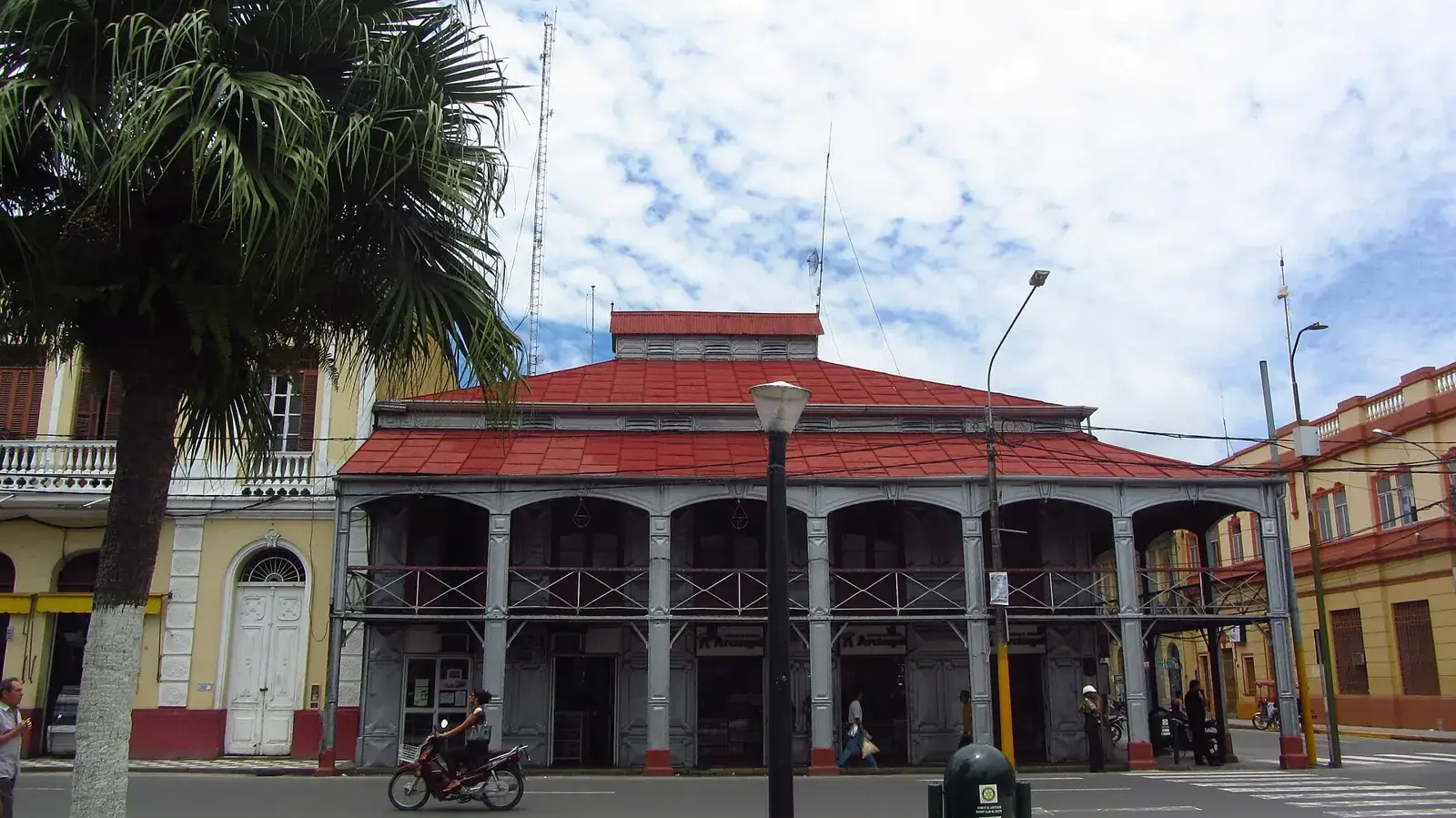
The Plaza de Armas is the main square of Iquitos, and the Casa de Fierro (Iron House) is the prefabricated metal building on its edge, between Próspero and Putumayo streets. Both are in the centre, a short walk or motorbike-taxi ride from most hotels. The house is popularly credited to Gustave Eiffel, but there is no good evidence for that. Give the pair 45 minutes to an hour, ideally in the early morning or around dusk, and use them as an easy introduction to the rubber-boom city.
Map
The square and the house
The Plaza de Armas is the civic heart of Iquitos, the place where the city's churches, municipal offices and older commercial buildings face one another. Like most Peruvian main squares it is laid out as an open, tree-shaded space with benches, and in this humid city people use it mostly in the cooler hours, early in the day and after sunset.
On one side stands the Casa de Fierro, a two-storey building whose walls and structure are made of metal panels and frames, painted and ornamented in a way that looks out of place among the concrete and tile of the neighbouring blocks. It is the best-known single building in the city, and the one most visitors photograph. You do not need a ticket to look at it from the street, and the plaza, the house and the nearby riverfront can be combined into a single easy walk.
Where the Iron House came from
The house is a product of the rubber boom, when fortunes made on the Amazon were spent on imported goods. It was manufactured in Europe as a prefabricated kit, shown at the 1889 Paris Universal Exposition by most accounts, shipped across the Atlantic and up the Amazon, and assembled in Iquitos around 1890. Reports differ on who bought it and what happened to the second half of the original kit, so treat the ownership details you read on site or online with some caution.
Because it was designed to be taken apart and shipped, it is often described as an early prefabricated house in the Americas. Later it served as a mansion, then a restaurant, and over the years it has held shops and other businesses. Its survival through the long decline that followed the rubber collapse is part of its interest, and it is among the buildings that give the city its sense of a grander past.
Tours and activities
Bookable online, chosen for their traveller reviews.
-
From €54 per person
The Eiffel question
Almost every guide, driver and souvenir stall will tell you the house was designed by Gustave Eiffel. The claim is repeated so often that it has become part of the city's identity, but it is the weak part of the story. Reference works describe the evidence for it as scant or absent, and credit the manufacture to a Belgian ironworks using a prefabrication process patented by another designer, not to Eiffel's firm.
None of this makes the building less worth seeing. A fair way to treat it is as an Eiffel-era iron building of European origin, with the attribution a local legend. If a guide tells the Eiffel story, you can enjoy it as folklore. Dates and designers are also given differently by different sources, so avoid repeating any single version as settled fact.
What you see and do
Walk once around the outside of the house and look at the repeated panels, rivets and cast ornament, which reveal that it was assembled from standard parts. The ground floor has been used for souvenir shops, and the upper floor has been used as a restaurant, so you can go in for a drink or a meal and see the metal structure from the inside. Opening hours and what occupies each floor change, so check on the day.
Around the square, look at the cathedral, the municipal building and the older commercial buildings with tiled façades, many of which date from the rubber era. The first block of Putumayo street leads towards the riverside promenade, where the former grand hotel and other tiled buildings are described in the Iquitos guide. For regional dishes at a table with a view of the square, see what to eat in the Amazon.
Best time to go and how long to stay
Iquitos is hot and humid all year, so the best hours are early morning and the hours around sunset, when the air is cooler and the square fills with families, vendors and students. At midday the heat can make even a short walk tiring, and the building is more pleasant to see from inside the restaurant, if it is open.
A first look needs about 45 minutes to an hour: a circuit of the plaza, a closer look at the house, and a coffee or juice. If you add a meal upstairs, a stroll to the river and a look at the other tiled buildings, allow a couple of hours. Rain can arrive suddenly, so keep a light waterproof in your bag, and the restaurant or a café is the easiest place to wait it out.
Getting there and moving around
The plaza is in the centre of Iquitos, and most hotels listed in where to stay in Iquitos are within walking distance or a short ride. Motorbike taxis and three-wheeled mototaxis are the normal local transport; agree the fare before you set off. If you have just landed, the airport transfer is covered in Lima to Iquitos, which also explains why there is no road in.
The area is flat and the pavements are uneven in places, so wheelchair users and people with limited mobility may find parts of the walk awkward; see accessible travel for general advice. Upstairs areas in an older building may not be reachable without stairs, so ask before you plan a meal there.
Safety and what to combine it with
The square is lively and generally busy in the evening, but the usual city precautions apply. Keep your phone and camera out of sight when you are not using them, carry limited cash, and read common scams and staying safe in Peru before you walk at night. Ask your hotel which streets to avoid after dark.
The plaza works well as the first or last stop of a day in the city. Pair it with the riverfront promenade for sunset, and treat jungle excursions as the main event: the tours from Iquitos page shows the formats available, and the Pacaya-Samiria National Reserve is the large protected area reached from here. If you are still choosing between Amazon bases, where to go in the Amazon compares them.
Where to sleep
-
Find hotels
Iquitos centre
Plaza and riverfront for lodges, tours and restaurants
-
Find hotels
Amazon lodges
Jungle stays with meals, guides and excursions, reached by boat
Frequently asked questions
Did Gustave Eiffel design the Casa de Fierro?
It is the popular story, but evidence for it is very thin, and the building is generally attributed to a Belgian ironworks and another designer. Treat the Eiffel name as local legend rather than established fact.
Is there an entry fee for the Iron House?
You can see the outside from the street without paying. Whether any area charges for entry, and which floors are open, can change, so check on the day. A meal or drink upstairs is the simplest way to see the interior.
How long do I need at the Plaza de Armas?
About 45 minutes to an hour covers the square and the house. Add a meal and a walk to the riverside and it becomes a couple of hours, still a light morning or evening plan.
What is the best time of day to visit?
Early morning or around sunset, when it is cooler and the square is at its liveliest. Midday is hot and humid, and rain can arrive at any time of year.
Is the Plaza de Armas safe at night?
It is busy in the evening and most visitors walk through without trouble, but petty theft happens. Keep valuables out of sight, use registered transport after dark and take your hotel's advice. See safety in Peru.
How far is the Iron House from the airport?
The airport is within the city area and the centre is reached by taxi or mototaxi in a short ride. Confirm the fare before leaving, and see Lima to Iquitos for arrival tips.
Can I eat at the Casa de Fierro?
A restaurant has operated on the upper floor in recent years, but businesses in the building change. Check whether it is open before you plan around it, and see Amazon food for dishes to look for in the city.