Qenqo, Puka Pukara and Tambomachay are three small Inca sites on the road north-east of Cusco, beyond Sacsayhuamán. Qenqo is usually described as a carved-rock sanctuary, Puka Pukara as a small fortress or lodging post, and Tambomachay as a ritual site built around water. Together with Sacsayhuamán they make an easy half-day, and they are normally covered by the Cusco tourist ticket.
Allow about 30 to 45 minutes at each of the smaller sites, and dress for cold and strong sun.
Map
Three small sites, one road
Beyond Sacsayhuamán, the road climbs north-east out of Cusco and passes three smaller Inca sites within a few kilometres of each other: Qenqo, Puka Pukara and Tambomachay. None is as monumental as the walls at Sacsayhuamán, and none needs more than a short stop, which is why most visitors treat them as a group rather than separate trips.
Their appeal lies in variety. Qenqo shows how the Incas shaped living rock, Puka Pukara shows a small built structure on a hillside, and Tambomachay shows the careful handling of running water. Together they give a more rounded picture of Inca ideas than any one large ruin, and they sit in open country, so the views over the surrounding hills are part of the experience.
Because they are modest in size, expectations matter. Come for details and atmosphere, not for scale. If you want a first look at the larger complex they accompany, read Sacsayhuamán first.
Qenqo: the carved rock
Qenqo is usually described as a ceremonial site built around a large limestone outcrop, which has been carved with channels, steps, niches and a flat platform. Its name is often linked to the Quechua word for a zigzag or labyrinth, a reference to the winding channels cut into the stone. Many writers connect it to rituals involving offerings, water or ancestors, but what exactly happened here is not certain, and interpretations should be treated as informed guesses.
On site, the visit is quick and tactile. A passage leads through the rock into a small chamber with niches, and above it a flat top has carved forms that some guides read as astronomical or ritual features. A semi-circular enclosure with niches is also visible nearby. Watch your footing, because the rock is uneven and slippery in places.
Allow roughly 30 minutes. A guide adds a lot here because the carving is easy to overlook without someone to point out where to look.
Tours and activities
Bookable online, chosen for their traveller reviews.
-
★ Top rated From €23 per person
-
★ Top rated From €22 per person
-
★ Top rated From €23 per person
-
★ Top rated From €17 per person
Puka Pukara: the red fortress
Puka Pukara means roughly "red fortress" in Quechua, from the reddish tint of its stone in some light. Despite the name, it is not generally considered a major fortress. Many researchers suggest it was a small military or administrative post, or a lodging place for travellers and officials on the road into Cusco, although this is an interpretation rather than a certainty.
What you see is a set of terraces, low walls, stairways and small rooms arranged on a slope. A circular tower-like feature and several enclosures can be explored by walking along the stone paths. The site gives a sense of how the Incas organised roadside infrastructure around their network of roads.
It is an easy stop: allow 20 to 30 minutes, and use the elevated position to look back over the land towards Cusco. The ground is uneven and there is little shade, so the visit is more comfortable in the morning or with a hat.
Tambomachay: the water site
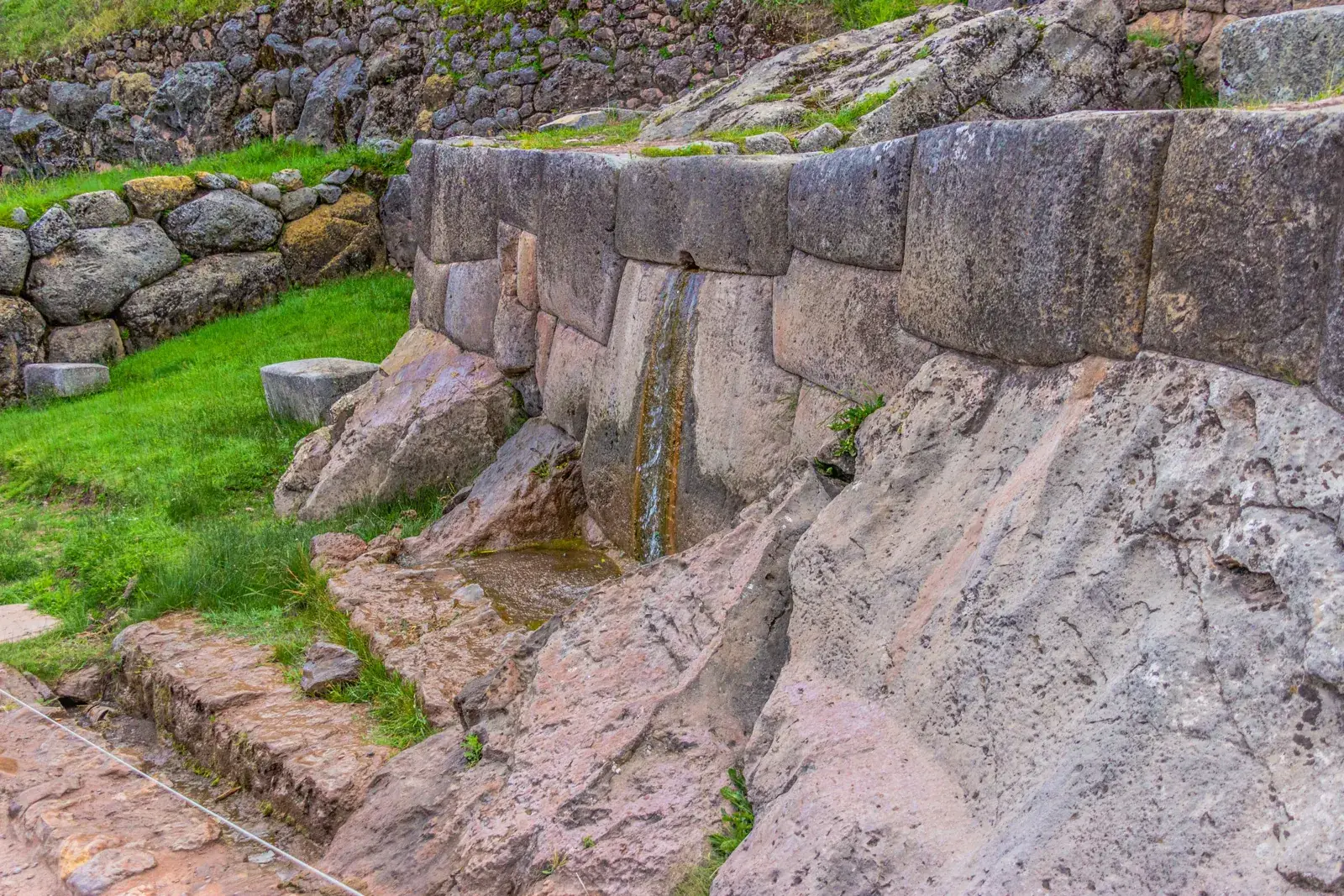
Tambomachay is usually described as a ritual or ceremonial site focused on water, and some call it the "baths of the Inca", a popular nickname that is not firmly documented. A spring emerges from the hillside above a series of finely cut stone terraces, and water runs through channels and small waterfalls. The stonework is neat and tidy, and the flow of water, which continues for much of the year, is the main attraction.
Why the Incas built it is debated. Suggested explanations include a water cult, a place for ritual purification, an elite resting place linked to hunting, or an engineering showpiece. It is best to treat any single explanation with caution.
Visit for the sound of water and the neat masonry. Allow around 30 minutes. The site is the highest of the group, so it is often the coldest and windiest. Do not climb on the walls, and keep to the paths to protect the stone.
A half-day with Sacsayhuamán
The usual pattern is a half-day circuit that begins at the farthest point, Tambomachay, and works back through Puka Pukara and Qenqo to Sacsayhuamán, ending with a walk or ride down to the centre. This direction means the downhill walk finishes the day, which is gentler at altitude. Tour minibuses follow a version of this circuit, and so can a private taxi.
A realistic timetable puts the whole circuit at about three to four hours including transport. If you are short of time or energy, Sacsayhuamán and one smaller site such as Qenqo are enough.
For a second option, visit the smaller sites in the afternoon after a morning in the centre, with the Qorikancha and the Plaza de Armas. Add things to do in Cusco to compare it against other half-days. Keep in mind that you can go on to other sites in the area, such as Moray, on a different day.
Getting there and tickets
The sites lie along a road leading out of Cusco, so they are most simply reached by taxi, by a guided half-day tour or by joining a tour that includes them with Sacsayhuamán. Some people take a taxi to the farthest site and walk or ride back, but the road has traffic and not all stretches have pavements, so a full walk requires care. Public transport options exist but are less convenient, and a bus ride may involve a walk from the road.
The sites are generally included in the Cusco combined ticket, known as the boleto turístico, which covers a range of sites in and around the city and is checked at each entrance. Its details, validity, price and whether a partial version is available change from time to time, so verify the current arrangements before buying. See Cusco tours for what a half-day tour usually includes and what to ask.
Ask a driver to wait or to agree a price in advance, and bring your ticket and a form of ID in case they are requested.
Altitude, weather and practical tips
All three sites are higher than central Cusco, with Tambomachay among the highest. The air is thin and the climate is changeable: cold and windy in the shade, strong sun at midday, and sudden rain in the wet season from roughly November to March. Dry months are generally May to September, with clearer skies and colder nights.
If you have just arrived, take it slowly. Read about altitude sickness and consider leaving this trip until your second or third day. People with heart, lung or blood conditions, or who are pregnant, should ask a doctor first.
Bring layers, a hat, sun cream, water and sturdy shoes. There is little shelter and few facilities, so a snack and a small bag are useful. See the packing list for general advice.
Vendors sell snacks and crafts near the entrances, and food stalls are limited, so lunch is usually better in the centre. Common mistakes include arriving late, when light is poor and groups cluster, and expecting large ruins rather than small ones.
Where to sleep
-
Find hotels
Plaza de Armas and historic centre
Everything on foot, at the price of noise and crowds
-
Find hotels
San Blas
Artisans' quarter with steep lanes and views, a short walk uphill
-
Find hotels
All of Cusco
Compare every area and price level in one search
Frequently asked questions
How long does it take to visit Qenqo, Puka Pukara and Tambomachay?
Most visitors need 20 to 45 minutes at each site, so the three together take about two hours without transport. With Sacsayhuamán added, plan on three to four hours for the half-day.
Are Qenqo, Puka Pukara and Tambomachay included in the Cusco tourist ticket?
They are normally covered by the combined ticket, the boleto turístico, but the exact options, sites and validity change. Check the current arrangements at the official ticket office before buying.
Can I walk from Sacsayhuamán to Tambomachay?
It is possible in principle, since the sites lie along the same road, but it is a long uphill walk at altitude and the road carries traffic. Most visitors take a taxi or tour to the farthest site and walk back down.
What does Puka Pukara mean?
The name is generally translated from Quechua as 'red fortress'. It is not clear that it was a true fortress, and many researchers suggest a small post for travellers or officials.
Which of the three sites is the best if I have little time?
Qenqo and Tambomachay are usually considered the most distinctive, one for its carved rock and the other for its running water. Puka Pukara is the simplest and can be skipped if time is short.
Is it worth going with a guide?
A guide helps most at Qenqo, where the carving is easy to miss, and at Tambomachay, where interpretations differ. If you go independently, read a short account first and look for signs on site. See Cusco tours for options.
Is it cold at these sites?
Often yes, particularly in the shade, in the wind and early or late in the day. At the same time the sun at altitude is strong. Carry layers, a hat and sun protection whatever the season.