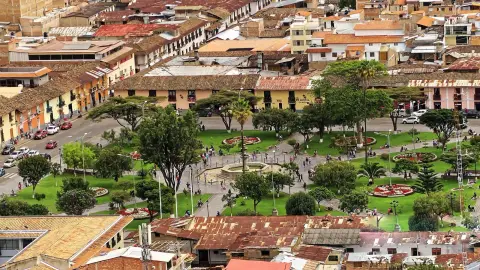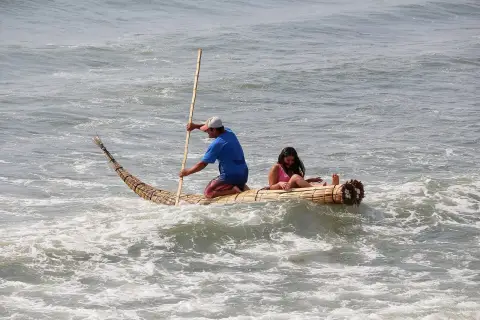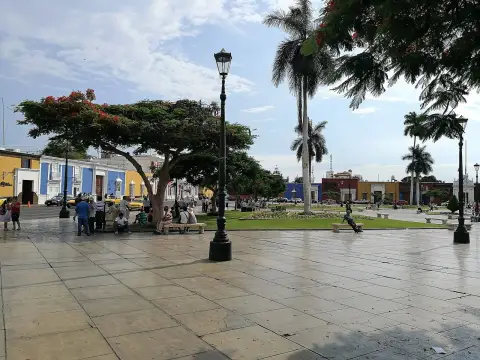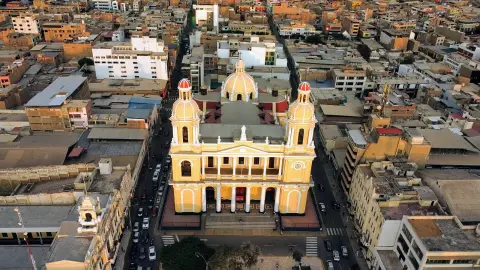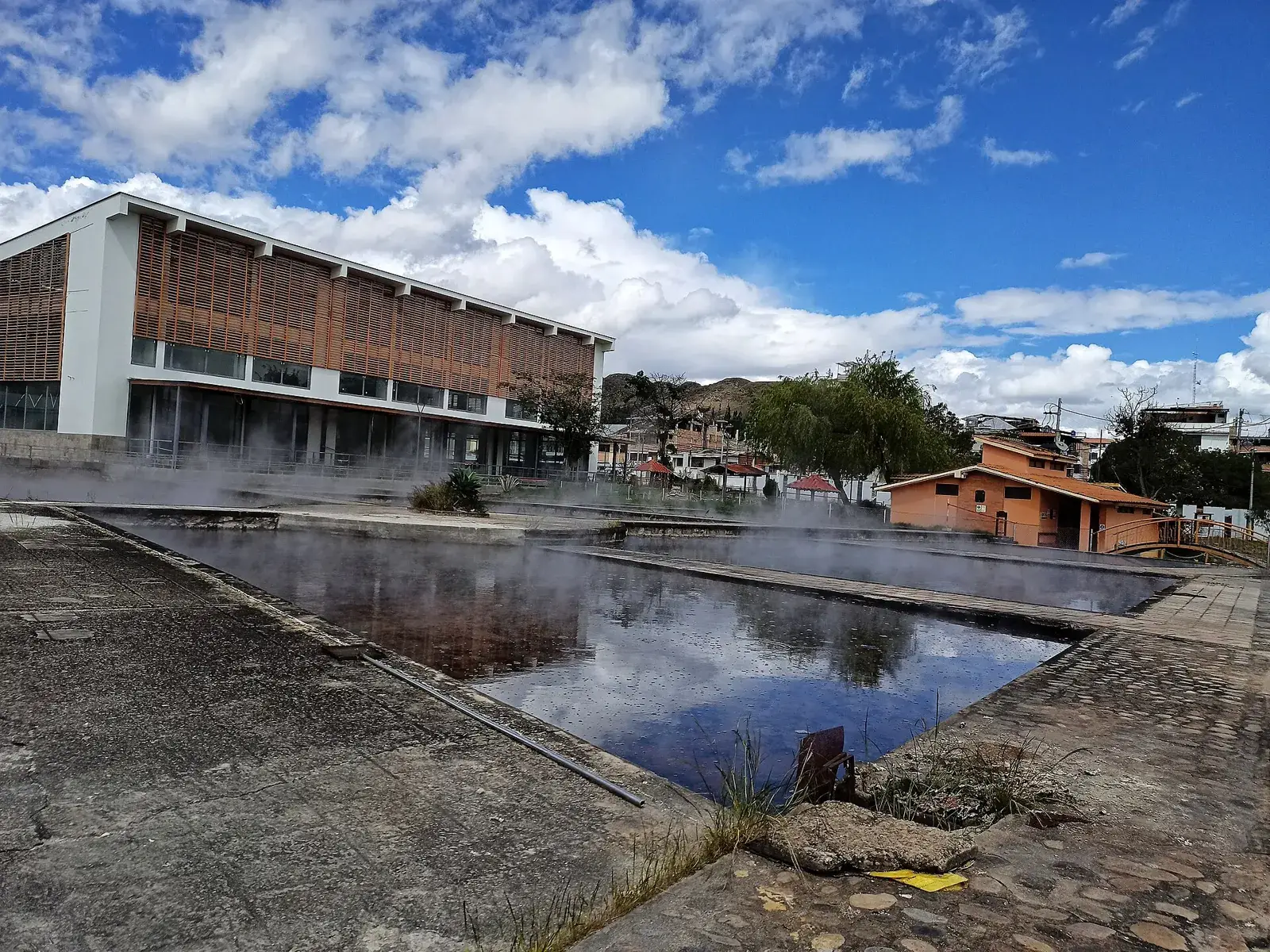
The Baños del Inca are a thermal spa complex in a suburb about 6 km from Cajamarca, at roughly 2,680 m. Water emerges at over 70 °C and is cooled for bathing in private pools, family rooms and a larger pool. Tradition says the last free Inca, Atahualpa, was bathing here in 1532. Allow one to two hours, plus about 15 minutes each way by taxi or local transport. Prices and hours change, so check on arrival.
Map
What the Baños del Inca are
The Baños del Inca are hot springs on the edge of the town of the same name, a district that has grown into a suburb of Cajamarca. The springs are the reason the place exists. Water rises from volcanic rock at more than 70 °C, and the complex channels it, cooled, into the pools where visitors bathe.
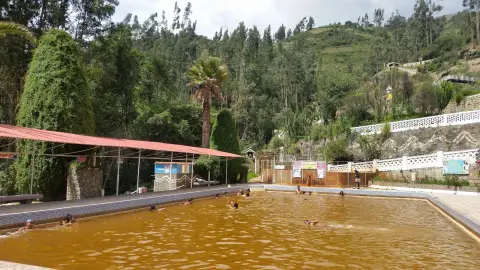
Unlike many thermal spots in the Andes, this one is not a quiet retreat in the countryside. It sits among streets, shops and houses, and the pools are laid out inside a walled tourist complex with gardens, a restaurant area and accommodation. Steam hangs over the open channels on a cool morning, and that is the image most people remember.
Treat it as a combination of two things: a working spa, where locals and visitors come simply to soak, and a historical curiosity, where the story of the Inca and the Spanish is told in a few pieces of surviving stonework. Neither is large, so the visit is short and easy to combine with the rest of a day in town.
Atahualpa and the springs
Before the Spanish arrived, the settlement was known as Pultumarka, and the springs were used by the Inca as a resort. The tradition that matters most to visitors is that Atahualpa was resting here in 1532, while Francisco Pizarro and his small force were nearby in Cajamarca. The Inca accepted an invitation to meet the Spanish in the town, and the ambush that followed is the event that opened the conquest of the empire.
A Spanish account from the sixteenth century, often quoted, describes a great stone tank fed by two pipes, one hot and one cold, which were mixed to suit the bather, and says that no one else dared enter the water on pain of death. Later writers, such as the nineteenth-century historian William Prescott, mention the columns of vapour seen rising from the valley.
These are chronicles and traditions, not archaeological proof of any particular day. Take the story as the background to the visit rather than as something the pools themselves demonstrate.
The Pozo del Inca
The best-known feature inside the complex is the Pozo del Inca, the Inca's Pool, which is presented as the bath used by Atahualpa. It is a square stone-lined basin of about 4 m by 4 m and 1.7 m deep, according to the usual descriptions, and it was remodelled in 1947, so what you see is a mixture of old and restored work.
It is not a pool you can enter. It is there to be looked at, with the hot water feeding it and the steam rising from the channels around it. The experience is more modest than the legend suggests, and visitors who expect a ruin like those near Cusco will find something much smaller, but it gives a physical anchor to the story.
It is also worth walking the stone channels and the garden paths, where different springs feed separate basins. Signs, where present, give the names of the older pools. Allow a short while here before heading to the bathing areas, since this is the part with historical interest.
Bathing: pools, family rooms and the big pool
The complex is organised in several sections, and descriptions mention individual pools, family rooms with a shared pool, a section of more formal pools and a larger outdoor pool. Peruvian tourism sources give counts of several dozen individual pools, but the layout changes, so check what is on offer on the day.
The simplest choice for a visitor is a private pool, rented by the hour, where you control the mix of hot and cold water. Staff usually fill it before you enter. This is the quieter and more comfortable option, particularly for couples or for a family. The larger pool is cheaper and more social, and it is busiest at weekends, on public holidays and during the February carnival.
Bring a swimsuit, a towel and sandals, and keep valuables in your bag rather than by the pool. Ask at the ticket desk what is included, whether towels are rented and how long the time slot lasts. Sulphur is present in the water, so expect a mineral smell and, in some pools, a slightly orange or grey tint.
How long to soak and basic health sense
Hot water at altitude is more tiring than it looks. The complex is at roughly 2,680 m, which is lower than the surrounding countryside but still enough for the heat and the thinner air to affect some people. A sensible soak lasts 20 to 30 minutes, followed by a rest and water, and you can repeat it once if you feel well.
Avoid soaking if you have drunk alcohol, and take care if you have heart or blood pressure problems, are pregnant, or are travelling with small children. The pools may be hotter than they feel. Get out if you feel dizzy, and stand up slowly.
Local sources describe the water as good for muscles, joints or skin, and some visitors report feeling better afterwards. Treat that as testimony rather than medical advice. If you have a medical condition, ask a doctor before you go. General guidance on adjusting to elevation is in altitude sickness.
Getting there from Cajamarca
The baths are about 6 km from the centre of Cajamarca, a drive of roughly 15 minutes. A taxi from the plaza is the simplest way to go, and it is usually inexpensive; agree the fare before you set off. Local minibuses and shared vehicles also run along the road between the town and the baths, and they are the budget choice if you are comfortable asking the driver to tell you where to get off.
For the return, you can find a taxi near the entrance, though at busy times it may take a few minutes. If you are on a tour of the area, the baths are often combined with the Ventanillas de Otuzco, the burial niches mentioned in the Cajamarca guide, and with the stone channels of Cumbemayo.
Cajamarca itself is reached from the coast by long mountain road journeys or by air. See buses in Peru and flights for the general picture, and the northern itinerary for how the town fits a longer route.
When to go and how to plan the day
Season matters less than weather and crowds. The dry season, roughly May to September, gives clear skies, cool nights and steamy mornings, which is a good time for a soak. In the wetter months, roughly December to March, showers are frequent, but a hot pool in the rain is not a bad experience.
Morning is quieter, and the steam is most dramatic when the air is cool. Late afternoon is a pleasant time to end a sightseeing day. Weekends and local holidays draw many Peruvian families, and the large pool is then crowded. If you want a private pool at a busy time, arrive early.
A sensible plan is to spend the morning on the colonial centre and the Ransom Room, have lunch in town, and go to the baths in the late afternoon. The evening is cool, so bring a jacket and a dry layer for the ride back. The packing list covers what to take for the highlands.
What to combine it with, and what to expect
The Baños del Inca work best as a half-day or evening stop in a stay of two nights in Cajamarca. They sit comfortably alongside the town's colonial centre, the Cumbemayo stone channel and a taste of the local dairy cooking, described under eating in the north. Visitors travelling on to the cloud forest can continue to Chachapoyas and Kuélap.
Expect a developed, busy and somewhat commercial site rather than a wilderness hot spring. There are food stalls, souvenir sellers and, at times, queues. The upside is convenience: you can go in a taxi, bathe in clean pools and be back in town the same afternoon.
If hot springs are a theme of your trip, compare it with the Monterrey hot springs near Huaraz, which are quieter and set in a valley with mountain views. For the coast, see Trujillo and Chiclayo, the usual starting points for the road to Cajamarca.
Where to sleep
-
Find hotels
Cajamarca
Colonial highland town with thermal baths nearby
Frequently asked questions
How far are the Baños del Inca from Cajamarca?
About 6 km, or roughly 15 minutes by taxi. Local transport also runs along the same road, and a taxi is easy to find in the town.
Is the water really hot?
Yes. It is reported to emerge at over 70 °C, which is far too hot to bathe in, so it is cooled before it reaches the pools. Even so, test the temperature before you get in and leave if it feels too hot.
Did Atahualpa really bathe here?
Tradition and Spanish chronicles say so, and he is said to have been at the springs in 1532 before the meeting with Pizarro. The evidence is from written accounts rather than archaeology, so treat the details as tradition.
Can I swim in the Pozo del Inca?
No. It is the historic pool and it is shown to visitors rather than used for bathing. You bathe in the private pools, the family rooms or the large pool, depending on what is open.
How long should I stay?
A soak of 20 to 30 minutes is a sensible limit, and a whole visit, including a look at the historic pool, takes one to two hours. Add the taxi ride each way.
Is it worth going if I do not want to bathe?
It is a short visit, but the historic pool and the steaming channels make it worth a quick look if you are interested in the Inca story. Without bathing, a short stop is enough. Ask at your hotel what else fits into the same day.
Is it good for children and older visitors?
Many families go, and the pools are shallow in places, but the heat can be tiring. Keep soaks short, give children water and supervision, and check with a doctor first if you have a heart or blood pressure condition.