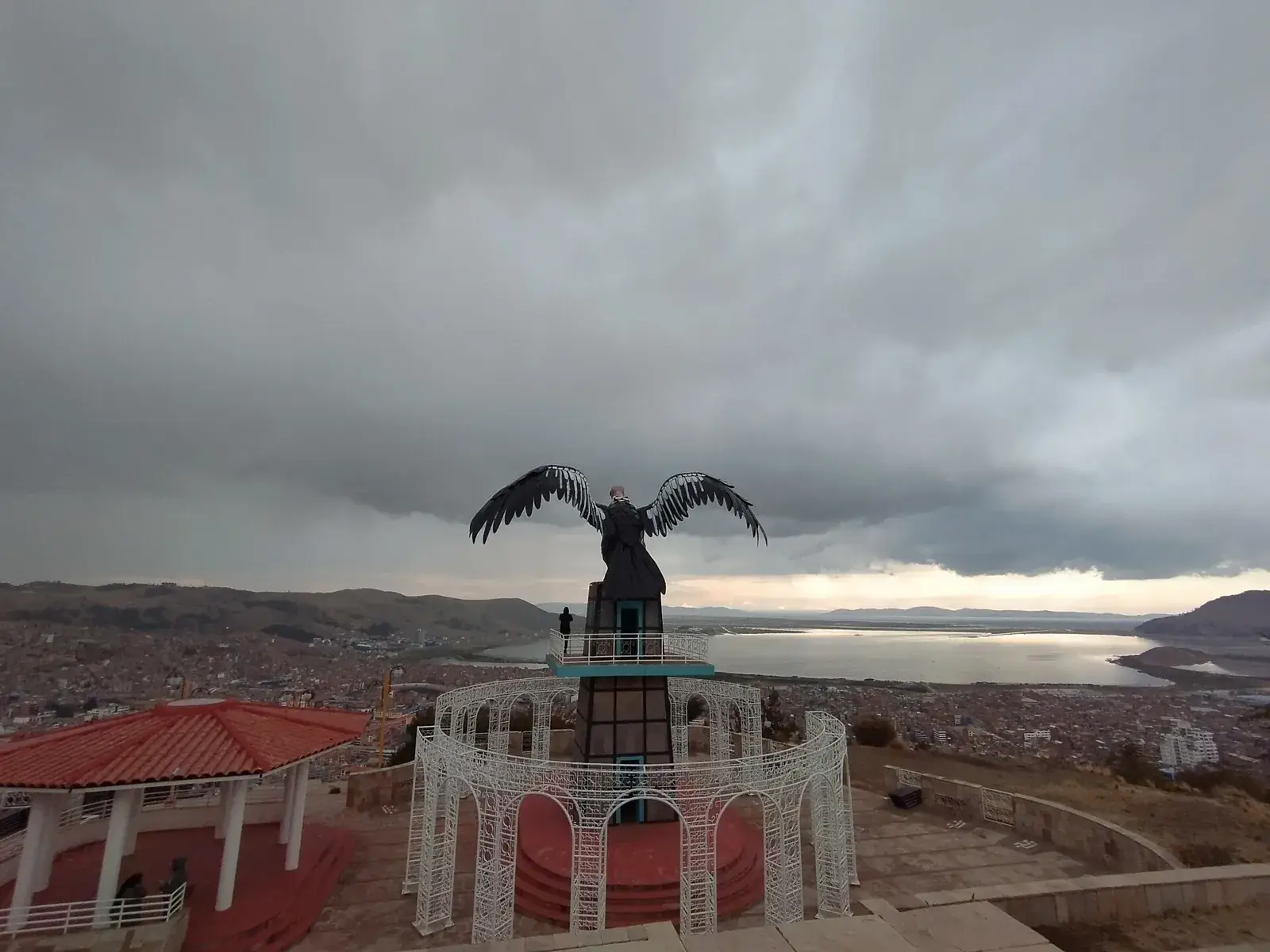
The Kuntur Wasi viewpoint, "House of the Condor", is a lookout on a hill just southwest of central Puno, about 2 km from the main plaza. It is crowned by a large metal condor with open wings and gives a panorama over the rooftops and the bay of Lake Titicaca. Go up by taxi or on foot (reported as about 620 steps), allow one to two hours, choose late afternoon for the light, and dress warmly: at close to 4,000 m the wind is cold even on a sunny day.
Map
What the viewpoint is
The Mirador Kuntur Wasi is the best-known lookout in Puno. In Quechua, *kuntur* is the condor and *wasi* is house, and the name fits: the hilltop is dominated by a metal condor with spread wings, set on a concrete base and visible from many streets below. Local sources report that it was inaugurated in 2003. Its size is quoted as about 11 m, but some sources give that as the height and others as the wingspan, so treat the figure as an order of magnitude rather than a measurement.
The condor matters here because it is the great bird of the Andes and, for many Andean communities, a symbol of the upper world and of the mountains. A city that lives by a lake at nearly 3,800 m has chosen it as its own emblem on the skyline, and for the visitor the statue gives the climb a destination and a photograph.
The viewpoint is a short, simple visit rather than a major sight. Its value is orientation: after a day on the water or a long bus from Cusco, it lets you see the town, the port and the shape of the lake in one look. The wider list of what to do in town is on the things to do in Puno page.
What you see from the top
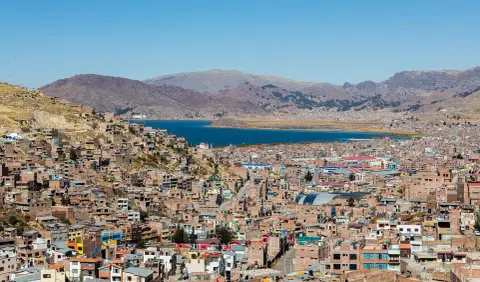
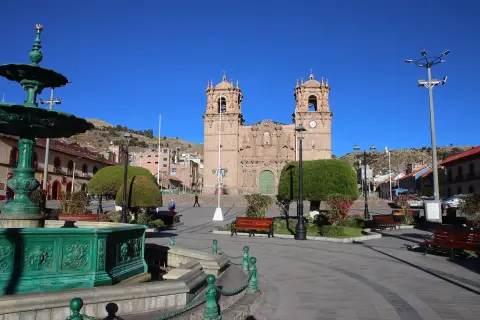
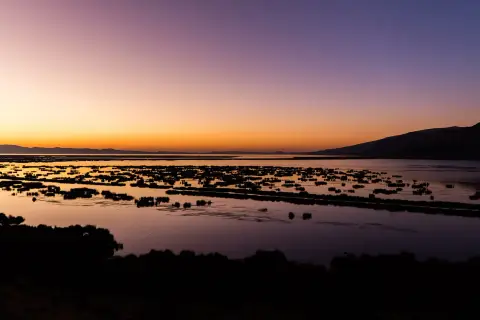
Below you lie the grid of Puno, the cathedral and plaza, the red brick and corrugated roofs of the hillsides and, beyond them, the bay of Puno and the open water of Lake Titicaca. On a clear day the reed beds near the shore and the lines of boats leaving the port are easy to pick out. Some guides name the islands and the far mountains of the lake as visible in good conditions, but distances are large and haze is common, so do not count on identifying the Uros floating islands from this height.
Look also at the town itself. Puno climbs the surrounding slopes in unplanned layers, with the colonial centre near the shore and newer neighbourhoods higher up, and the lookout makes that pattern obvious. Around the statue there is room to walk and to sit, and the structure frames the view well for photographs, especially with the lake behind the wings.
If the view is your main aim, bring binoculars or a zoom lens, and keep in mind that the lake can be bright and flat at midday and far more interesting when the sun is low.
Tours and activities
Bookable online, chosen for their traveller reviews.
-
★ Top rated From €23 per person
-
★ Top rated From €23 per person
-
Day trip From €41 per person
-
From €8 per person
Getting up: steps or taxi
The lookout is about 2 km from the plaza, on a hill southwest of the centre. There are two ways up. The first is a stairway of roughly 620 steps, a figure repeated by several local sources, which starts in the streets of the neighbourhood and climbs steadily to the statue. The second is a taxi or mototaxi, which takes about ten to fifteen minutes from the centre and drops you close to the top, so the last stretch is short.
Ask the driver to wait or to return at an agreed time, since taxis are not always available at the top, and agree the fare before you start. Where the road meets the stairway, and which way you get up, can change with works, so ask at your hotel in Puno for the current best route.
The stairs are a good plan for a fit and acclimatised traveller who wants the walk, and a poor one on arrival day. A common pattern is to take a taxi up and to walk down in daylight, which spares your lungs and your knees.
Altitude, cold and effort
Reported heights for the hill range from about 3,900 to nearly 4,000 m, which is a little above the town itself. That is a real consideration: the climb is short, but the air is thin, and a flight of 620 steps at this altitude is hard work for anyone who has not spent a couple of days at height. Go slowly, stop often, and drink water. If you feel dizzy, headachy or short of breath, read altitude sickness and rest rather than pushing on.
The weather is the other test. Wind on the exposed hilltop is frequent, the sun is strong during the day, and the temperature drops quickly after sunset, especially in the dry months from May to September when nights are close to freezing. Bring a windproof jacket, a hat, gloves and sun protection, as described in the packing list. Anyone with heart, lung or blood conditions, or who is pregnant, should ask a doctor before climbing at this height.
The viewpoint is not a long hike, but it is not for people with limited mobility who would use the stairs. A taxi to the top removes most of the effort.
Best time and time of day
Late afternoon is the usual recommendation: the low sun warms the town and the lake, and the shadows give the view relief. Sunset is the busiest moment, so arrive 30 to 45 minutes earlier to find a good spot and to have time to come down before the cold deepens. Some visitors also go after dark to see the lights of Puno, which is attractive, but see the safety note below.
Morning is quieter and often clear, with the lake colours strongest when the air is still. Midday light is flat. The dry season, roughly May to September, brings the clearest air and the coldest nights, while the wetter months bring cloud and afternoon showers that can hide the view, so pick a day with a clear sky rather than a fixed date. Around the Virgen de la Candelaria festival in February, described in festivals and holidays, the town is full and the hill may be busy.
Half an hour at the top is enough for most people, and one to two hours covers the climb, the view and the descent.
Other lookouts and what to combine
Puno has other viewpoints. Huajsapata, with a statue of Manco Cápac, is reachable on foot from the plaza and is much closer to the centre. Puma Uta, "House of the Puma", is in the Alto Puno area in the north of the city and is described as easier to reach than Kuntur Wasi. Together with the condor they form a trio of animal lookouts, and visiting one is normally enough unless you have time to spare.
Kuntur Wasi pairs well with a short walk in the centre, a meal of lake trout and an evening of music. On a longer stay it fits between the big excursions: the boat trip to the Uros and Taquile islands, covered on the Uros page, and the half-day to the burial towers at Sillustani. A good order is the viewpoint on your first afternoon, as a gentle introduction, once you have rested.
To decide where to sleep so the climb is easy, see where to stay in Puno. If you are comparing Puno with other bases, Puno or Arequipa sets out the differences, and Cusco to Puno explains how most visitors arrive.
Where to sleep
-
Find hotels
Puno centre
Walkable to the main square and the lake port
Frequently asked questions
What does Kuntur Wasi mean?
It is Quechua for House of the Condor. The name refers to the large metal condor with open wings that stands on the hilltop above Puno.
How many steps are there to the Kuntur Wasi viewpoint?
Several local sources give about 620 steps from the foot of the hill, but the exact count and starting point can vary. At nearly 4,000 m, go slowly or take a taxi to the top.
How far is the viewpoint from the plaza in Puno?
About 2 km southwest of the Plaza de Armas. A taxi takes roughly ten to fifteen minutes, and you can also walk and climb the stairs.
Is there an entrance fee or opening time?
It is a public lookout and no entry fee or fixed hours are reported, but check locally before you go, especially if you plan to visit after dark.
When is the best time to visit Kuntur Wasi?
Late afternoon for the light on the lake and town, or a clear morning for calm air. Arrive early for sunset and bring warm clothes, since it gets cold quickly.
Can I see the Uros islands from the viewpoint?
You see the bay and the open lake, but the islands are far away and haze is common, so do not rely on it. The Uros page explains how to visit them by boat.
Is it safe to go up at night?
Daytime and sunset visits are the usual choice. If you go after dark, use a taxi both ways and avoid walking the stairs alone; see safety in Peru.