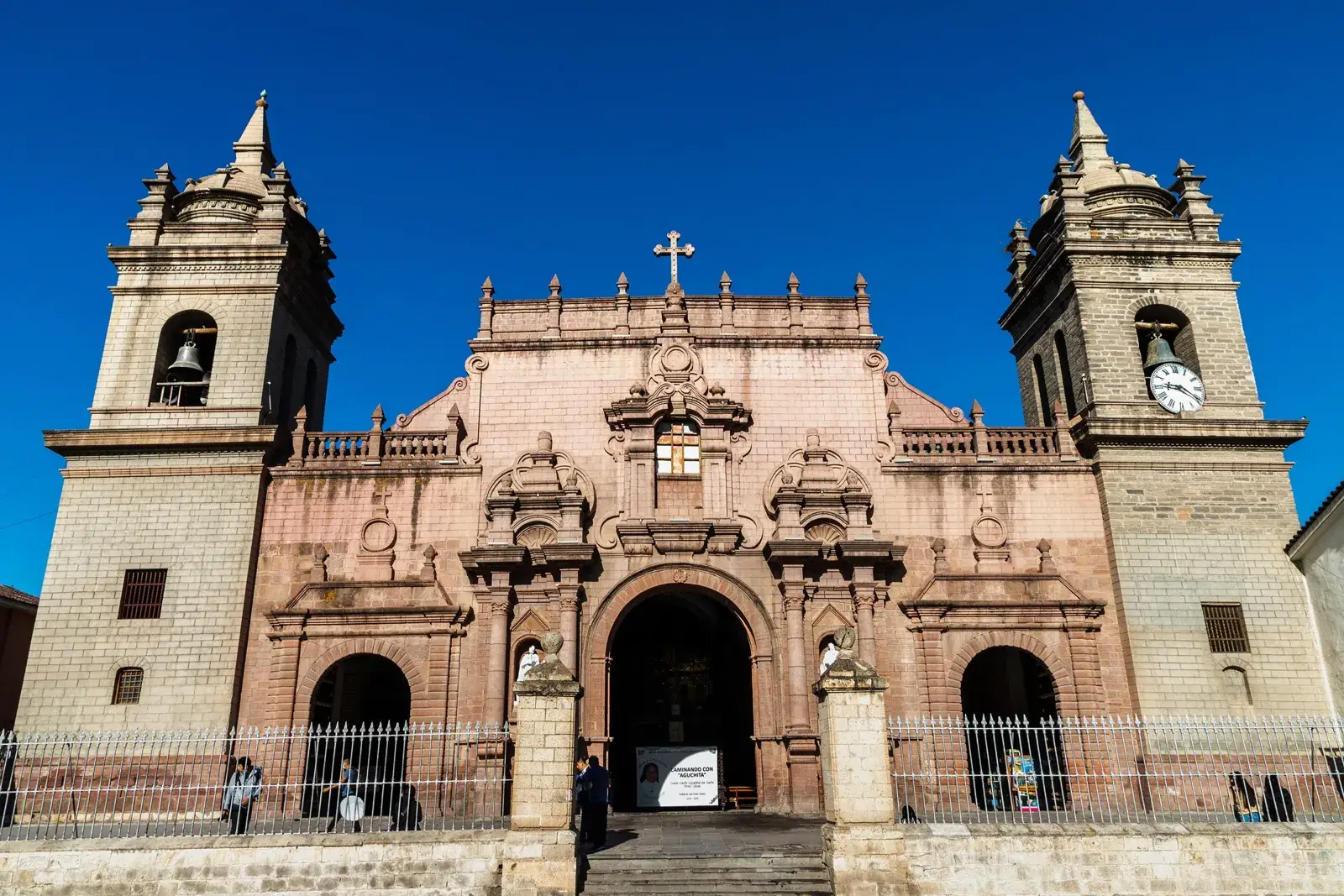
Ayacucho Cathedral stands on the east side of the main square and is the natural start of any walk through the city's colonial churches. Allow about 30 to 45 minutes for the cathedral and half a day if you add the other churches within a few blocks. Opening times change, many churches close at midday, and some open only for services, so plan around that and dress modestly.
Map
The cathedral on the main square
The Cathedral Basilica of Santa María closes the east side of the main square of Ayacucho, above the arcade of the municipal building. It is a baroque church of the seventeenth century, and its warm, pinkish stone front is flanked by two bell towers, one of them carrying a clock. Three doors open onto the square, which is unusual among the churches of the city, and the entrance is flanked by statues of Saint Peter and Saint Paul.
The site was not empty before. A parish church dedicated to San Juan Bautista is recorded on the same ground from the early years of the city, and the cathedral replaced it during the seventeenth century. It is the seat of the archdiocese, so it is first of all a working church, with masses and processions that take priority over visitors.
Because it faces the square, it is easy to see from the outside at any hour. The light is kindest in the morning, when the front is lit, and at dusk, when the square fills with families and students.
Building the cathedral
The order to build a cathedral in the city dates to a royal decree of 1612, and building ran from 1632 to 1672, roughly forty years, under the second bishop of Huamanga, Francisco Verdugo. The name Huamanga is the city's older name and is still used for the province and in some church titles.
The long timeline is typical of colonial cathedrals in the Andes, which depended on local labour, local quarried stone and funds that arrived unevenly. The result is a building with a clear baroque plan but plain proportions, rather than the lavish stone carving of Cusco or Arequipa. If you have already seen the cathedrals of Cusco or Arequipa, expect a quieter building with a very rich interior instead of a showy front.
The cathedral was declared part of Peru's national cultural heritage in 1972. As with any building of this age, parts may be under restoration, so scaffolding or closed chapels are possible on the day.
What to see inside
The interior has three naves, a dome on an octagonal base and a series of gilded altarpieces, about ten of them, dedicated to saints and to different images of Christ and the Virgin. The three-tiered main altar holds the Virgen de las Nieves, the Virgin of the Snows, to whom the cathedral is dedicated.
Look for the altarpiece of the Señor de la Resurrección, the Risen Christ. It matters for the calendar because the image closes the Holy Week observances, when it is carried out in the Easter procession. Around the base of the dome are images of the four evangelists, each with their traditional symbol, which are easy to miss unless you look up.
Take a few minutes to stand still. Gilding, dark wood and candlelight make the church feel very different from the bright square outside. A small tower detail that guides like to point out is a pair of tiny figures hidden in the bell chamber of the left tower, though access to the towers is not normally part of a visit.
The city of 33 churches
Ayacucho is known as the city of 33 churches, a number usually explained as one for each year of the life of Christ. Counts vary, but more than thirty colonial churches are recorded, and most of them sit within a short walk of the main square. Many date to the first decades after the city was founded in 1540, when the religious orders arrived: the Mercedarians in 1541, the Dominicans in 1548, the Franciscans in 1552 and the Jesuits later in the sixteenth century.
That history explains why so many churches belong to convents. Santo Domingo, San Francisco de Asís and the Jesuit church of La Compañía are among those most often mentioned, and each started as part of a convent or religious house, so look at the surrounding buildings as well as the church itself.
Do not try to see them all. Choose four or five and let the streets between them, with their colonial courtyards and stone doorways, be part of the visit.
A walking circuit
A sensible circuit starts at the cathedral, then fans out within a few blocks. Walk from the square to Santo Domingo, continue to San Francisco de Asís and La Compañía, and finish at a smaller church such as Santa Teresa or the quarter of Santa Ana, which is the historic parish quarter beside the original town square. The distances are short and the streets are mostly flat, so the effort is low, but the ground is cobbled in places.
Plan half a day, ideally starting after breakfast, because some churches close in the middle of the day and reopen in the afternoon. The visit works best in the morning for light and in the late afternoon for the open doors of evening services.
If you have a second day, add a taxi to the ruins of Wari or the battlefield plain of Quinua, which are covered in the Ayacucho guide. Most visitors want to keep the churches as a slow, short outing rather than the whole day.
Holy Week and the churches
The churches are at their most intense during Holy Week, when the city's celebration, usually described as lasting about ten days, fills the streets with processions, carpets of flowers and coloured sawdust, and crowds. It is one of the most celebrated Easter observances in Latin America, and the cathedral and the other churches are the starting and ending points of the main processions.
If you come for Holy Week, you will see the churches as living places rather than monuments, but you will also find crowds, closed streets and full hotels. Book accommodation and transport far ahead, and use festivals and holidays to see how the calendar works, since the dates move with Easter.
Outside Holy Week the churches are calm. Visits are quieter, you can look at the altarpieces without the crowds, and you can often hear music practice or a small mass. Most visitors who want to see the interior without people choose a weekday morning.
Etiquette, opening hours and photography
These are working churches, so follow the usual rules. Dress modestly, with shoulders and knees covered, take off hats, speak quietly, and do not walk through during a service. The local etiquette is described in Peruvian etiquette. Ask before you photograph people, and look for signs about flash or filming, since some churches restrict them.
Opening hours are the weak point. Many churches open for a few hours in the morning and late afternoon, close at midday and may open only for mass on some days. Some charge a small fee or ask for a donation, and the rules change. Ask at your hotel or at the tourist information desk for the current times rather than trusting an old listing.
Carry a little cash in small notes for entry or donations. Keep your bag in front of you in crowded processions, and see safety in Peru for general advice.
Getting there and fitting it in
The cathedral and the churches are in the historic centre, so there is nothing to arrange beyond reaching Ayacucho. Most visitors fly in from Lima, as described in flying in Peru, and walk everywhere once they are in the centre.
The city lies at about 2,750 m, lower than Cusco, but you may still feel the altitude on the first day, especially on the steps and slopes between churches. Go slowly and drink water, and read altitude sickness if you are arriving from sea level. Evenings are cool, so bring a warm layer.
The dry season, roughly May to September, is the easiest time for walking, with clear skies and cold mornings. In the rainy months, roughly December to March, showers are common in the afternoon, and cobbles can be slippery.
Churches combine well with a visit to a workshop for the local altarpiece craft, and with the souvenir advice in souvenirs.
Frequently asked questions
How long does it take to see the cathedral?
About 30 to 45 minutes is enough to see the interior and the main altarpieces. If you add the other churches, allow half a day.
Is there an entrance fee for Ayacucho Cathedral?
This can change, and some churches ask for a small fee or a donation. Ask at your hotel or the tourist information office for the current rule, and carry small notes.
Why is Ayacucho called the city of 33 churches?
The number is usually explained as one church for each year of the life of Christ. Counts differ, but more than thirty colonial churches are recorded, mostly within walking distance of the main square.
Which churches in Ayacucho are worth seeing besides the cathedral?
Santo Domingo, San Francisco de Asís and La Compañía are the ones most often recommended, and they are close to each other. A smaller church such as Santa Teresa adds variety.
Can I visit the churches during Holy Week?
Yes, but the churches are then centres of processions, so visits can be crowded and times shift. Book far ahead and read festivals and holidays before choosing your dates.
What should I wear to visit the churches?
Cover shoulders and knees and take off hats. The churches are active places of worship, and visitors in beachwear may be asked to leave.
Can I take photos inside?
Often yes, without flash, but some churches ban photography or filming, and it is never appropriate during a service. Look for signs and ask the staff.