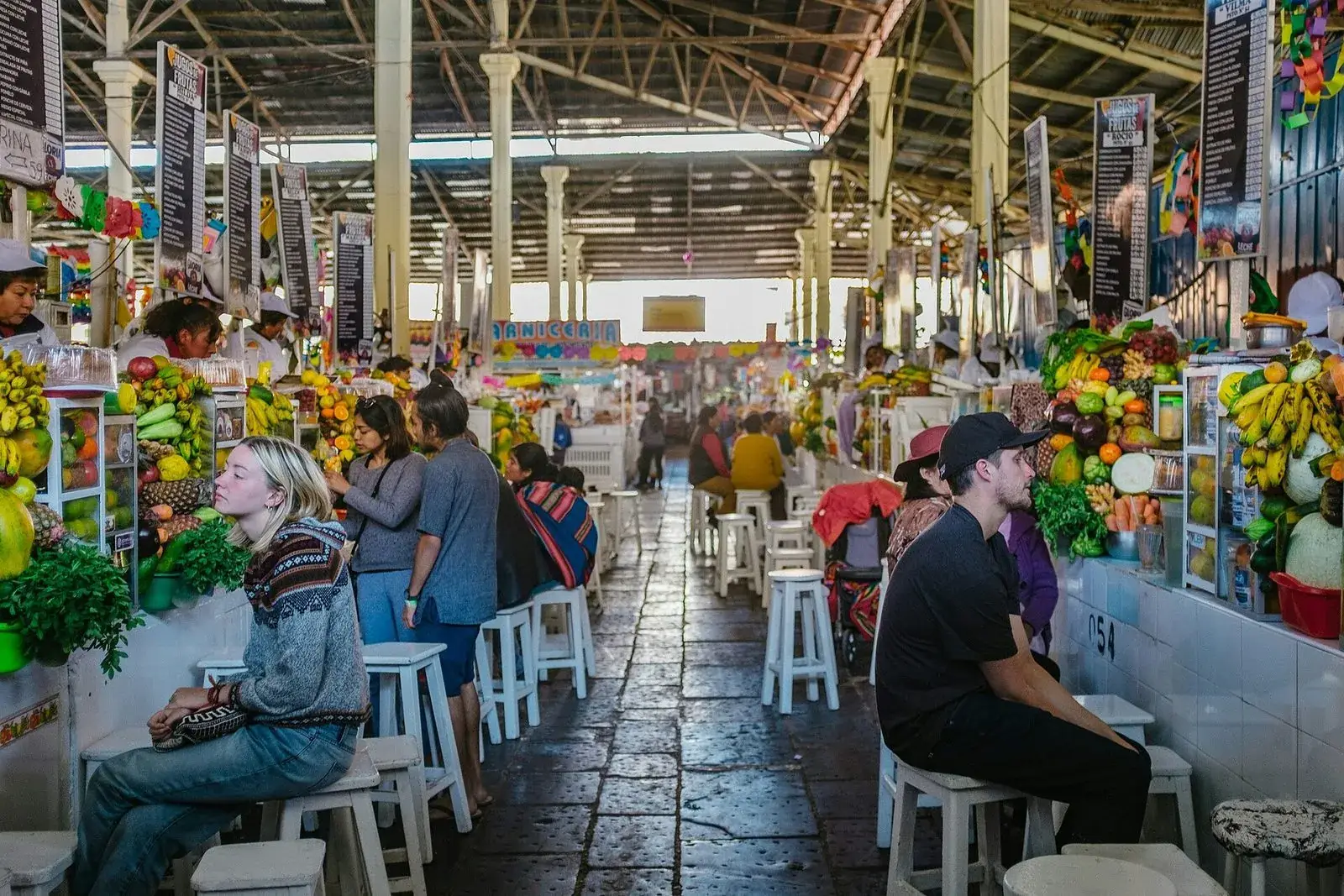
Daily cost in Peru depends more on where you sleep and how you eat than on any other variable. Lima and Cusco usually cost the most for lodging and sit-down meals, mid-sized cities like Arequipa are often better value, and Amazon lodges are sold as packages that include meals and excursions.
Four ways to split a day's spending
It helps to split a day into lodging, food, local transport and things you pay to enter. Each behaves differently. Lodging varies the most and is the line that tends to differ by an order of magnitude between a hostel and a luxury hotel. Food has a wide range within the same street, because a market stall, a set-lunch restaurant and a tasting-menu restaurant are all neighbours in the cities with a strong food scene. Local transport is small unless you use private cars or taxis constantly. Entry fees are lumpy: a day with a major site costs far more than a day wandering.
Because the lines move independently, two travellers in the same city can spend very different amounts, which is why a single "average per day" figure is of limited use.
How the main cities differ
Lima is the most expensive place for restaurants, especially in the districts popular with visitors, but it also has some of the most affordable lunches in the country if you eat where residents do. Cusco is priced for tourists in the historic centre, where lodging and restaurants cost more than a few streets away, and tickets for the surrounding sites add up. Arequipa is generally easier on a budget while still offering good food and attractions.
Puno and Lake Titicaca depend on the tours you choose, and the northern coast has beach towns with large seasonal swings. In the Amazon, the cost is mostly the package: lodge, guide, transfers and meals are bundled, and the difference between operators lies in what is included, not just the headline price.
What a day costs: worked examples
These are rounded estimates in soles (S/) that change with season and exchange rate. Euro and dollar amounts are indicative, at roughly S/ 4.2 per euro and S/ 3.7 per dollar. Each day has a bed, a set lunch, a casual dinner, local transport, one ticket or tour-type item, and coffee or snacks.
Lima, lean day: dorm bed or simple room S/ 40-80, menú S/ 10-18, dinner S/ 20-35, metro bus or colectivo S/ 8-20, a museum ticket S/ 15-30, snacks S/ 8-15; about S/ 100-200 (about €25-50 / $25-55). Comfortable day: mid-range hotel S/ 200-350, lunch S/ 40-70, dinner S/ 80-140, taxis S/ 30-60, a guided visit S/ 50-100, coffee S/ 20-35; about S/ 420-750 (about €100-180 / $115-205).
Cusco, lean day: bed S/ 35-70, menú S/ 10-18, dinner S/ 18-30, colectivo or short taxi S/ 5-15, one site ticket S/ 30-70, snacks S/ 8-15; about S/ 105-220 (about €25-50 / $30-60). Comfortable day: room S/ 180-330, lunch S/ 35-60, dinner S/ 70-120, taxis S/ 20-50, a half-day tour S/ 80-160, coffee S/ 18-30; about S/ 400-750 (about €95-180 / $110-205).
Arequipa, lean day: bed S/ 30-60, menú S/ 8-15, dinner S/ 15-28, transport S/ 5-12, a ticket S/ 20-40, snacks S/ 6-12; about S/ 85-165 (about €20-40 / $25-45). Comfortable day: room S/ 150-280, lunch S/ 30-50, dinner S/ 55-100, taxis S/ 15-40, a tour S/ 50-110, coffee S/ 15-25; about S/ 315-605 (about €75-145 / $85-165).
Lodging: where the biggest differences are
Lodging deserves the most attention because it is the biggest line and the one you control most. In Lima, the same room costs differently depending on the district, and the districts popular with visitors, such as Miraflores and Barranco, tend to sit above the city average. In Cusco, a room a few streets from the central square can cost noticeably less than one on it, and the walk uphill is the price, which is a real cost at altitude.
The Sacred Valley offers a different trade. Boutique lodges and haciendas sit at the top of the range, while simple guesthouses in the villages are priced like those in smaller towns elsewhere. For how areas compare, see where to stay in the Sacred Valley and where to stay in Cusco.
Food: the line where Peru is generous
Food is the easiest place to spend little without feeling deprived. Set lunches, the menú del día, are the standard way that residents eat out at midday, and they typically include a starter and a main course. Markets are another reliable option, with prepared dishes and fresh juices at prices tied to local wages rather than tourist demand.
At the other end, Lima has restaurants that rank among the best in the world and are priced accordingly, and a tasting menu in the capital can cost more than a week of daily meals elsewhere. Most visitors choose a mix: a market breakfast, a set lunch, and one good dinner. To decide where to put the treat, see food and Lima food.
Transport and entry fees in a day
Local transport is small in the cities if you use buses, shared vans called colectivos and the occasional taxi. It rises sharply with private cars, airport transfers and tours with transport included. Between towns, the choice between bus and flight is the big lever: an overnight bus can save a night of lodging but costs a night of sleep, while a flight costs more but returns a day.
Entry fees are the least predictable part, because sites in the Cusco region and the Sacred Valley are often sold through a combined ticket that covers several places. Whether it is worth buying depends on how many of them you will actually visit. For the local options, see colectivos and taxis and apps.
Hidden costs worth including
Add a margin for the things people forget: tourist tickets that combine several sites, bottled water, luggage storage, taxis at night and airport transfers. Tipping in restaurants and for guides is customary. See tipping for typical practice. Card fees, cash-machine charges and exchange rates also matter, and are covered in the advice on money.
Trekking and Amazon days are different
Some days do not fit the daily pattern at all. A multi-day trek is priced as a package, with guides, porters, food and camping equipment included, and a day on the trail costs more than a day in town because of what is bundled. The same goes for an Amazon lodge, where a night covers meals, a guide and excursions rather than just a bed.
For these, compare what is included, not the headline. A cheaper trek that leaves out park fees, sleeping bags or the return transfer may cost more once the extras are added. For what to ask, see trek tours and choosing an agency. Treat these days as separate lines in the budget, outside the daily average.
Frequently asked questions
Is Cusco more expensive than Lima?
It depends on the line. Restaurants and lodging in the tourist core of Cusco can cost as much as comparable ones in Lima, but local food and transport are often cheaper.
What is the cheapest part of Peru for daily spending?
Smaller highland and provincial towns away from the main tourist circuit are typically cheaper, though choices there are narrower.
Are Amazon lodges good value?
They are expensive per night but bundle meals, guides and transfers. Compare what is included before comparing the price.
What is a menú del día?
A fixed-price lunch that usually includes a starter, a main course and sometimes a drink or dessert. It is how many Peruvians eat at midday and is often the best-value meal of the day in any town.
Does altitude change what I spend?
Indirectly. Staying nearer the centre of Cusco to avoid steep walks, and resting rather than doing paid tours on the first days, are common choices that change what a day costs.
How should I budget for tips?
Treat tips as a separate line, since guides, drivers and porters on tours expect them. Typical practice is covered in tipping, and how to carry small notes in money.
Are prices the same for visitors and residents?
Not always. Some sites and transport services charge visitors more than residents, and prices in tourist districts are higher. Eating and shopping where residents do is the easiest way to see local prices.