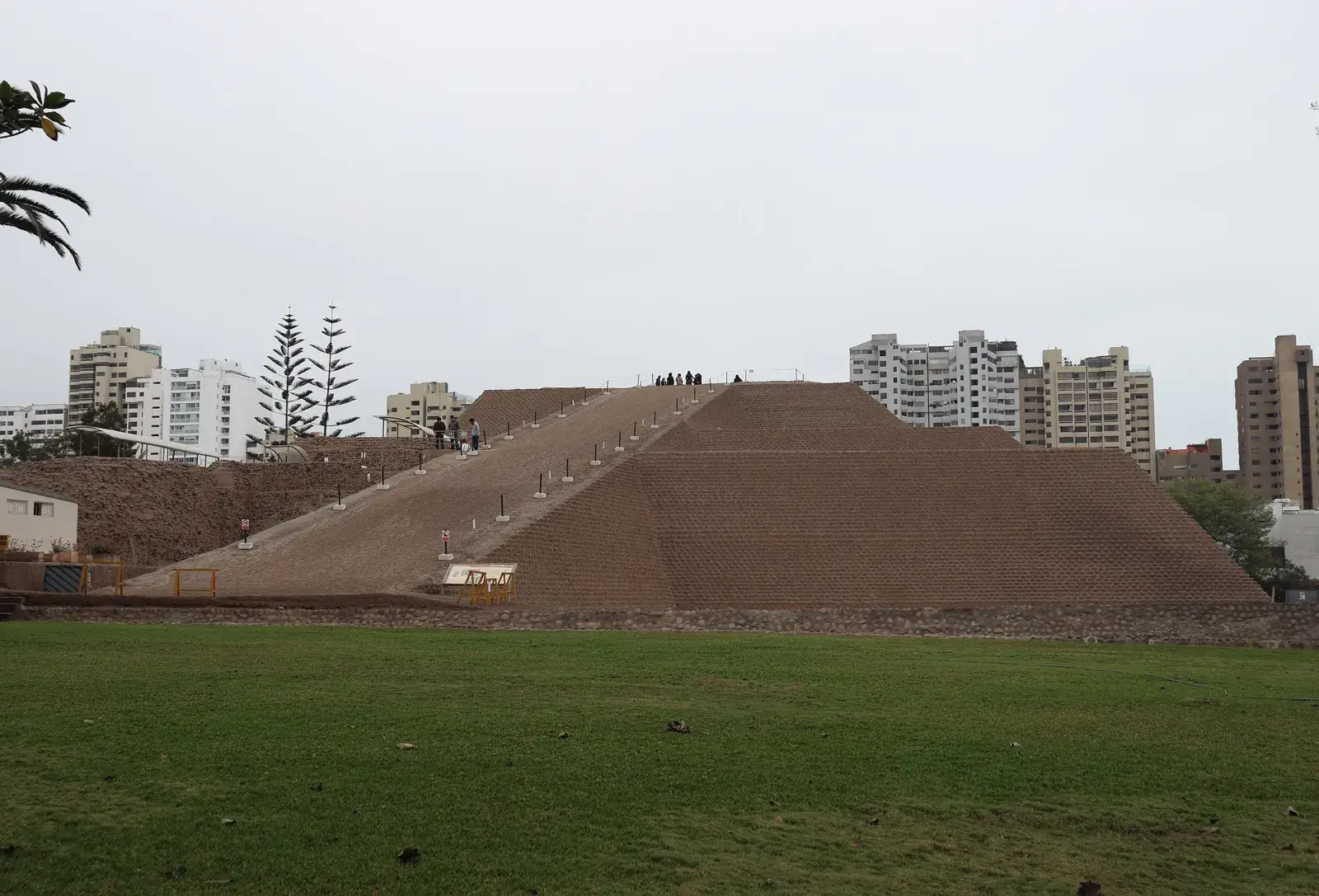
Huaca Huallamarca is a truncated adobe pyramid of roughly 19 m in the residential district of San Isidro, with a small museum beside it. It is one of the quickest archaeological visits in Lima: half an hour to an hour is enough. It is built of small hand-shaped adobes, was used for ceremony and later as a cemetery, and suits travellers who want a short, uncrowded stop rather than a full guided tour.
Map
What Huaca Huallamarca is
Huaca Huallamarca is a pre-Hispanic temple mound in San Isidro, a leafy business and residential district of Lima. It is a truncated, stepped pyramid of about 19 m in height, built of adobe, and it stands in a small park-like plot with tall apartment blocks all around. Older maps and writers also call it Pan de Azúcar, the Sugar Loaf, after the rounded shape it had before it was cleaned and rebuilt.
Like the other coastal huacas, it is a reminder that the capital grew over a landscape already crowded with temples and settlements. Many were levelled for farms and housing, and this one came close. The name is usually explained from Quechua words, though the exact meaning is debated, so treat any single translation you are given as one proposal among several.
Three phases of use
Archaeologists describe the site in three main phases. The first, from roughly 200 BC to AD 200, is the building of the mound as a ceremonial centre by the early coastal people of the Rímac valley, often grouped under the name Huallas. The second, from about AD 900 to 1300, turned the abandoned temple into a cemetery, used by communities linked to the Lima, Ychsma and Chancay cultures. The third, from about 1400 to 1532, saw the Incas use it as a public building, judging by food remains, textiles and large vessels.
These dates come from published excavation summaries and are revised as research continues, so the labels on site may differ in detail. The long span is the point: the same hill mattered to people for well over a thousand years, under several different powers.
Tours and activities
Bookable online, chosen for their traveller reviews.
-
★ Top rated From €52 per person
-
★ Top rated From €85 per person
-
★ Top rated From €94 per person
-
★ Top rated From €55 per person
From quarry to monument
The modern story is almost as interesting as the ancient one. In the 19th century the mound was known for burials with rich ceramic and metal objects, and in the early 20th century it was treated as a quarry, which left a large hollow in the structure. In the 1920s a cut was made into its flanks for a road to the summit, which was levelled.
In 1941 the district municipality began to demolish it, and the national archaeology authority stopped the work. Proper excavation began in 1942 under the archaeologist Julio C. Tello, and a reconstruction programme followed from 1958. The site museum opened in 1960 to house what had been recovered. The smooth ramp and neat terraces you see today are therefore largely a modern restoration over an original core, which is common for adobe monuments in Lima.
What you see on the visit
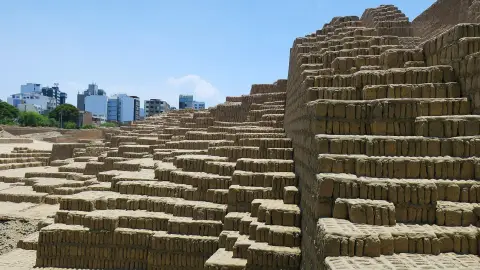
From outside, the mound looks like a tidy stepped hill of brown earth. Look closely at the surface and the small hand-made adobes, described by Tello as molar-shaped or irregular cones rather than rectangular blocks, can be made out in the older, unrestored parts. A ramp leads up to the top, where the view shows how completely the pyramid is surrounded by apartment towers, a good picture of Lima's mix of old and new.
The small museum shows items from the excavations, among them textiles, ceramics, tools for spinning and weaving, gourds and musical instruments, and funerary bundles of the kind found at the summit. The finds suggest an ordinary farming and fishing community with a ritual centre, and none of the excavation reports mention weapons or sacrifice. Displays and labels are often in Spanish, so check what is offered in English before you go.
Huallamarca or Pucllana
Visitors with time for only one adobe pyramid in Lima usually choose Huaca Pucllana in Miraflores, which is larger, has a stronger guided visit and is better known. Huallamarca is the quieter alternative, and it differs in useful ways: you can walk up a ramp to the summit, the visit is short, and there are rarely crowds.
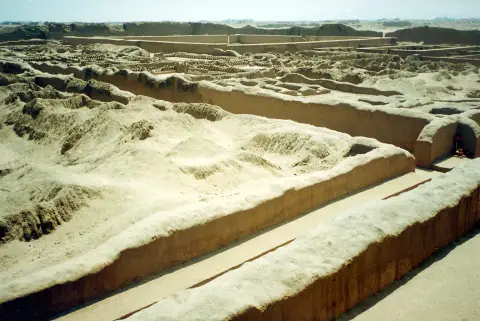
If you want to understand how coastal temples were built and used, Huallamarca is a perfectly good introduction, and the two sites suit the same day. For monuments on a bigger scale, look at Pachacamac south of the city, or at Chan Chan near Trujillo, a far larger adobe city. The things to do in Lima page shows where this fits among the other sights.
Getting there from Miraflores
San Isidro lies between Miraflores and the historic centre, so Huallamarca is a short taxi ride from most hotels in either area. Use a licensed taxi or a ride-hailing app, give the full name of the site and ask for the entrance, since the mound is large and the gate is on one side only. Read Lima safety for the usual precautions about taxis and phones.
From the airport the trip is mostly through traffic, and the transfer options are in the airport transfer guide. Because the site is small, it fits easily between a morning in Miraflores and lunch, or on the way out of the city. Staying in San Isidro itself is another option, covered in where to stay in Lima.
Timing, effort and practical points
Allow 30 to 60 minutes, a little more if you read the museum labels slowly. The site is at sea level, and the ramp to the summit is short, but the surface is open and dusty, with little shade, so wear a hat and sun protection and sturdy shoes. Lima's cloudy winter months, roughly June to September, give soft light but a cool, damp breeze, while the summer from December to March is sunnier and hotter.
Opening days, hours and ticket rules change, and some sites close on certain weekdays, so check the current arrangements with the district municipality or the Ministry of Culture before you go, and carry a few coins in soles, as explained in money and ATMs. Access for people with limited mobility is not something to assume, since the paths and ramp are uneven.
Who it suits and what to combine it with
Huallamarca suits travellers with a short layover, families who want an easy outing, photographers who like the contrast between a mud pyramid and glass towers, and anyone building a small archaeology theme in the capital. It is less rewarding if you expect a large complex or a detailed guided performance.
A sensible sequence is Huallamarca in the morning, then the Larco Museum for ceramics and gold, then a long lunch in Miraflores or Barranco, with ideas in what to eat in Lima. If you prefer a guide, the Lima tours page shows what city tours usually cover, and whether archaeological stops are included.
Where to sleep
-
Find hotels
Miraflores
Easy first base: restaurants, parks and the cliff-top walk
-
Find hotels
Barranco
Art, nightlife and a seaside feel, quieter by day
-
Find hotels
San Isidro
Calm business district with parks, close to Miraflores
-
Find hotels
Historic Centre
Colonial sights on the doorstep, busy by day and quiet at night
Frequently asked questions
How long does a visit to Huaca Huallamarca take?
Between 30 and 60 minutes covers the mound, the ramp to the top and the small museum. Add time only if you want to read every label or take photographs from the summit.
Where is Huaca Huallamarca?
In the San Isidro district of Lima, between Miraflores and the historic centre. It is a short taxi ride from most central hotels, and the entrance is on one side of the plot, so ask the driver for the gate.
How old is Huaca Huallamarca?
The first building phase is dated to about 200 BC to AD 200, so it is roughly two thousand years old. It was reused as a cemetery from about AD 900 and by the Incas in the last century before the Spanish conquest.
Is Huaca Huallamarca worth visiting if I have seen Pucllana?
It is worth it if you have an hour to spare, because you can climb the ramp and the site is quiet, but it repeats part of the story. Compare the two on the Huaca Pucllana page and pick one if time is short.
Do I need a guide for Huaca Huallamarca?
No. The site is small and can be seen on your own with the information panels and the museum. Whether guides are offered at the entrance, and in which languages, should be checked locally.
Is the pyramid original or rebuilt?
Both. The core is ancient, but the mound was damaged by quarrying and road cutting in the early 20th century and restored from 1958, so much of the smooth surface is modern. This is normal for adobe monuments in Lima.
When is the best time to go?
Mornings are cooler and less hazy, and a weekday is likely to be quietest. Check opening days first, then see the wider Lima guide for seasons and weather.