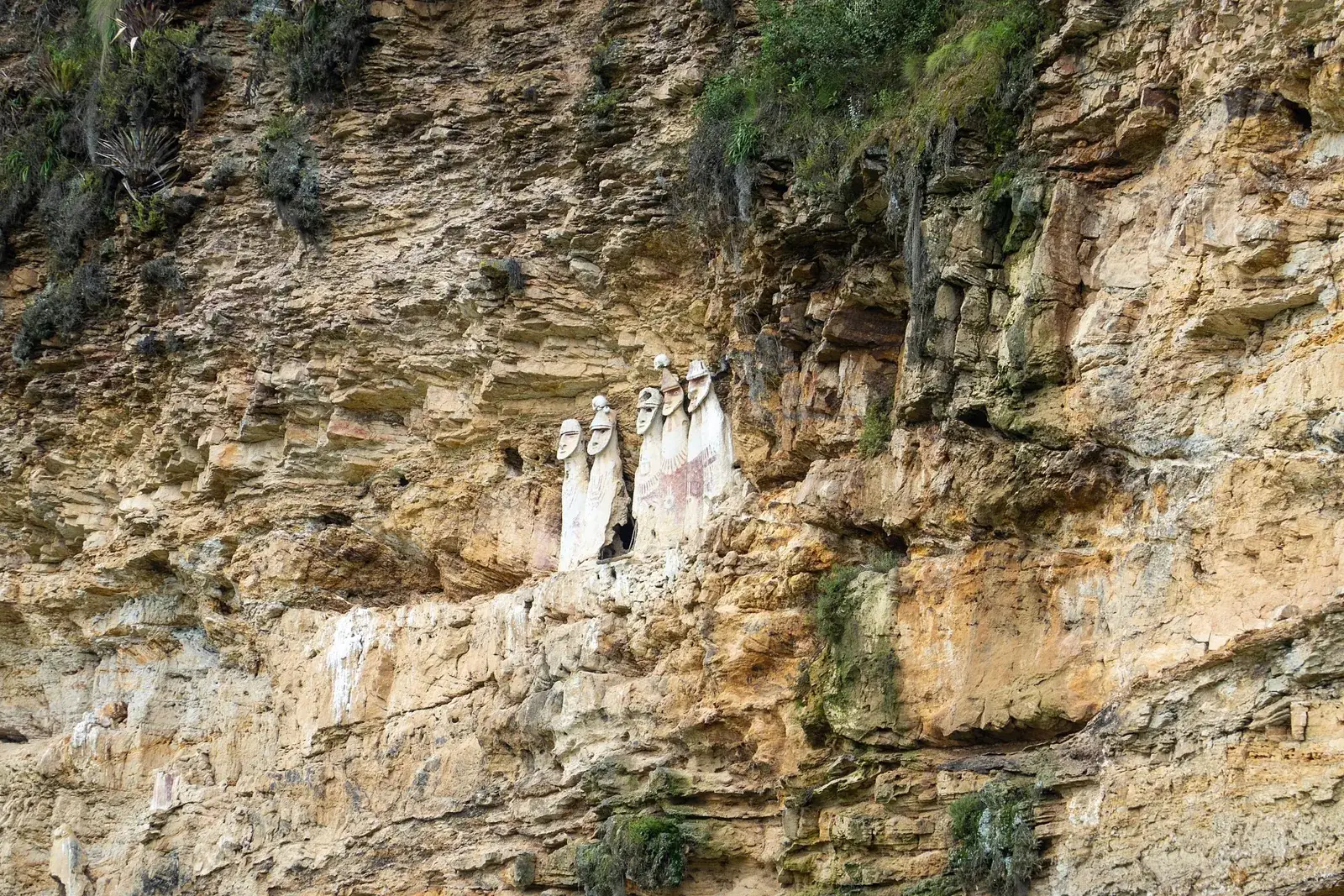
Karajía is a group of seven clay burial figures, up to about 2.5 m tall, standing in a row on a cliff ledge above a valley north of Chachapoyas. You see them from a viewing point across the gorge, after a short walk from the village at the end of the road. Plan a half day from Chachapoyas, start early, and confirm the ticket rules and access locally, because they change.
Map
What the sarcophagi are
The Karajía sarcophagi, also spelled Carajía, are large funerary figures made by the Chachapoyas culture, the people of the cloud forest whose wider history is told on the Chachapoyas guide. Each figure is a hollow clay capsule shaped roughly like a standing human body, with a rounded chest, a heavy head and a pronounced jaw. They are known as purunmachus, a name used for this type of Chachapoyas burial figure, and they held the bodies of important dead people.
Seven figures survive on a single ledge. Some older accounts speak of eight, because one is believed to have fallen into the gorge during an earthquake in 1928. The largest figures reach about 2.5 m in height, which is why Karajía is described as one of the most imposing burial sites of the region. The ledge sits well above the valley floor, in a natural recess of the limestone wall, and the figures stand shoulder to shoulder facing outward, like a row of sentries.
History and why they survived
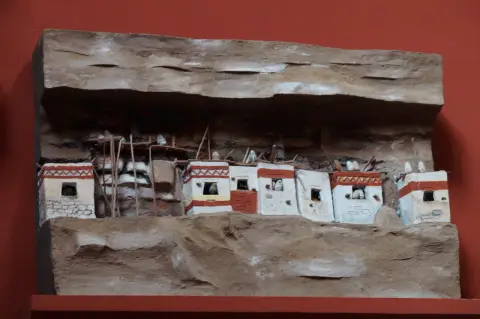
Radiocarbon dating places the burials in the 15th century, just before the Inca conquest of the Chachapoyas in the 1470s. Chachapoyas communities buried their dead in places that were hard to reach: cliff recesses, small funerary buildings and caves. The aim was to keep ancestors close to the community and visible, but out of reach.
That difficult position is also the reason the figures exist today. The cliff made them almost impossible for looters to reach, so the ledge stayed largely untouched for centuries. The sarcophagi were only documented by outsiders in the twentieth century, and an expedition in the 1980s climbed the rock wall to the cave for the first time. When one figure had been damaged and opened, it was found to contain a mummified body sitting on an animal skin, wrapped in cloth and accompanied by ceramics and other objects. Other figures were left closed. The mummy and objects were removed for study and conservation, which is why you may read that other finds from the area are exhibited in the Leymebamba museum.
What you see
From the viewing point the figures look small against the cliff, then grow as you notice detail. The bodies were built from clay mixed with sticks and stones, and the surface was painted white and decorated with red and ochre pigment. Faint patterns can still be seen on the chest and body, and traces of colour remain on some faces. Several figures carry human skulls on top of their heads, placed there as offerings or marks of status, and these are the most striking feature in a good photograph.
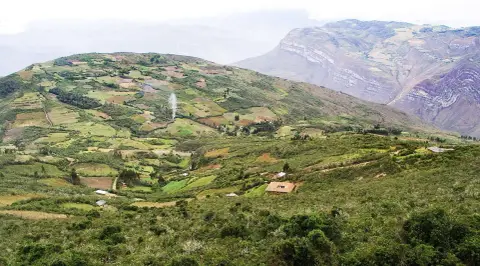
Binoculars or a camera with a zoom lens make a real difference, because you view the ledge from across the gorge. You cannot approach the figures, and you should not try to. Climbing the wall damages a fragile site and is dangerous, and access to the ledge is controlled. Beyond the sarcophagi, the cliff face and the cloud-forest valley are worth a few minutes of attention, and in mist the whole scene becomes moody and quiet.
Getting there from Chachapoyas
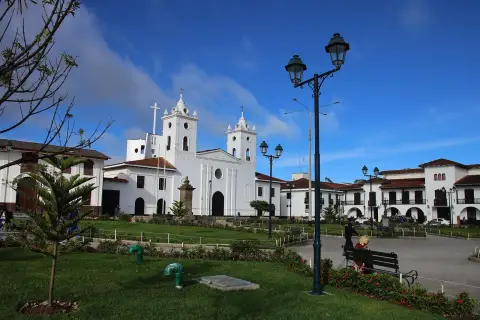
Karajía lies north of Chachapoyas, in the hills above the Utcubamba valley. Visitors normally travel by road to the village of Cruz Pata (also written Cruzpata), where the trail starts, either on an organised tour or with a taxi or private driver hired for the morning. Public transport is possible but slow: guides describe a bus or shared vehicle to the town of Luya and then a further connection to the trailhead, which makes a same-day return harder without an early start.
Expect around two hours each way by road, and a morning departure. Tours often combine Karajía with the Quiocta cave and the town of Luya, so ask what is included before you book. The road surface and bus schedules change, particularly in the rainy season, so confirm them with your hotel or an agency. For the long-distance part of the journey see Lima to Chachapoyas.
The walk and the viewpoint
From Cruz Pata a path leads through farmland and then downhill and uphill through forest towards the cliff. Guides and local sources describe the walk as roughly 20 to 40 minutes each way, depending on pace and conditions, and horses may be offered for part of the way. Treat these times as approximate and ask at the village.
The path is uneven and can be slippery after rain, with a few steep sections, so wear shoes with grip and carry a waterproof layer. The area is moderately high rather than extreme, but climbing back uphill at the end can feel harder than the way down, so walk slowly if you have just arrived in the region (see altitude sickness). Entry is normally paid at a local checkpoint or association office on arrival, run by the community. Ask for the current price and hours, and carry small notes in soles, since card payment and cash machines should not be expected in the village.
Best time and time of day
The drier months, roughly May to September, give the most dependable conditions for the road and the trail, as described in when to go. The rainy months bring mud, slippery trails and more cloud, and landslides can interrupt roads, so read the weather by region before you commit to a tight schedule.
Morning is the better time of day. Clouds often build in the afternoon and can hide the cliff completely, and the light on the white-painted figures is better earlier. Allow about half a day in total, including the drive. If you arrive early, you may also have the viewing point almost to yourself, which suits the place.
Who it suits and what to expect
Karajía suits travellers with an interest in archaeology, photography or the pre-Inca cultures of the north. It is a short and easy walk by trekking standards, and the effort is much smaller than the road journey that reaches it. Children and active older travellers can usually manage it if they are comfortable on uneven ground.
Be realistic about what you see. There is no entry to the ledge, no museum and no explanatory trail beyond what a local guide offers, so the visit is a view of a remarkable site from a distance. A local guide adds meaning, explaining the funerary beliefs, the figures and the history of the discovery, and their fees support the village. If you want to handle objects and see mummies up close, the museum in Leymebamba is the better complement. Accessibility is limited, and the site is not suitable for wheelchairs.
What to combine it with
Karajía is most often paired with another site on the same day, because the trip out is long. The usual combination in the area is the nearby Quiocta cave, and the market and plaza of Luya on the way. A different full-day option is to see Karajía and then the Leymebamba museum, which holds mummies and artefacts that give context to the burials, although the two are in different directions and are normally done on separate days.
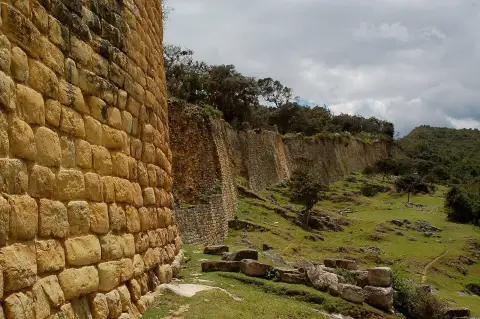
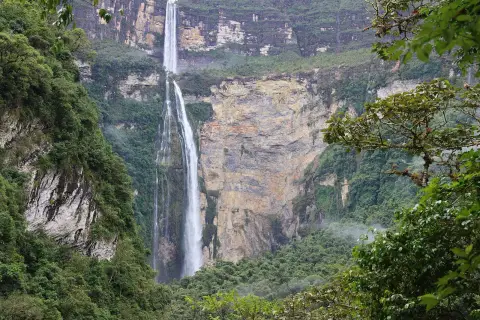
Kuélap and the Gocta waterfall are the other major sights of the region, and each needs its own day. A comfortable plan for three nights in Chachapoyas gives one day to each of the three, with Karajía as the easiest of them. Because all of these excursions start early, arrange transport and guides a day in advance.
Where to sleep
-
Find hotels
Chachapoyas
Base for Kuélap and Gocta
Frequently asked questions
How many sarcophagi are there at Karajía?
Seven figures stand on the ledge today. An eighth is believed to have fallen in an earthquake in 1928. The figures are up to about 2.5 m tall.
Can you get close to the Karajía sarcophagi?
No. They are seen from a viewing point across the gorge, and the ledge is out of reach for visitors. Do not attempt to climb the cliff, as it is dangerous and damages the site.
How long does the walk to Karajía take?
Local sources describe roughly 20 to 40 minutes each way from the village of Cruz Pata, with some steep and muddy sections. Horses may be available for part of the route. Ask at the village for current advice.
Do I need a guide to visit Karajía?
A guide is not always required, but a local guide explains the site and is the simplest way to arrange transport and entry. Ask at your hotel in Chachapoyas or at the village on arrival.
Can I visit Karajía and Kuélap on the same day?
It is possible only with a very early start and a long day, because they lie in different directions. Most people give each its own day. See Kuélap for its own timing.
Are there mummies at Karajía?
The figures hold the remains of important people, but they are closed and not visible. To see mummies and other Chachapoyas finds up close, visit the Leymebamba museum.
What should I bring to Karajía?
Shoes with grip, a rain layer, water, sun protection, small notes in soles for the entry fee and binoculars or a zoom lens. A day pack with a snack is enough for a half-day trip.