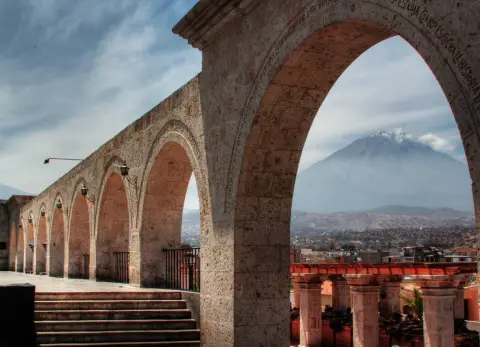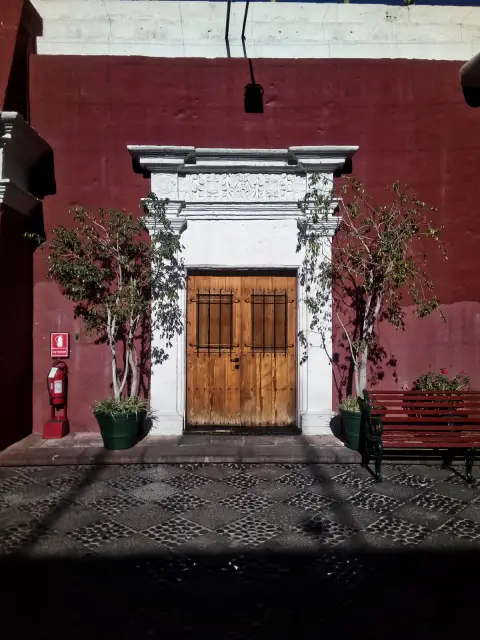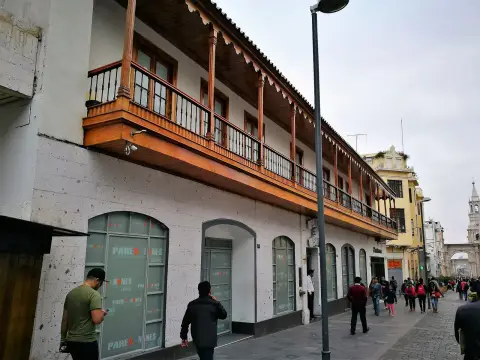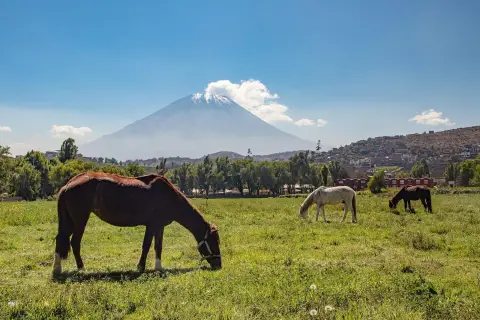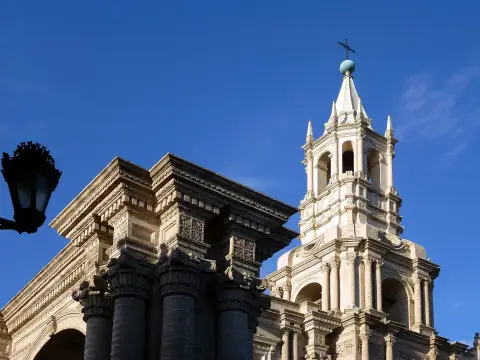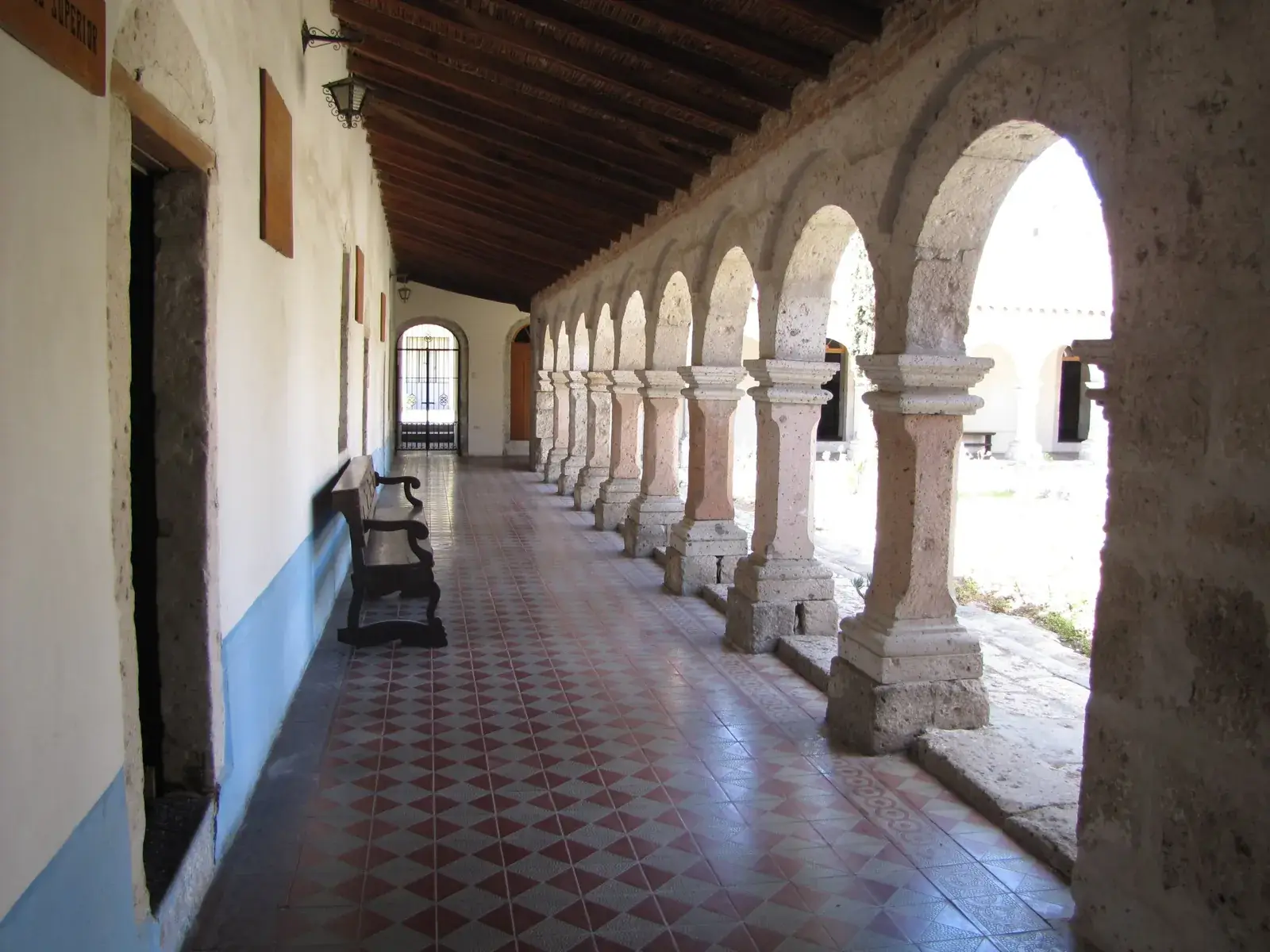
La Recoleta is a Franciscan convent founded in 1648 on the west side of the Chili river, a short walk or taxi ride from the Plaza de Armas of Arequipa. It is now a museum, and the reasons to go are the old library with its cedar shelving, the ethnographic and Amazonian collections gathered by missionaries, and the quiet cloisters of pale volcanic stone. Allow one to two hours, check the opening hours and ticket price locally, and pair it with the Yanahuara viewpoint.
Map
What La Recoleta is
La Recoleta is a former convent of the Franciscan order, now run as a museum, in the city of Arequipa. It is usually described as a convent and museum together, because the building still looks like a working religious house: low cloisters, a church, a garden and long corridors of plain rooms. Unlike the better-known Santa Catalina monastery, which is a walled miniature town and one of the first things travellers see, La Recoleta is a smaller and quieter visit and works well as a second monastery rather than a replacement.
Its value lies in what the friars kept rather than in architecture alone. Over centuries the community collected books, documents, religious art and objects from their missions, and much of it can still be seen on site. That makes it one of the more unusual museums in southern Peru, and a good choice for travellers who like libraries, history or ethnography more than colonial facades.
A short history
The convent was founded in 1648 by Franciscans of the Recollect, or discalced, tradition, a branch of the order that followed a stricter and simpler life. The design is attributed to Father Pedro de Peñaloza, and sources say the church and two cloisters were finished within a few years. The complex was later enlarged and has four cloisters built in sillar, the pale volcanic stone of Arequipa.
Arequipa lies in an earthquake zone, and the building has been repaired and rebuilt several times. The church you see today is generally dated to the twentieth century, so the convent is a layered building rather than an untouched seventeenth-century survivor. The site was opened to visitors as a museum in the late twentieth century, with sources giving dates in the 1970s and early 1980s, and the friars have remained part of its story, with some guided visits traditionally led by people who know the collection well.
Tours and activities
Bookable online, chosen for their traveller reviews.
-
Day trip From €38 per person
-
Day trip From €16 per person
-
Day trip From €58 per person
-
From €9 per person
The library
The library is the main draw for many visitors. It holds roughly 20,000 to 25,000 volumes, depending on the source, many of them from the sixteenth to the eighteenth centuries, including early printed books known as incunabula. It is kept in a room fitted with old cedar shelving, and access is supervised, so you look at the shelves and a few displayed volumes rather than browsing.
One book that guides like to mention is the so-called Libro del Millón, a sixteenth-century edition of Marco Polo's travels with handwritten notes in the margins, whose annotator has not been firmly identified. Do not expect to handle anything. The pleasure is in the atmosphere: dark wood, tall spines, and the sense of how much reading a remote colonial community kept within reach. If you read Spanish, ask the guide about the subjects the friars collected, because the range says a lot about what a religious house in the Andes considered worth keeping.
The Amazonian and ethnographic collections
The second reason to come is the Amazonian museum. Franciscan missionaries worked in the Peruvian jungle for generations, and the objects they brought back to Arequipa are displayed in an ethnographic room: tools, feather work, clothing and ornaments of Amazonian peoples, together with preserved animals from the rainforest. Some displays are old in style, with a taxidermy tradition that looks dated by modern standards, which is part of their interest as a record of how missionaries documented unfamiliar regions.
Other rooms cover pre-Columbian art from the Andes, religious painting including works associated with the Cusco school, and a collection of coins. Descriptions mention a room of old toys, the old cemetery and gardens. Rooms and exhibits are rearranged from time to time, so treat this list as a guide to what has been reported, not a promise of what will be open on your day.
Where it is and how to get there
La Recoleta stands on Calle La Recoleta, on the western side of the Chili river, across from the historic centre. From the Plaza de Armas it is a walk of roughly ten to fifteen minutes over the Puente Grau, a bridge that carries traffic into the Yanahuara side of the city. A taxi is cheap and quick for anyone who prefers not to walk uphill at about 2,330 m, and the district is usually described as quiet and safe by day, though common sense applies at night, as explained in safety in Peru.
The convent sits close to the Yanahuara viewpoint, which makes the two a natural pair in the same outing. Walking from one to the other takes a few minutes, and the area is a good place to stop for a coffee between sights.
Hours, tickets and how long to stay
Opening hours are the thing most likely to change. Published sources have given a morning and an afternoon session on weekdays and Saturdays, with a midday break and Sunday closed, but you should confirm current times before going, since small museums in Peru can shift their hours with little notice. Entry is paid at the door in soles, and a few notes and coins are useful, as described in money and ATMs. Prices quoted by different websites do not agree, so do not rely on one figure.
Plan on one to two hours. A guide, often included or offered at the entrance, adds a lot, because several rooms are easier to understand with explanation. Tours are usually in Spanish, and English may be available at some times. Go in the morning for the best light in the cloisters, and note that the building is mostly at ground level, with some steps between courtyards.
Who it suits and what to combine it with
La Recoleta suits travellers who like books, museums and quiet places, and families with children who are curious about animals and masks. It is less obviously suited to anyone who wants colourful lanes and photogenic corners, which Santa Catalina does better. If your time in Arequipa is short, put Santa Catalina and the plaza first and add La Recoleta only if you have a free half day.
A sensible combination is the Juanita and Inca mummy story at the Juanita museum in the morning, La Recoleta around midday, and Yanahuara at the end of the afternoon. For the wider city plan see things to do in Arequipa, and for a place to sleep nearby see where to stay in Arequipa. The question of how many days the city deserves is covered in is Arequipa worth visiting.
Where to sleep
-
Find hotels
Plaza de Armas and historic centre
Colonial core within walking distance of the main sights
-
Find hotels
San Lázaro
Old narrow lanes close to the main square, with character and lower prices
-
Find hotels
Yanahuara
Residential quarter with views of the volcano and good restaurants
-
Find hotels
All of Arequipa
Compare every area and price level in one search
Frequently asked questions
Is La Recoleta worth visiting if I have already seen Santa Catalina?
Yes, if you like libraries, ethnography or quiet places, because it offers something quite different: books, missionary collections and a calm setting. If you want colour and photographs, Santa Catalina is the stronger visit and La Recoleta can be skipped.
How long does La Recoleta take?
One to two hours is enough for the library, the Amazonian room and the cloisters, with extra time if you join a long guided visit. It combines easily with the nearby viewpoint in the same half day.
How do I get to La Recoleta from the Plaza de Armas?
Walk about ten to fifteen minutes via the Puente Grau, or take a short taxi ride. The route is on the other side of the Chili river, so it is slightly uphill on the way there. See the Plaza de Armas for the starting point.
What is in the Amazonian museum?
The collection was brought back by Franciscan missionaries and includes tools, ornaments, clothing and preserved animals from the Peruvian jungle. It is shown in an older style of display, so treat it as a historical record of the missions.
Can I read the books in the library?
Not freely. The library is visited under supervision and you see the shelves and a few displayed volumes. Researchers who want to consult material should ask the convent directly in advance.
Is La Recoleta open on Sundays?
Published sources have usually listed it as closed on Sunday, but hours change, so confirm locally before planning a day around it.
Is there a good way to see La Recoleta with a tour?
Most city tours concentrate on Santa Catalina and the centre, so La Recoleta is often visited independently. See tours from Arequipa to ask whether a guide can include it.