Stay in Aguas Calientes if you want the earliest entry and the least stress, in Ollantaytambo if you want a quiet base and a short train, and in Cusco only if you accept a long day. The Sacred Valley is the best option for acclimatising before you go up.
Book accommodation after you have your entry ticket, and prefer flexible rates.
Aguas Calientes: closest, busiest
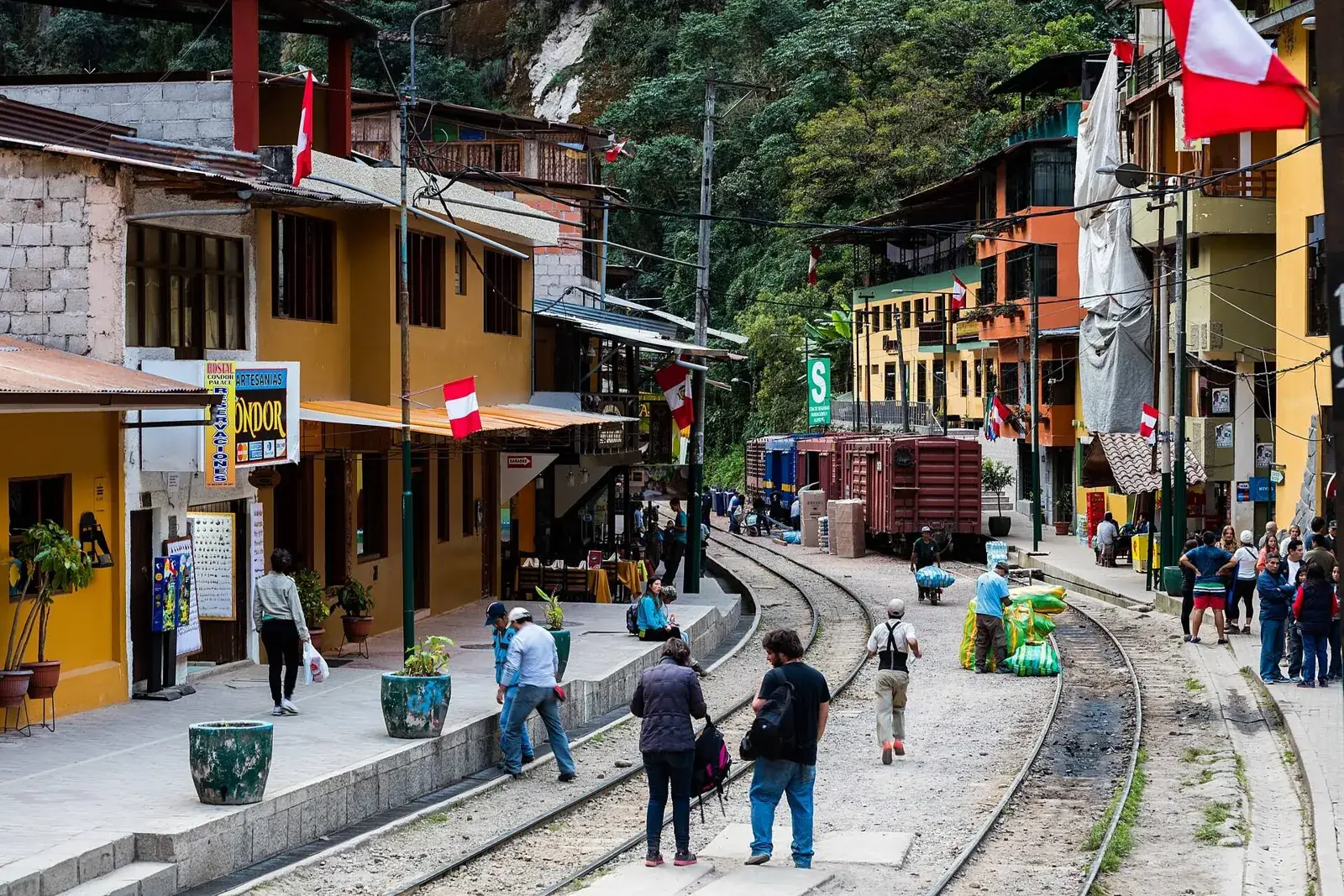
Sleeping in the town below the ruins puts you minutes from the bus and removes the early train from the equation. It is a compact, steep, touristy place built along the river and the railway, with hostels, mid-range hotels and a handful of luxury lodges. The advantage is convenience and the shortest morning; the drawbacks are higher prices for what you get, a noisy centre near the station, and a limited choice of restaurants that mostly cater to groups.
Pick a room away from the tracks if you are a light sleeper, and check how far the hotel is from the bus stop, since the streets climb. The town is described in Aguas Calientes, including what to do in the afternoon before an early visit.
Ollantaytambo: calm and convenient
Ollantaytambo is a small town with its own Inca ruins, stone-paved lanes and a train station. It sits at a lower altitude than Cusco and is a pleasant place to spend a night before or after the site. Staying here means a short train ride the next morning and a restful evening, with a few good restaurants and guesthouses. Rooms are easier to find than in Aguas Calientes, but trains from here can also be fully booked.
The town is also a sensible choice if your train leaves very early, because you can walk to the station in a few minutes instead of waking before dawn for a road transfer. Read more in Ollantaytambo, and compare it with the trains to Machu Picchu to see which departures it supports.
The Sacred Valley: gentler on the body
Towns and lodges along the valley, including Urubamba, Yucay and Pisac, are lower than Cusco and have a mild climate, which helps many visitors adjust to altitude. A night or two here before Cusco, or between Cusco and the train, is a common strategy. The valley floor lies at roughly 2,800-2,900 m, against about 3,400 m in Cusco, which is enough of a difference for sensitive sleepers.
Distances to the stations vary, so check the transfer time to Ollantaytambo before booking. The wider area, with its ruins, markets and lodges, is described in the Sacred Valley, and where to stay in the valley compares the towns in more detail. If you cannot decide between the valley and the city, see Sacred Valley or Cusco as a base for the trade-offs.
Cusco: only with a long day
Cusco is cheaper and has the best choice of places to eat, but staying there means a road transfer plus a train in each direction, and an early alarm. It works if you are combining Machu Picchu with several nights in the city and take a day trip, or if your plan is built around an early departure. It is not the best base if your goal is to enter the site as early as possible.
Whatever you choose, book after securing the ticket and the train, and look for rates that allow cancellation. If you do stay in Cusco, where to stay in Cusco explains which districts suit a night before an early start.
Compare the full cost of the extra transport before assuming Cusco is the cheaper choice.
Choosing by how early you want to enter
The strongest link between your bed and your visit is the entry window. For the earliest windows, Aguas Calientes is the only base that does not require a pre-dawn transfer and a train. For mid-morning windows, Ollantaytambo or the valley work well, with a morning train. For a late window, even Cusco can work, provided you can face a long, late return.
If you plan to be at the gate for the first entry, check sunrise at Machu Picchu, because the bus queue starts earlier than most people assume. If you are not sure how many nights you need in total, days needed will help you decide before you reserve rooms.
Match your bed to the earliest time you need to be on the bus, not to the time of your entry.
Budget, comfort and booking tips
Prices in Aguas Calientes are higher than elsewhere in the region because every item arrives by train, and quality varies widely. Mid-range rooms with a good bed and hot water matter more than a view, since you will be out early and back tired. Luxury lodges near the site offer a quiet alternative, but they cost much more and still depend on the same bus and train.
Look for flexible cancellation, particularly in the wet season when disruptions are likelier. Check whether breakfast starts early enough for your window, and ask the hotel whether it can store luggage, since the train luggage limits mean you may leave a bag behind. Ask about packed breakfasts for early starts.
Read recent reviews rather than star ratings alone.
Booking order and what to check
Reserve in a sensible order: the entry ticket first, the train second, and the bed last, while keeping the bed cancellable until the first two are final. In the dry season the best rooms in Aguas Calientes and Ollantaytambo go early, so a flexible booking made soon after the ticket is better than waiting.
Check three things before paying: the walking distance to the bus stop or station, whether the room is quiet at the hours you will be sleeping, and what time breakfast starts. Ask whether the hotel will keep your large bag while you travel light on the train, and whether it can arrange an early taxi if you need one. If you are on a package, read which hotel is included, because the location differs a lot between the town centre and the outskirts.
Where to sleep
-
Aguas Calientes
Sleep at the foot of Machu Picchu for an early entry
A compact town of steps, restaurants, a market and hot springs, with the buses to the entrance leaving from the town. Staying a night lets you enter early, before the day trippers, and avoid a rushed return train.
Keep in mind: Everything costs more here, rooms are often small, and the train times set your plans. A tight town, busy with tour groups.
Find hotels → -
Ollantaytambo
Early trains to Machu Picchu and a walkable old town
Stone-paved lanes, a large fortress above the town and the station for the trains. Small hotels, hostels and a few lodges are all within walking distance of the main square.
Keep in mind: It is a small town with little nightlife, and the streets near the station are busy in the morning.
Find hotels → -
Plaza de Armas and historic centre
Everything on foot, at the price of noise and crowds
Everything is on foot: the main square, the cathedral, Qorikancha, restaurants, tour offices and shops. It is the easiest choice for short stays and for the first nights, when walking uphill is tiring.
Keep in mind: Expect tourist prices, street noise and late bars near the square. Ask for a room facing the inner courtyard.
Find hotels → -
San Blas
Artisans' quarter with steep lanes and views, a short walk uphill
The artisans' quarter: steep cobbled lanes, small boutique hotels, workshops and cafés with views over the red-tiled roofs. The Plaza is a short walk downhill. A good fit for couples and for anyone who likes character.
Keep in mind: The way back is uphill and steep, which is hard on the first days at altitude, and some lanes are too narrow for cars.
Find hotels → -
All of Cusco
Compare every area and price level in one search
Not sure yet? Search the whole city and filter by price, rating and distance from the centre.
Keep in mind: Prices change a lot from one area to the next, so check on the map where each hotel is.
Find hotels →
Hotels on the map, with prices
Frequently asked questions
Is it worth staying in Aguas Calientes?
For most visitors yes, because it allows an early entry and removes the stress of a single long day.
Where is cheapest to stay?
Cusco and the smaller Sacred Valley towns are usually cheaper than Aguas Calientes, but cost more in transport time.
How many nights should I book?
One night in Aguas Calientes or Ollantaytambo is the usual minimum. Add more if you plan a climb or want a slower pace.
Is Aguas Calientes noisy?
The area around the station and the river can be loud, especially in the evening. Rooms facing a courtyard or higher up the hill are usually quieter.
Can I leave my luggage at the hotel?
Most hotels in Cusco, the valley and the town hold bags for guests, which is useful given the train limits. Ask when you book.
Should I stay near the station or near the bus stop?
Near the bus stop is more convenient for early entry, but both are within a short walk in this small town. Avoid steep side streets if you have heavy bags.
Does the town have a cash machine?
There are usually cash machines in town, but they can run out of notes or be busy, so bring some cash for the bus and small purchases.