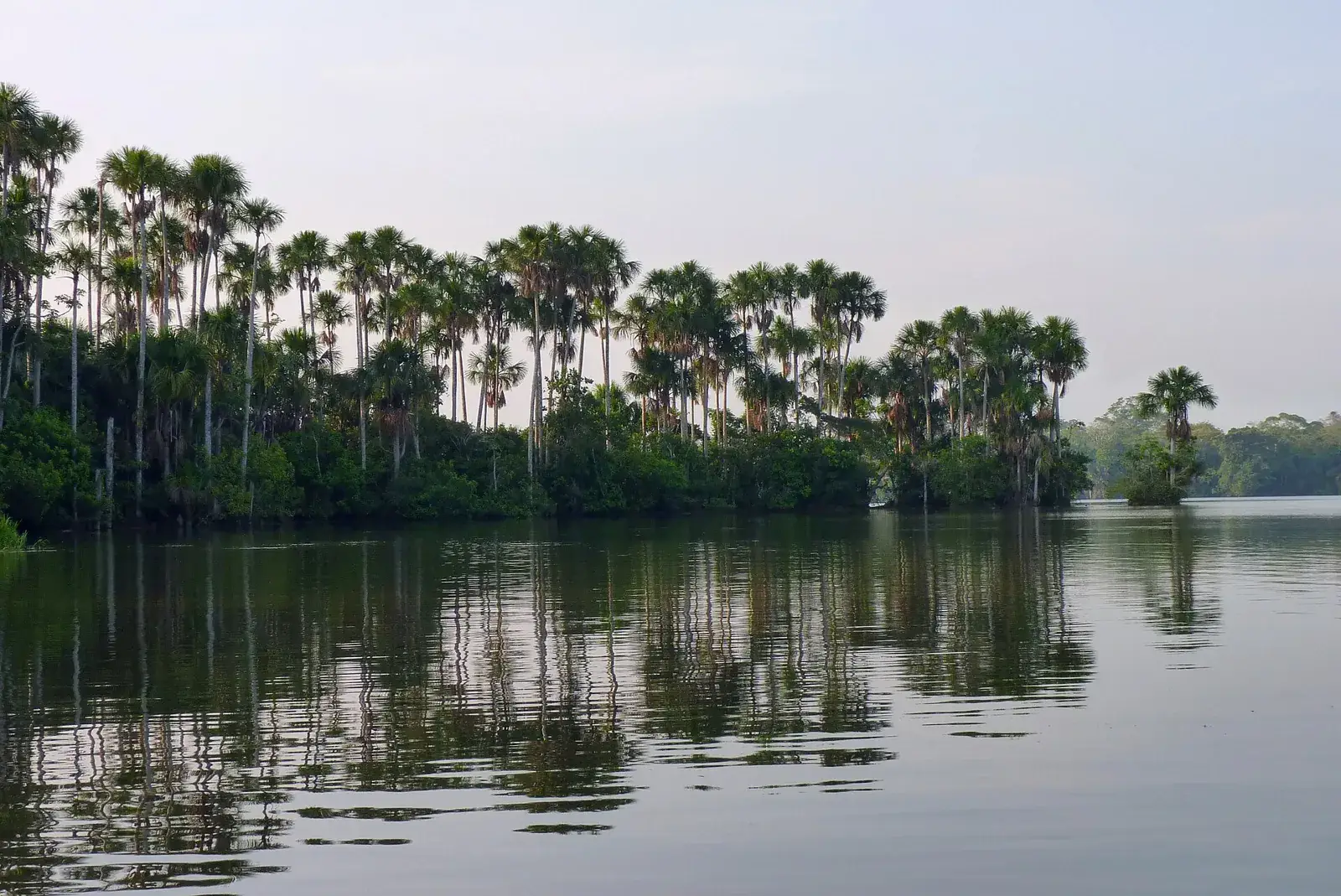
Sandoval Lake is a calm oxbow lake about 16 km from Puerto Maldonado, reached by a boat ride on the Madre de Dios river, a walk through the forest and a paddled canoe. It works as a long day trip or as a night at a lodge on its shore. Giant otters and black caimans live here, but sightings are never guaranteed, so go for the whole experience rather than for one animal.
Map
What Sandoval Lake is
Sandoval Lake (Lago Sandoval) is an oxbow lake: a bend of a river that was cut off when the channel shifted, leaving a curved body of still water beside the main stream. It lies in the Department of Madre de Dios, within the Tambopata-Candamo reserved zone, about 16 km from Puerto Maldonado and is one of the larger oxbow lakes in the south-east of Peru, at roughly 125 hectares.
For visitors it is the easiest taste of the lowland rainforest that does not require a long river journey. The water is dark and quiet, and the shore is lined with tall aguaje palms, which stand in standing water and give the lake its recognisable silhouette. Within the wider Tambopata area it is the classic short excursion, and it is often the first activity of a longer jungle stay.
A short history of the lake
The lake's modern story is partly a human one. In the 1970s an aquaculture facility nearby raised arapaima, the giant freshwater fish of the Amazon basin. According to Wikipedia, flooding in 1979 released about a thousand fry into the lake and the wider Madre de Dios watershed, and the species later turned up in Peruvian waters and, by the early 1990s, in Bolivian ones. It is a useful reminder that even a protected lake has been shaped by people.
Later came conservation measures. After a request in 1998, a giant otter tourism management plan was prepared, and a control post with park guards and an interpretation centre were built in the early 2000s. That is why visits today pass through a checkpoint of the reserve authority rather than straight into the forest, and why numbers of canoes and visitors are managed.
Getting there from Puerto Maldonado
The standard route has three legs. First a motorised boat upstream on the Madre de Dios river from Puerto Maldonado, which operators generally put at somewhere between 30 and 60 minutes. Then a forest walk of about 3 km on a trail, partly on raised wooden walkways, which ends at a small landing on the lake. Finally a paddled canoe takes you onto the water, sometimes through a short channel lined with palm swamp before the lake opens up.
The walk is flat but hot and humid, and after rain the muddy sections can be slow. Wear rubber boots if your operator lends them, and carry water. The shore is also served by one or more lodges, which let you reach the lake before and after the day-trippers; see jungle lodges near Puerto Maldonado for how to compare them. If you are arriving by air, Cusco to Puerto Maldonado covers the flight and the airport transfer.
What you can see on the water
The headline animal is the giant otter, a river predator that lives in family groups and is loud, curious and entirely unbothered by canoes that keep their distance. A family lives around the lake, but they roam, and whether you see them depends on the day. Treat any promise of a guaranteed sighting with caution.
More reliable are the black caimans, which rest along the banks and are easier to spot after dusk with a torch on a night trip, plus turtles, squirrel monkeys and a long list of birds. Macaws and parrots cross overhead, herons and kingfishers fish from the edges, and with luck you may see the hoatzin, a shaggy, crested bird that tends to sit in low branches over the water. A guide matters here: they spot movement and listen for calls long before most visitors do.
Best time of day and season
Early morning and late afternoon are the best times on the lake: animals are active, the light is soft and the heat is bearable. A canoe in the middle of the day tends to be quieter for wildlife, though the reflections of the palms are at their best when the water is still. Many lodge programmes therefore include a dawn paddle and a sunset paddle.
Seasonally, the drier months, roughly May to October, mean firmer trails and fewer insects. The rainy months, roughly November to April, bring muddy walking and downpours, but also a greener forest and more lively birds. River levels also affect the boat leg, so ask your operator how conditions are on the day. The wider picture for the region is in where to go in the Amazon, if you are still choosing between destinations.
Day trip or overnight stay
A full-day trip from Puerto Maldonado is the simplest way to see the lake: the boat, the walk, the canoe and lunch, returning in the afternoon. It suits travellers with limited time, but the day is tight and you will share the lake with other groups at the busiest hours.
An overnight stay at a lodge on the shore is a better way to see it. You can paddle at dawn and dusk, join a night excursion to spot caimans, and avoid the midday rush. The trade-off is a simpler stay: expect basic rooms, a limited electricity supply and fixed meal times, as described in what to eat in the Amazon. If you have only two nights in the lowlands, Sandoval is a reasonable base; with more time, combine it with a stay elsewhere in Tambopata so you see different habitats and, for example, a macaw clay lick.
Health, comfort and what to bring
The lowland forest is hot, humid and full of insects. Wear long sleeves and trousers in light colours, use the repellent your doctor recommends, and bring a hat, sunscreen and a rain jacket. A small dry bag protects phones and cameras in the canoe, and binoculars make a real difference.
Ask a doctor or travel clinic well before the trip about vaccinations and malaria prevention; health and vaccines gives general information only. Drink only water your operator provides or treats, as explained in water and food safety, and do not swim in the lake: it is home to caimans and piranhas. A full list of clothing and gear is in the packing list, and a good travel insurance policy is sensible for any remote excursion.
Frequently asked questions
How far is Sandoval Lake from Puerto Maldonado?
It is about 16 km away, but the trip takes most of a morning because it involves a river boat, a walk of roughly 3 km and a canoe. Plan a full day if you are not staying at a lodge.
Will I see giant otters at Sandoval Lake?
Possibly, but nobody can promise it. A family lives around the lake and moves between areas, so some visits see them and many do not. Caimans, birds and monkeys are far more predictable.
Can I visit Sandoval Lake without a tour?
Reserve access and canoes are normally arranged through operators or lodges, so independent visits are awkward. Check current rules with the reserve authority or your hotel in Puerto Maldonado before trying to go alone.
Is a day trip enough, or should I stay overnight?
A day trip shows you the lake but at the busiest hours. A night at a lodge on the shore adds dawn and dusk paddles and a night outing. Compare options in jungle lodges.
Is it safe to swim in Sandoval Lake?
No. The lake has black caimans and piranhas, and guides do not allow swimming. Stay in the canoe and keep your hands inside it.
What should I wear and bring?
Light long sleeves and trousers, a hat, repellent, sunscreen, a rain layer, water and binoculars. Rubber boots are usually supplied for the walk. See the packing list.
Is Sandoval Lake better than other Tambopata areas?
It is the easiest and quickest to reach, with calm water and a good chance of caimans and birds. Deeper parts of the reserve offer more remote forest and clay licks, so see Tambopata for how they compare.