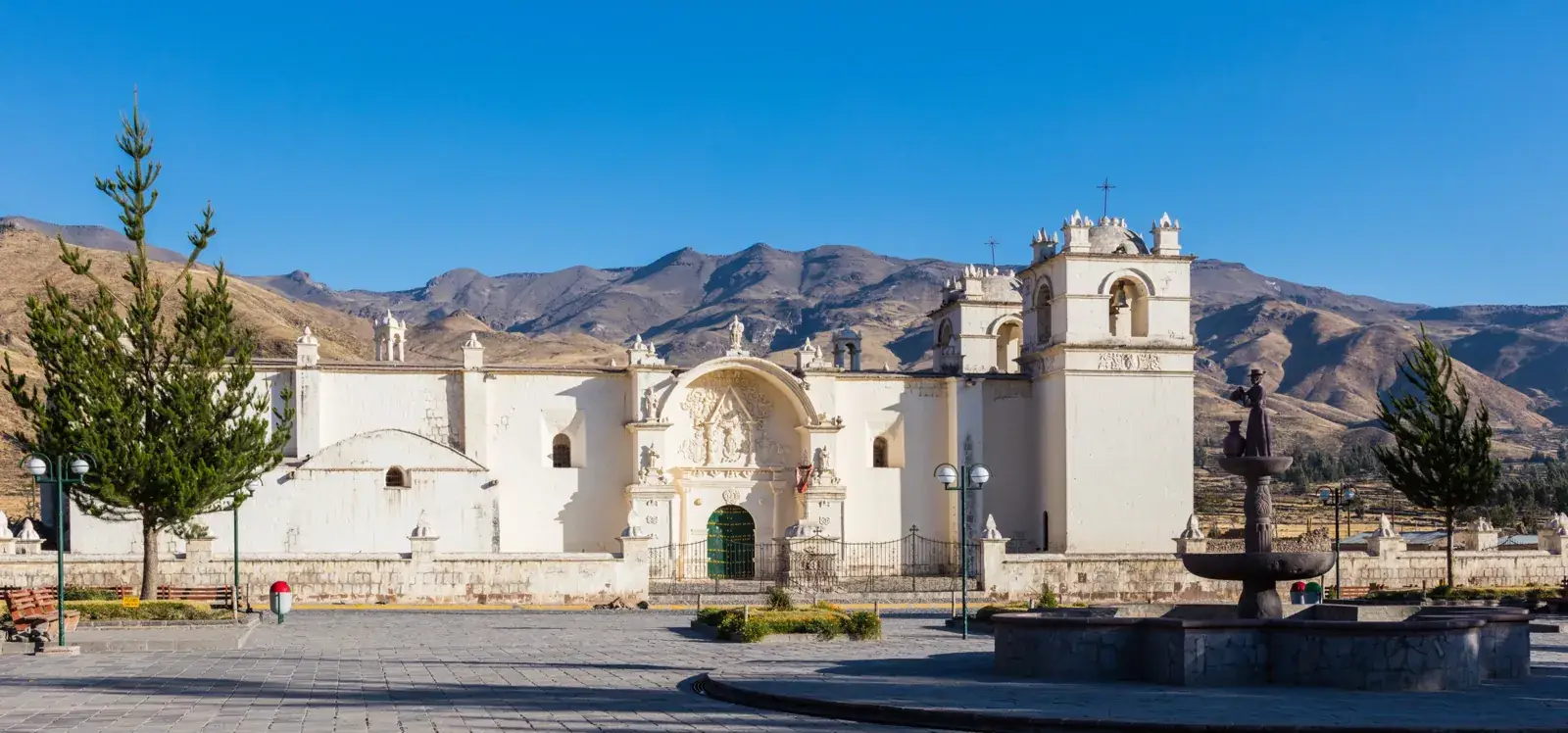
The Colca road runs through a chain of Andean villages: Chivay, Yanque, Maca, Pinchollo and Cabanaconde, in that order from the Arequipa side. Chivay is the main base, with the widest choice of lodging and the nearby hot springs, while Cabanaconde sits closest to the Cruz del Condor viewpoint and the trailheads into the canyon.
For a two-day trip, most people arrive at Chivay on the first day and go to the condor viewpoint early on the second. A night in Cabanaconde saves an early start and suits walkers.
How the valley is laid out
The Colca valley is a long, high river valley north-west of Arequipa, and the road follows it from the plateau down to a string of villages. Coming from Arequipa, you reach Chivay first, then continue along the valley through Yanque and Maca, then Pinchollo, and finally Cabanaconde at the western end, where the road stops above the deepest part of the canyon.
The villages are close together by road, so you can visit several in a day without a long drive. Each has its own plaza and church, and their colonial churches are among the main sights. The surroundings are agricultural: terraces cut into the slopes, some of them pre-Hispanic and still farmed.
Understanding this order helps with planning. Time at each stop is short, and the question is mostly where to sleep and when to be at the viewpoint. The broader picture is in Colca Canyon.
Chivay: the main base
Chivay is the largest town in the valley and the usual base. It has the widest choice of lodging, restaurants, an ATM or two (do not rely on them), a market and the departure points for local transport. Its altitude is roughly 3,600 m, so visitors arriving from the coast or from Arequipa at about 2,330 m often feel the change on the first evening.
The hot springs near Chivay are a popular way to rest after the journey or after a day of walking. Ask locally about opening times, entrance fees and the water temperature before you go, and avoid long soaks if you feel unwell at altitude.
Chivay suits those who want services and flexibility rather than village charm. Its market is a good place to see local produce and traditional dress, and a short stroll shows how the town is organised. Read altitude sickness before the trip and plan a quiet first evening.
Yanque and Maca
Yanque lies a short distance along the valley from Chivay and is known for its colonial church on a pleasant plaza and for local dance performances staged for visitors. It has a smaller choice of lodging and a calmer feel, and suits those who prefer a quieter base than Chivay.
Maca is further west and also has a church of note, along with views over the terraces. As with many valley villages, its chief interest is the setting and the way daily life continues around the plaza.
Both villages are normally visited as stops on the road rather than as destinations in their own right. A tour often includes them, while independent travellers can use local transport and stop where they like. Opening times of churches and the details of dance shows change, so check on the day. Respect people when photographing, and ask permission before taking a close portrait of anyone in traditional dress.
Pinchollo and Cabanaconde
Pinchollo is a small village close to the canyon edge, used as a stop on the road and as a base for walks. Beyond it, Cabanaconde is the last village on the road and the starting point for trails into the canyon. It sits lower than Chivay, at roughly 3,300 m, and has a more rustic feel with simple lodging and restaurants.
Staying in Cabanaconde means a short ride to the Cruz del Condor viewpoint in the morning, avoiding the long early start from Chivay. This also makes it the natural base for walkers. See Cruz del Condor for the viewpoint and for how condors behave.
From Cabanaconde, trails descend into the canyon towards Sangalle, often called the oasis, a green spot with simple lodging at the bottom. The descent is steep and the climb back is hard, and this is a real hike, not a stroll; read the Colca trek page before deciding.
A two-day route
A typical two-day plan runs like this. On day one, travel from Arequipa to Chivay, stop at a high viewpoint on the way, check in, and rest. Visit the hot springs in the afternoon or evening if you feel well. On day two, leave early for the condor viewpoint, as the birds are usually most active in the morning, then return via the villages and head back to Arequipa.
If you have an extra day, sleep in Cabanaconde on the second night and walk the canyon edge or part of the trail. This is a better way to see condors than a rushed visit, and a quieter way to see the valley. Alternatively, use the extra time to spend more hours in the villages.
For the journey itself, see Arequipa to Colca. Condor activity cannot be guaranteed, so treat any sighting as a bonus.
Where to sleep and why
Choose Chivay if you want choice, services and an easy base, particularly on a short trip or if you are not walking. Choose Yanque or Maca for a quieter night and a village atmosphere. Choose Cabanaconde if the condor viewpoint or a canyon hike is the main goal, since it saves a long early drive.
Lodging in the valley ranges from simple guesthouses to some comfortable lodges, but nights are cold at this altitude, so ask about heating and blankets. Hot water can be unreliable, and breakfast times may not suit very early starts, so confirm both. For general advice, see where to stay by type of traveller.
Book ahead in the dry season, roughly May to September, when the valley is busiest. Do not assume that rooms with heating or private bathrooms are standard; ask when booking, and keep a warm layer for sleeping.
Markets, dress and local life
The valley is home to communities with strong local traditions, and many women wear embroidered hats and brightly decorated clothes in daily life. The hat styles are often said to differ between the upper and lower parts of the valley, but check that detail locally before repeating it.
Markets are the best places to see local produce and daily routines. Chivay's market is the largest, and smaller village markets operate on set days. Ask your lodging which day each market runs, as the schedule changes. You will see potatoes of many kinds, maize, alpaca wool goods and snacks.
Be considerate with photographs. In some villages, people in traditional dress pose for tips; elsewhere they do not wish to be photographed at all. Ask first, and respect a refusal. Buying a handmade item from a local seller is a better way of supporting the community than paying for a photograph.
Moving between villages, and cash
Public buses and shared vans (colectivos) run along the valley, usually with frequent departures in the morning. Schedules change, so ask at the terminal or at your lodging. Moving independently is cheaper and flexible, but you must plan the condor viewpoint carefully because the first transport may leave later than the birds are most active. A tour handles this for you; see Colca tours and tour or independent to weigh them up.
Taxis are available in the larger villages and can be agreed for a fixed trip. Settle the price before you get in.
Cash matters in the valley. ATMs are few and can run out of money or fail, so withdraw soles in Arequipa and carry small notes for village shops, entrance fees and transport. See money in Peru for how to handle it. Many small businesses do not take cards.
Frequently asked questions
Where should I stay in the Colca Canyon?
Chivay is the easiest base, with the most choice and services. Cabanaconde is better if you want to see the condors early or hike into the canyon. Yanque and Maca are quieter options.
How high is Chivay?
Roughly 3,600 m above sea level, higher than Cusco at about 3,400 m. Arriving from Arequipa at about 2,330 m, rest on the first day and drink water. See altitude sickness.
Can I do the Colca Canyon in two days?
Yes, and it is the most common plan: travel to Chivay on day one and go to the condor viewpoint early on day two before returning. A third day gives more time to walk or rest. Condors are never guaranteed.
How do I get from Chivay to Cabanaconde?
Public buses and colectivos run along the valley road, and taxis can be agreed in larger villages. Ask at the terminal for the current departures, as they change. A tour avoids the planning.
Are the hot springs near Chivay worth it?
Many visitors enjoy them after the journey or a hike, especially on a cold evening. Check opening times and fees locally, and avoid long soaks if you feel dizzy at altitude.
Is the walk down to Sangalle difficult?
The descent is steep, and the climb back up in the heat is the hard part, often taking much longer than going down. It is for people used to walking. See Colca trek for what is involved.
Is there an ATM in the Colca villages?
Chivay may have one or two, but they are not always working or stocked. Bring enough cash in soles from Arequipa, including small notes. See money in Peru.
Do I need a tour?
No, the road is easy to follow and public transport runs, but a tour simplifies timing for the condor viewpoint. Compare both in tour or independent.