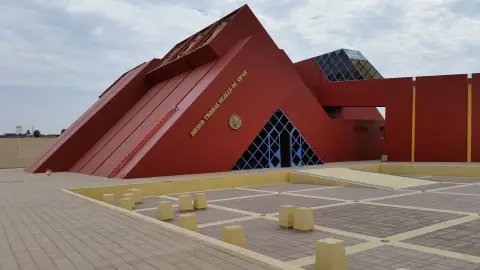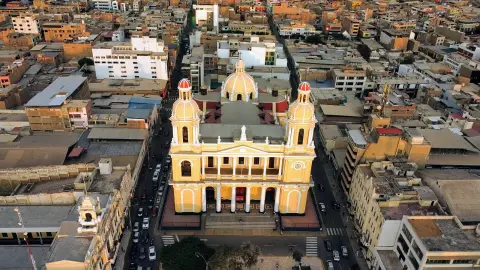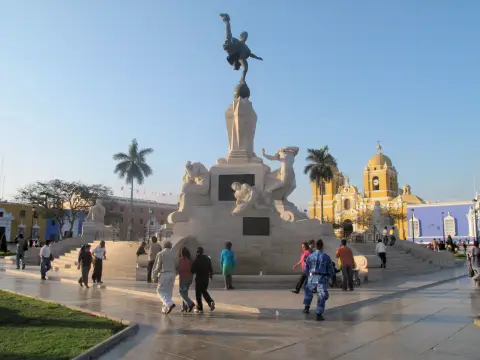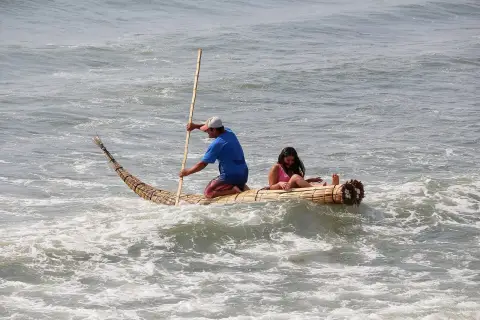
El Brujo is a coastal archaeological complex in the Chicama Valley, roughly an hour north of Trujillo. Its main visit combines the Moche temple of Huaca Cao Viejo, with painted reliefs, and the site museum that shows the mummy of the Lady of Cao. Count on half a day including the road, longer on a tour. It is further and quieter than the Huacas de Moche, and best done with a driver or an organised trip.
Map
What El Brujo is
The El Brujo Archaeological Complex lies in the Chicama Valley, on the dry coast north of Trujillo, close to the Pacific. The name means "the sorcerer" or "the wizard", and it covers not one monument but a long-used ceremonial landscape with three main mounds, called huacas: Huaca Prieta, Huaca Cortada and Huaca Cao Viejo.
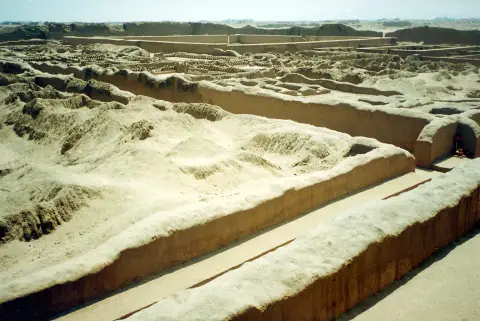
Huaca Prieta is by far the oldest and belongs to the time before pottery was made on this coast, while the large stepped pyramids belong to the Moche culture, which flourished on the north coast in the first centuries AD. Later peoples, including the Lambayeque and Chimú, also left traces, and the place seems to have kept a funerary and ceremonial role long after the temples stopped being rebuilt.
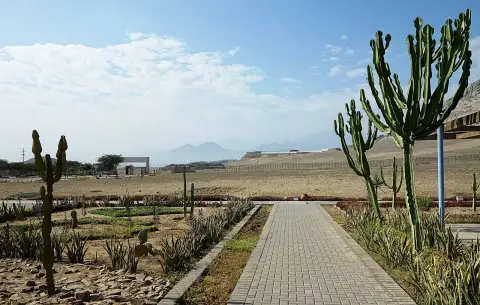
Most visitors see only Huaca Cao Viejo and the museum, which is the part prepared for tourism. The rest is mainly a matter for researchers, so do not expect a network of open ruins like Chan Chan.
Huaca Cao Viejo and its reliefs
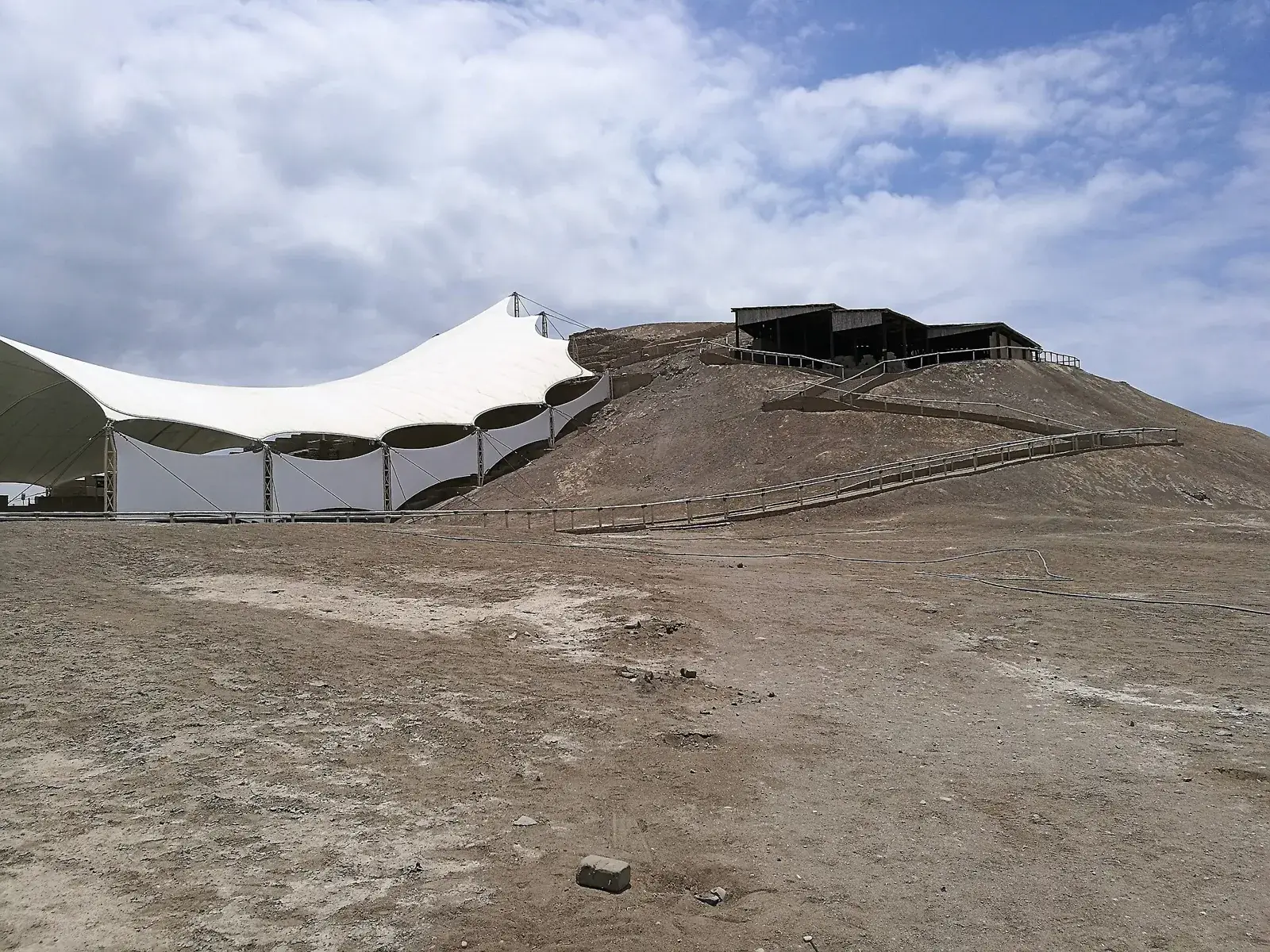
Huaca Cao Viejo is the largest of the pyramids, a stepped, truncated mound of adobe that was built and enlarged in several phases over generations. What makes it special is the decoration: polychrome reliefs and wall paintings that survive because later construction sealed them in, and because the climate here is almost rainless.
Guides explain the scenes, which include figures linked to Moche religion and processions of what are generally read as prisoners, along with fanged, aggressive deities such as the Decapitator. The imagery connects to sacrifice and ritual power. Treat any single reading as an interpretation, since written records do not exist and scholars still debate details.
If you have seen the painted temple of the Huacas de Moche, this is a companion rather than a copy: a different valley, a different set of scenes, and a quieter setting. Walkways and roofs protect the delicate walls, and touching them is forbidden because skin oils and abrasion cause damage.
The Lady of Cao
The reason many people make the trip is the Lady of Cao (Señora de Cao), a Moche woman whose tomb was found inside Huaca Cao Viejo and announced in the mid-2000s by the archaeologist Régulo Franco. Sources differ on the exact year of the find, so treat dates carefully. She is described as a young adult, aged about 25, who was buried with an exceptional set of objects.
Her body was preserved by the dry conditions, and the skin shows tattoos, reported as snakes, spiders and other symbolic motifs. Among the grave goods are crowns, tiaras, ceremonial clubs and ear and nose ornaments, which archaeologists read as insignia of rank. This is why she is widely presented as the earliest evidence of a woman ruler in Peru.
Be careful with the more dramatic claims in leaflets. The status of the burial is well supported by the objects, but her exact title, powers and cause of death are not known, and a good guide will say so.
The museum
The Cao Museum stands beside the huaca and is part of the same visit. It displays the mummy of the Lady of Cao with her funerary goods, and also textiles, ceramics, ceremonial weapons and reconstructions of her face. Tickets are normally combined for the site and the museum, but confirm this on the day.
Plan for an hour or more inside, longer if you read the panels. Photography is restricted in the room with the mummy, so ask before taking out a camera.
The museum also explains Huaca Prieta, the early mound, whose cotton textiles are among the oldest known on the continent. This helps because the mound itself looks like an ordinary hill to a casual visitor. Together, the museum and the huaca give a long view that runs from the first coastal settlers to the Moche elite.
Getting there from Trujillo
El Brujo lies north of Trujillo, near the village of Magdalena de Cao, and the drive is often given as about an hour, though sources quote different distances, from roughly 45 to 60 km. The route leaves the Panamericana Norte at the Chocope junction and continues on a local road to the site entrance.
The easiest option is a half-day tour or a taxi with a driver who waits, arranged through your hotel in Trujillo. Many agencies run a full day that adds the village or the coast at Puerto Malabrigo. Public transport exists in stages, a bus to Chocope followed by a shared car and then a mototaxi, but it is slow and unpredictable, and the last stretch has little shade.
If you are combining sites, things to do in Trujillo explains how to group them. El Brujo and Chan Chan are in opposite directions, so do not plan both in one afternoon.
When to go and what to bring
The site is open-air and exposed, with very little shade between the car park, the huaca and the museum. Go in the morning, when it is cooler and the light is better on the walls, and carry a hat, sun protection and water. The coast can be cloudy and damp in winter, roughly May to October, and sunnier and hotter from about December to April, but the reliefs can be seen in either season.
Rain is very rare, though the fragile adobe is protected from it by roofs. Wear closed shoes, as paths are dusty, and bring a light layer for wind. The altitude is close to sea level, so there is no altitude issue, unlike in the highlands.
Opening hours and ticket prices vary between sources, which is a good reason to confirm them with your hotel or the site before leaving. Cash is the safest way to pay for entry. For general precautions on the road, see safety in Peru.
Who it suits and what to combine it with
El Brujo suits travellers who already have a taste for archaeology and want to understand the Moche beyond a single pyramid. It is less suited to a rushed day or to people who want a lot to walk through, since the visit is compact and rests on the reliefs and the museum.
It pairs naturally with the other north-coast sites. The Huacas de Moche and Chan Chan cover the same region on different days, and the Moche story continues further north at Sipán, near Chiclayo, where another elite tomb was found. Seeing the Lady of Cao after Sipán, or before it, gives a useful comparison between two Moche burials.
Within the region, a day at El Brujo can be followed by an evening in the coastal town of Huanchaco, which is a base for many visitors. The northern itinerary places the complex inside a longer loop, and Lima to Trujillo covers how to reach the city.
Where to sleep
-
Find hotels
Trujillo centre
Colonial centre, base for Chan Chan and the Moche temples
-
Find hotels
Huanchaco
Surf village by the sea, a short ride from the city
Frequently asked questions
How long does a visit to El Brujo take?
Plan about two to three hours on site for the huaca and the museum, plus the road. With the return journey from Trujillo, most people use half a day, and tours often run a full day.
Can I see the real Lady of Cao mummy?
Yes. The mummy and her funerary goods are shown in the Cao Museum at the complex. Photography is restricted in that room, so ask before using a camera.
Is El Brujo worth it if I have seen the Huacas de Moche?
It adds a different valley, different reliefs and the Lady of Cao, so it is worth it if you are interested in the Moche. If you only have one day for Moche sites, the Huacas de Moche are closer and easier.
Can I go to El Brujo by public transport?
It is possible, using a bus to Chocope, a shared car to Magdalena de Cao and then a mototaxi, but the connections are slow and not reliable. A tour or a taxi that waits is simpler.
Is there shade or food at the site?
Shade is limited, so bring a hat and water. Do not count on finding a full meal at the complex. Eat in Trujillo or in a village on the way, and read about water and food safety.
Can I do El Brujo and Chan Chan on the same day?
It is not practical, because they lie in opposite directions from Trujillo and each needs a few hours. Do them on separate days, or pair Chan Chan with the Huacas de Moche instead.
Is El Brujo suitable for children or people with limited mobility?
The visit is short and the museum is on level ground, but the huaca involves walkways and sun exposure. Ask the site about access before you go if mobility is an issue.