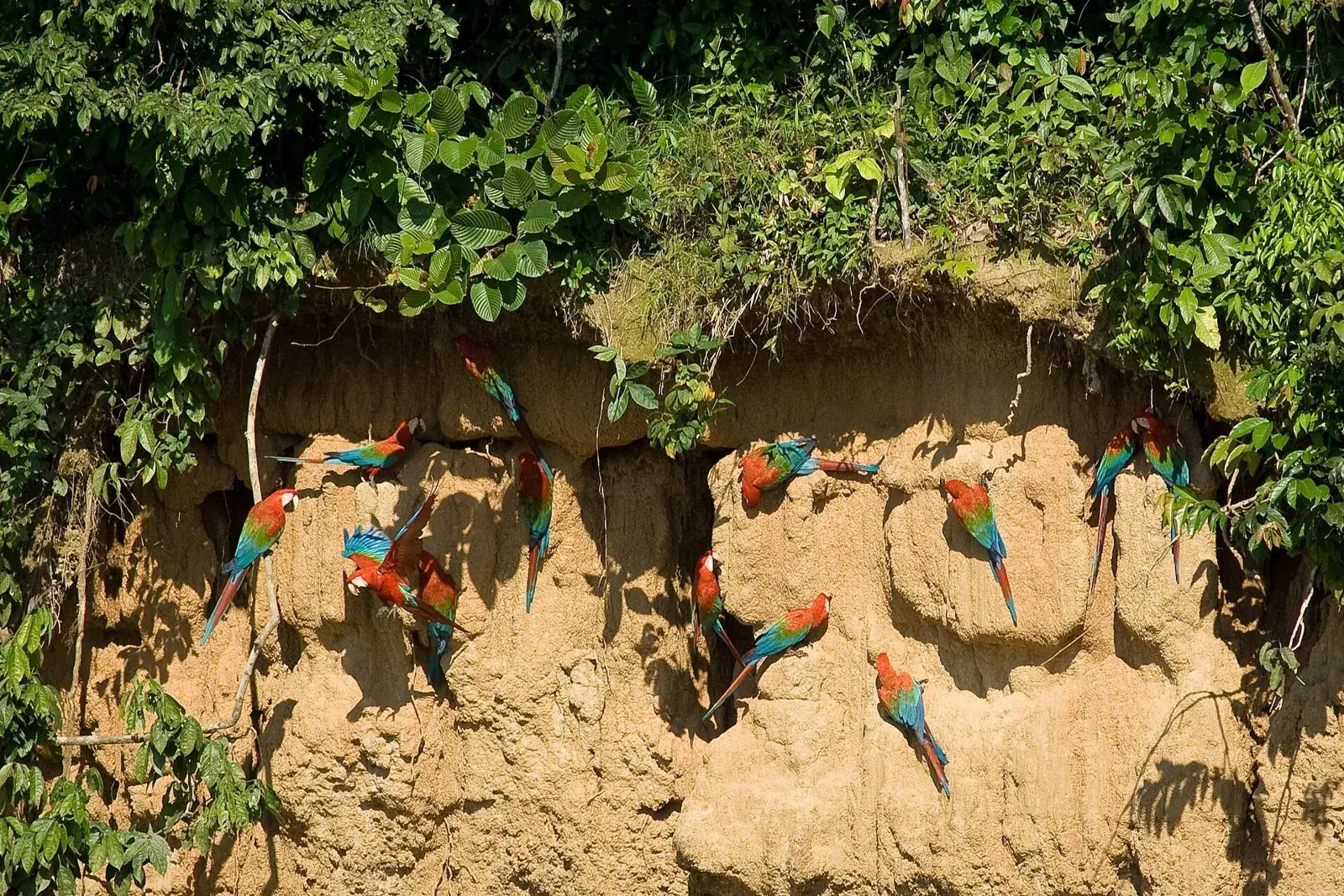
Chuncho is a clay riverbank in the Tambopata area of Madre de Dios where macaws, parrots and parakeets gather to eat clay, mostly in the early morning. It is reached from Puerto Maldonado by road, then by boat up the Tambopata river, either as a long day trip or as part of a lodge stay. The spectacle is real but not guaranteed: numbers and timing depend on the season, the weather and the day. Go with a licensed operator and be ready to start before dawn.
Map
What the clay lick is
The Chuncho clay lick, known locally as Collpa Chuncho, is an exposed wall of clay on a bank of the Tambopata river, inside the wider Tambopata area of the department of Madre de Dios. Operators describe it as one of the largest macaw clay licks in Peru. On most mornings in season, macaws, parrots and parakeets land on the face of the bank, peck at the clay and then lift off again in noisy groups.
Species reported here by operators include scarlet macaws, blue-and-yellow macaws and red-and-green macaws, mixed with smaller parrots and parakeets. Which species you see, and how many, changes from day to day, so treat any figure quoted in a brochure as a best case rather than a promise.
The site is a natural feature, not a built attraction. There is a viewing area at a respectful distance from the bank, and the rest is patience: you sit, watch and listen while the birds decide whether to come down.
Why birds eat clay
The behaviour is called geophagy, and it is not fully settled science. The explanation most often given is that clay helps neutralise toxins in the unripe fruit and seeds that parrots eat, and that it supplies minerals, especially sodium, which are scarce in the lowland forest diet. Both ideas are widely repeated and probably both contribute.
A useful detail for visitors is the pattern that follows. Birds usually gather in a nearby tree first, sometimes for a long time, and drop to the clay only when they feel safe. A hawk overhead can send the whole flock into the air at once, which is a good sight but also a reminder that the birds are cautious. Their hesitation is normal behaviour, not a sign that the visit has gone wrong.
Other animals use clay licks too, including mammals such as peccaries and deer, but the macaws are what people come for.
Getting there from Puerto Maldonado
Chuncho is reached from Puerto Maldonado in two stages. Operators describe a drive of roughly an hour and a half to the river port of Filadelfia, part on paved road and part on a dirt road, followed by a boat ride up the Tambopata river of about an hour to an hour and a half, depending on water level. A short walk through the forest leads from the landing to the viewing area. Some websites quote far longer boat times, so confirm the real schedule with whoever sells the trip.
There are two usual ways to go. A long day trip leaves Puerto Maldonado in the dark and returns in the evening, which is tiring but simple. The alternative is a stay at a lodge in the area, which means you sleep close to the lick and arrive fresh; see Puerto Maldonado lodges for how to compare them.
Going without an operator is not realistic: the lick lies in a protected area and boat access is arranged through authorised companies.
Best season and time of day
Morning is the time to be there. Birds are most active in the first hours after sunrise, and the visit is built around being in position before they arrive, which usually means a very early start. By late morning the clay is often empty.
Season matters as well. The drier months, roughly May to October, are the usual advice for comfort and easier travel, and some operators recommend the months from September onwards for bird activity. Others report a quieter spell in the dry months of April to July, linked to the availability of fruit in the forest. The honest summary is that activity follows food and weather, and nobody can promise a particular day.
Rain and cloud can delay or reduce the show. If the lick matters to your trip, plan at least one spare morning rather than a single attempt, and ask the operator what happens if the birds do not come.
What a visit is like
Expect an early breakfast or a packed one, a boat ride in cool morning air and then a stretch of sitting still. The viewing area is basic, and talking is kept low so as not to scare the birds. Binoculars make a real difference, because the birds can be tens of metres away and the details of plumage are what you remember.
Photography is possible but demanding: the light is low at dawn, the birds move fast and a long lens helps. A phone will record the noise and the colour, which is often enough.
The experience is quiet and slow until a flock descends, and then it is loud, colourful and over in minutes. Guides can usually name the species and explain what you are seeing, which adds a great deal. Do not feed the birds, do not leave rubbish and keep to the marked paths.
Health, weather and what to bring
The lowland forest has health risks that the Andes do not, including mosquito-borne disease, so speak to a doctor or travel clinic well before you travel; health and vaccines gives general information only. Wear long sleeves and trousers in neutral colours, use insect repellent advised by your doctor and bring a hat.
Practical items are simple: binoculars, a rain layer, water, a small torch for the dark start and a dry bag or plastic cover for the camera. Boots or sturdy shoes help on muddy landings. The packing list covers the rest of a lowland trip, and water and food safety explains what to drink and eat.
Heat and humidity are constant, but a river ride at dawn can feel cool, so a light layer is welcome. Travel insurance that covers medical evacuation is sensible for any trip into the forest.
Combining Chuncho with the rest of Tambopata
One morning at the lick is rarely a full trip. Most visitors combine it with a night or two in the forest, walks with a guide and a river or lake excursion, which is why Tambopata is usually planned as three or four nights. Operators also sell short packages of two or three days built around the lick, often with an extra stop at an oxbow lake.
If you are choosing between regions, where to go in the Amazon compares Tambopata with Manu and Iquitos, and is the Amazon worth it gives a measured view. Visitors arriving from Cusco will find the flight described in Cusco to Puerto Maldonado.
Responsible choices matter at a site like this. Choose operators that follow the reserve rules, keep group sizes modest and employ local guides; responsible travel sets out what to ask.
Frequently asked questions
What time should I be at the Chuncho clay lick?
Early morning, shortly after sunrise, is the standard time, which means leaving Puerto Maldonado or your lodge in the dark. Birds are most active in the first hours of light and the clay is often quiet by late morning. Ask your operator for the exact departure time.
How far is Chuncho from Puerto Maldonado?
Operators describe about an hour and a half by road to the port of Filadelfia, then roughly an hour to an hour and a half upriver by boat. Some websites quote longer boat times, so confirm with the company you book. See Puerto Maldonado for the town itself.
Can I do Chuncho as a day trip?
Yes, long day trips from Puerto Maldonado are sold, though they involve a very early start and a late return. A stay in a nearby lodge is easier on the body and gives a second chance if the first morning is quiet.
Will I definitely see macaws?
No. Numbers depend on season, weather and the day, and the birds sometimes wait in the trees and leave without landing. A spare morning improves your odds, and a good guide will set realistic expectations.
Which macaws can I see at Chuncho?
Operators report scarlet, blue-and-yellow and red-and-green macaws, along with smaller parrots and parakeets. The mix changes with the day and the season.
Is the Chuncho clay lick worth the early start?
For most bird-lovers, yes: a flock of macaws descending on a river bank is one of the memorable sights of the Peruvian Amazon. If birds do not interest you, you may prefer to spend the morning on a forest walk. Is the Amazon worth it can help you decide.
What should I bring to the clay lick?
Binoculars, a rain layer, insect repellent advised by your doctor, water and a small torch for the dark start. Wear neutral colours and keep your voice low while you watch. See the packing list for more.