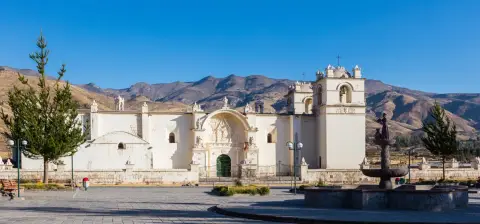
Yanque Church is the Church of the Immaculate Conception, on the plaza of Yanque, a village a short drive from Chivay in the Colca Valley. It is widely described as one of the finest colonial churches of the valley, in the Andean mestizo Baroque style, with a carved stone portal and gilded, painted altarpieces inside. Give it 20 to 40 minutes, pair it with the plaza, and check opening times locally because they are not fixed.
Map
What the church is
The Church of the Immaculate Conception stands on the main plaza of Yanque, the village that follows Chivay on the road along the Colca Valley. It is a working parish church, and the reason many visitors stop: in a valley where almost every village has a colonial church, this one is often named as the most beautiful.
The village sits at roughly 3,400 m, a little lower than Chivay, and the church is the first thing the eye finds on the plaza. It is built in the regional version of Baroque that art historians call Andean mestizo, in which European forms are carved and painted with local motifs. Yanque is a good example of what the broader Colca Canyon offers beyond the canyon itself, which is a string of Andean villages with a layered history. The villages page puts Yanque in order along the road.
A short history
Yanque was a centre of Franciscan missionary work in the valley. The Spanish brought the Franciscans to convert and reorganise the Collagua and Cabana communities of the Colca, and Yanque became one of the main sites of the order. Published studies describe a first church of the sixteenth century, built by local labourers under the direction of friars and master builders from Arequipa.
That building is reported to have been badly damaged by an earthquake in 1668 and rebuilt on a larger scale, with the work running into the following century. The sources disagree on dates, and the church is described in different guides as seventeenth or eighteenth century, so treat any single year with caution. What the stone and plaster show is a church shaped by Franciscans, by Arequipa masons and by Andean craftsmen, in a region that has always been rich in earthquakes.
The exterior and portal
From the plaza you see a single tower, a plain whitewashed body and a carved portal in pale stone. Descriptions of the portal mention Saint Francis of Assisi surrounded by saints of his order and of the Dominicans, set in oval shields, and a large oval window above, a feature attributed to Cusco influence. The relief work on the side borders is credited to Arequipa carvers.
You do not need to know the details to enjoy it, but the portal rewards a slow look from a few steps back and then from close up, because the stone carving mixes European saints with plants and patterns that feel local. Morning light on the facade is gentle, and the plaza is usually quiet before the first tour groups arrive. The church is also a good reference point if you arrive without a plan, since the plaza is the centre of the village.
Inside the church
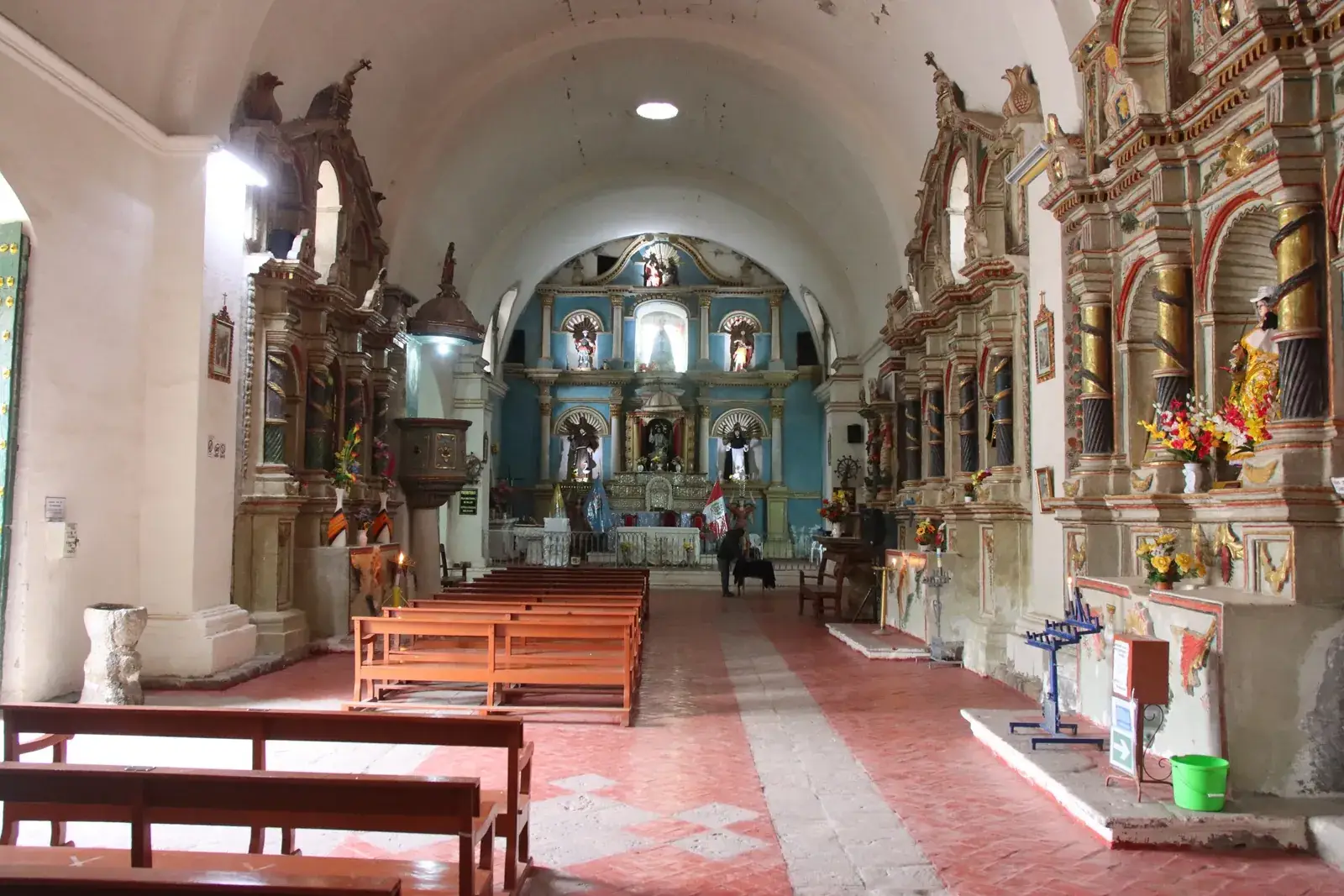
Inside is a single long nave under a vault, lined by carved side altarpieces with twisted columns, shell motifs and painted detail in red, green and old gold tones. At the far end the high altar is set against a blue wall, with niches holding statues of saints. There is also a carved wooden pulpit along the left side of the nave.
The altarpieces are the main reason to go in. They are made of plaster and wood and are polychrome, so the colours look soft rather than bright. Candles and fresh flowers from local people are a reminder that the building is in use. Light inside is dim, so a phone with a steady hand copes better than a flash, and photography rules can change, so look for signs and ask. Dress modestly, remove your hat, and keep voices low during services.
Seeing it from Chivay
Yanque is a short drive along the valley from Chivay, the usual base described in the villages guide. Local vans and buses run along the road, and taxis can take you there and wait. Most organised days from Arequipa fit it in as a stop between Chivay and the condor viewpoint, as shown on the Colca Canyon tours page.
If you travel on your own, Yanque works well as a morning stop on the way to Cruz del Condor, or as a quieter place to sleep than Chivay. The comparison of tours and independent travel helps you decide how much freedom you want. The route from the city is in Arequipa to Colca.
When to visit and how long to stay
Twenty to forty minutes is enough to see the portal and the interior. Add time if you want to sit on the plaza, wander the side streets or watch whatever event is on. The village sometimes stages dance performances for visitors, and local festivals fill the plaza with music, but these depend on the day and the calendar, so ask locally.
The dry months, roughly from May to September, give the clearest skies. They are also the coldest, especially at night, when temperatures at this altitude fall near or below freezing. No reliable published source gives the church's opening hours, and it may be closed outside visiting times or during a service. A small donation or ticket may be asked, so carry small coins in soles. The money guide explains how to carry cash.
Altitude, effort and who it suits
Effort is low: a flat plaza and a few steps at the door. The challenge is altitude. At about 3,400 m, Yanque is high enough for headaches and breathlessness if you came straight up from Arequipa at about 2,330 m, so move slowly, drink water and skip alcohol on the first evening. See altitude sickness for the basics.
The church suits anyone interested in colonial art, religious architecture or Andean village life, and it is easy for older travellers and for children. It is less suited to those who want a major monument, since this is a modest church in a small village. Weather changes fast, so bring layers, sun protection and a hat, as described in the packing list.
What to combine it with
Yanque fits easily into a day along the valley. A natural pairing is the plaza and church in the morning, a look at the nearby village life, then the road to Maca and the condor viewpoint. Walkers heading to the canyon can read the Colca trek page for the next stage.
If you only have two days from Arequipa, the usual plan is Chivay on day one and the viewpoint on day two, with Yanque as a stop on the way. If you can spare a night, staying here instead of Chivay gives a quieter evening and an early start for the condors. Whatever you choose, treat the church as a pleasant pause, not a reason to rearrange a trip.
Where to sleep
-
Find hotels
Chivay
Main town of the Colca Valley, hot springs nearby
-
Find hotels
Cabanaconde
Village at the canyon rim, near the trails down
Frequently asked questions
Is Yanque Church worth visiting?
Yes, if you like colonial architecture. It is often named among the best churches of the Colca Valley, with a carved portal and painted altarpieces, and it takes little time. It is a modest village church, so do not expect a major monument.
How long does a visit to Yanque Church take?
About 20 to 40 minutes for the portal and the interior. Allow more if you also want to walk the plaza and side streets of the village.
How far is Yanque from Chivay?
It is a short drive along the valley road, and local vans, buses and taxis make the trip. Confirm the current fares and times locally, as they change. The wider layout is on the villages page.
Is there an entrance fee for Yanque Church?
No fixed fee is confirmed. A small ticket or donation may be asked, so carry small coins in soles and ask at the door. Guided tours usually include the stop in the price of the day.
What style is the church?
It is described as Andean mestizo Baroque, a regional style where European forms are carved and painted with local motifs. The portal and the carved side altarpieces are the clearest examples.
Can I visit Yanque on a day trip from Arequipa?
Yes. Many one-day tours stop in the valley villages, though the day is long and the altitude is high. A night in the valley is more comfortable; see Colca Canyon tours for the options.
Can I take photographs inside?
Rules vary and can change, so look for signs and ask. Even where allowed, avoid flash and do not photograph people at prayer or in services at close range.