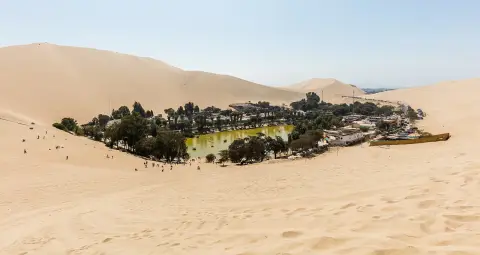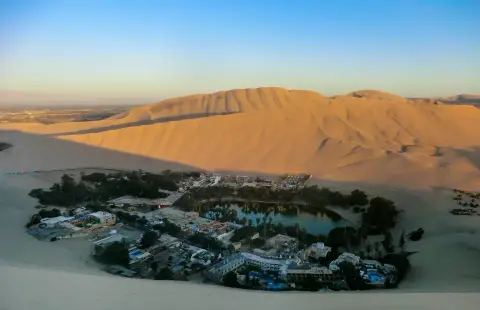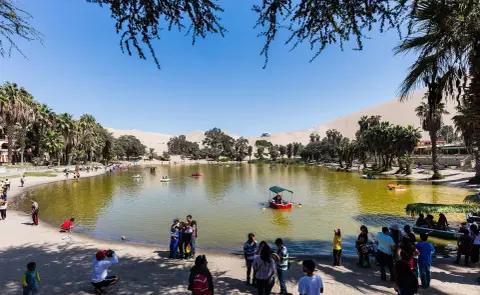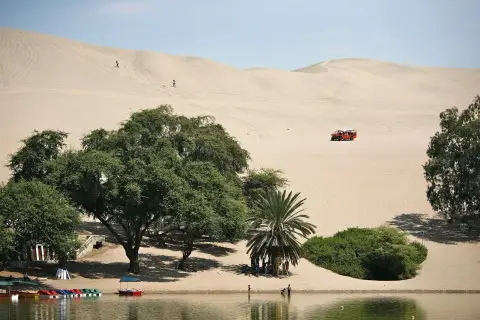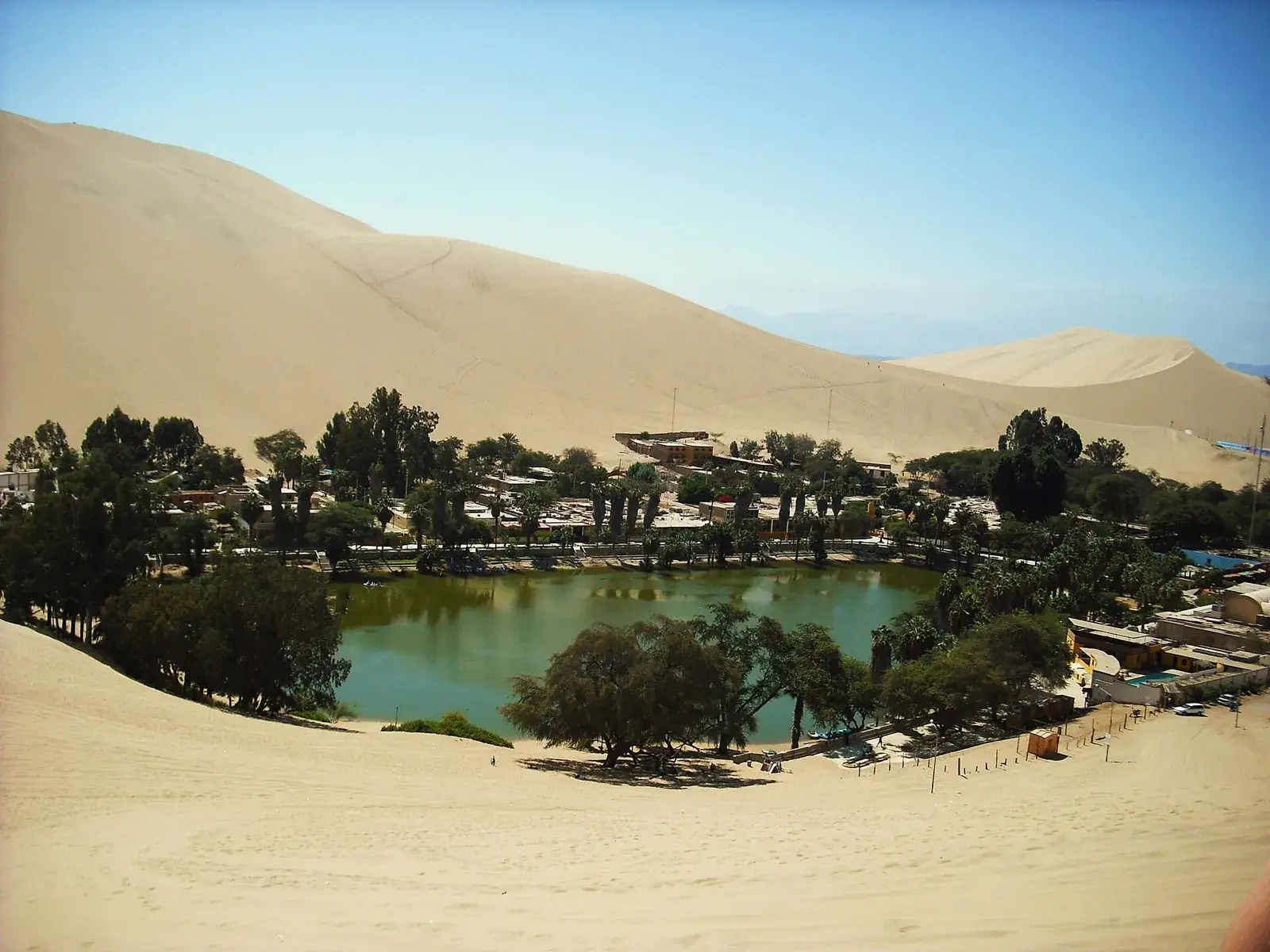
Huacachina is a small natural lagoon in the desert, about 5 km from the city of Ica, ringed by palms, a lakeside promenade and very tall dunes. The lagoon itself can be walked around in well under an hour, so the oasis is best seen at the start or end of the day, with a climb up the dunes for the view. Do not expect a swimming lake: it is a landscape to look at, and its water level depends on human management.
Map
What the oasis is
Huacachina is a village of roughly a hundred permanent residents built around a natural desert lagoon, about 5 km from Ica. The name is usually traced to a Quechua phrase meaning "hidden lagoon", which suits a pool of green water tucked into a hollow among enormous dunes. The image was famous in Peru long before backpackers arrived: the oasis once appeared on a banknote, and for decades it was a weekend and summer resort for families from Ica, later drawing visitors from further afield.
The lagoon is fed by seepage from underground water, not by a river, and that fact explains most of what is interesting and fragile about the place. The palms, the reeds and the fringe of vegetation exist because water reaches this one spot in an otherwise dry landscape. The wider picture of the town, the pisco country and the surrounding activities is on the Ica and Huacachina page; this page stays with the oasis itself.
The legend of the lagoon
Every local will tell you the story of the princess, and it comes in more than one version. In the best known, a young woman bathing in a hidden pool saw a hunter approach and fled, leaving behind the mirror she was holding. The mirror became the lagoon, and the folds of her cloak, thrown behind her as she ran, became the dunes. In some tellings she never left and lives in the water as a mermaid.
It is folklore, not history, and nobody presents it as anything else, but it is worth hearing because it shows how the place is understood locally. It also explains the small statues, murals and names that you will notice around the lakeside. Some visitors and residents also believe that the dark mud of the lagoon has healing properties for joint and breathing complaints. That is tradition rather than established medicine, so treat it as a curiosity and not as a reason to get into the water.
Tours and activities
Bookable online, chosen for their traveller reviews.
-
From €26 per person
-
Day trip From €35 per person
-
Day trip From €40 per person
-
Day trip From €148 per person
A lagoon that needs help
The oasis is not as secure as the postcards suggest. As wells multiplied in the surrounding valley from around the early 2000s, the underground water that feeds the lagoon came under pressure, and the water level fell. Since about 2015 local business groups have pumped water into the lagoon to keep it from drying out, and restoration projects have been announced over the years with varying reported results.
In practice you should expect the lagoon to look different from the photographs, with a level and colour that change with the season and with how much water has been added. The water is not suitable for swimming, and the village has hotel pools for that purpose. It is worth understanding why the oasis is there at all. A lagoon that exists only while groundwater lasts is a reminder that the green valley of Ica, with its vineyards and farms, is drawing on the same resource. The question of whether the oasis is worth the detour is covered in is Huacachina worth it.
Walking the lakeside
A promenade runs around much of the lagoon, with palms and benches on one side and a line of cafes, restaurants and hostels on the other. A circuit on foot is short and flat, and you can do it at a slow pace in well under an hour. The best moments are early morning, when the village is quiet and the light on the water is soft, and the last hour of the day, when the dunes turn orange and the buggies are busy overhead.
At midday the promenade is hot, shadeless in places and crowded with day visitors, and the cafes are at their loudest. Take a hat and water, and keep your belongings close, as in any busy tourist spot; the general guidance in safety in Peru applies here too. Prices in the lakeside restaurants tend to be higher than in Ica, so a meal in town is the cheaper option if you are passing through.
The dunes above the lagoon
What turns a pretty pond into a landmark is the setting. The village sits in a bowl surrounded by dunes that rise high above the water, and the view from the ridge is the reason to climb. A path of footprints leads up from the edge of the village; the sand is soft and the ascent is slow, so allow time and wear closed shoes you do not mind filling with sand.
From the top the lagoon looks like a small green coin among the buildings, with the farmland of the Ica valley beyond. Sunset from the ridge draws a crowd, and the dunes become cooler and quieter after the sun goes. Climbing alone at dusk is not a good idea: footing is hard to judge in poor light and the way down is easy to lose. Buggy rides and sandboarding are separate activities, described on the Ica and Huacachina page, and the buggies share the dunes with walkers, so keep to the side of any tracks.
When to go and how long to stay
The area is dry and sunny for most of the year, so the oasis can be visited in any month. In the hottest months, roughly December to March, midday is intense and the sand burns bare feet, which makes early morning and late afternoon the sensible times. In winter the days are milder but evenings are cool, and coastal cloud can reduce the sunset colours.
Most people give the lagoon a morning or an evening, not a whole day. If you are travelling between Lima and Nazca, it works as a stop of a few hours, though staying one night lets you see both the early and the late light. The accommodation options, from dormitories to quiet hotels away from the bars, are covered in where to stay in Huacachina, and the route from the capital is in Lima to Huacachina.
Getting there from Ica and Lima
From the city of Ica the oasis is a short taxi ride, normally about 10 to 15 minutes, and taxis are the usual way to go. Long-distance buses stop in Ica, not in the village, so the last stretch is always a taxi or a pre-arranged transfer. Agree the fare before you get in, or ask your accommodation to arrange a pick-up.
Coming from Lima means a bus journey of several hours along the Panamericana, then the taxi. Coming from the coast, many travellers visit Paracas first and continue inland, while others go on south to Nazca afterwards. The choice between the coast and the oasis is discussed in Paracas or Huacachina. The village is compact and pedestrian, so once you arrive you will not need a vehicle apart from a buggy tour.
What to combine it with
The lagoon pairs naturally with a pisco tasting in the Ica valley, which gives context to the green fields you saw from the ridge; the background is in pisco and pisco sour. A buggy ride and sandboarding use the dunes themselves and take a few hours, usually in the late afternoon.
If you want a quieter experience, spend an early morning on the promenade and a short walk up the near dunes, then leave before the day groups arrive. Visitors with limited time often combine the oasis with the coast and the lines in a loop from Lima, which is realistic over three or four days but involves long transfers. Honest expectations help: the oasis is small, touristic and photogenic, and its best hours are the edges of the day.
Where to sleep
-
Find hotels
Huacachina
Lagoon among dunes, built for dune buggies and sandboarding
-
Find hotels
Ica
The city for more space and local life, a short ride from the oasis
Frequently asked questions
Can you swim in the Huacachina lagoon?
It is not recommended. The lagoon is shallow in places, its water is not maintained like a pool and its level depends on added groundwater. Use a hotel pool instead; ask your accommodation what is currently advised.
How long does it take to see the lagoon?
A walk around the promenade takes well under an hour. Add time for the dune climb and a meal. Most visitors spend a morning or an evening, or one night.
Is the Huacachina lagoon natural?
Yes, it is a natural desert lagoon fed by underground water. Its level has fallen as wells increased in the valley, and water has been pumped in since about 2015 to keep it from drying out.
Is the oasis free to visit?
Walking around the lagoon and the village has generally not required a ticket, though buggy tours and some viewpoints are paid. Check locally, as arrangements can change.
What is the best time of day to visit?
Early morning and the hour before sunset. Midday is hot and crowded, and the sand can burn bare feet in summer. Sunset from the dune ridge is the most popular time, so go up early to find a place.
Is it safe to climb the dunes alone?
In daylight and on the main paths, many people do. Avoid climbing alone at dusk or after dark, keep valuables at your hotel and carry water. See safety in Peru for general precautions.
Is the oasis worth a stop between Lima and Nazca?
For most travellers, yes, if you can arrive in time for the late light or stay one night. If you only have a few hours at midday, the experience is weaker. Is Huacachina worth it weighs this up.