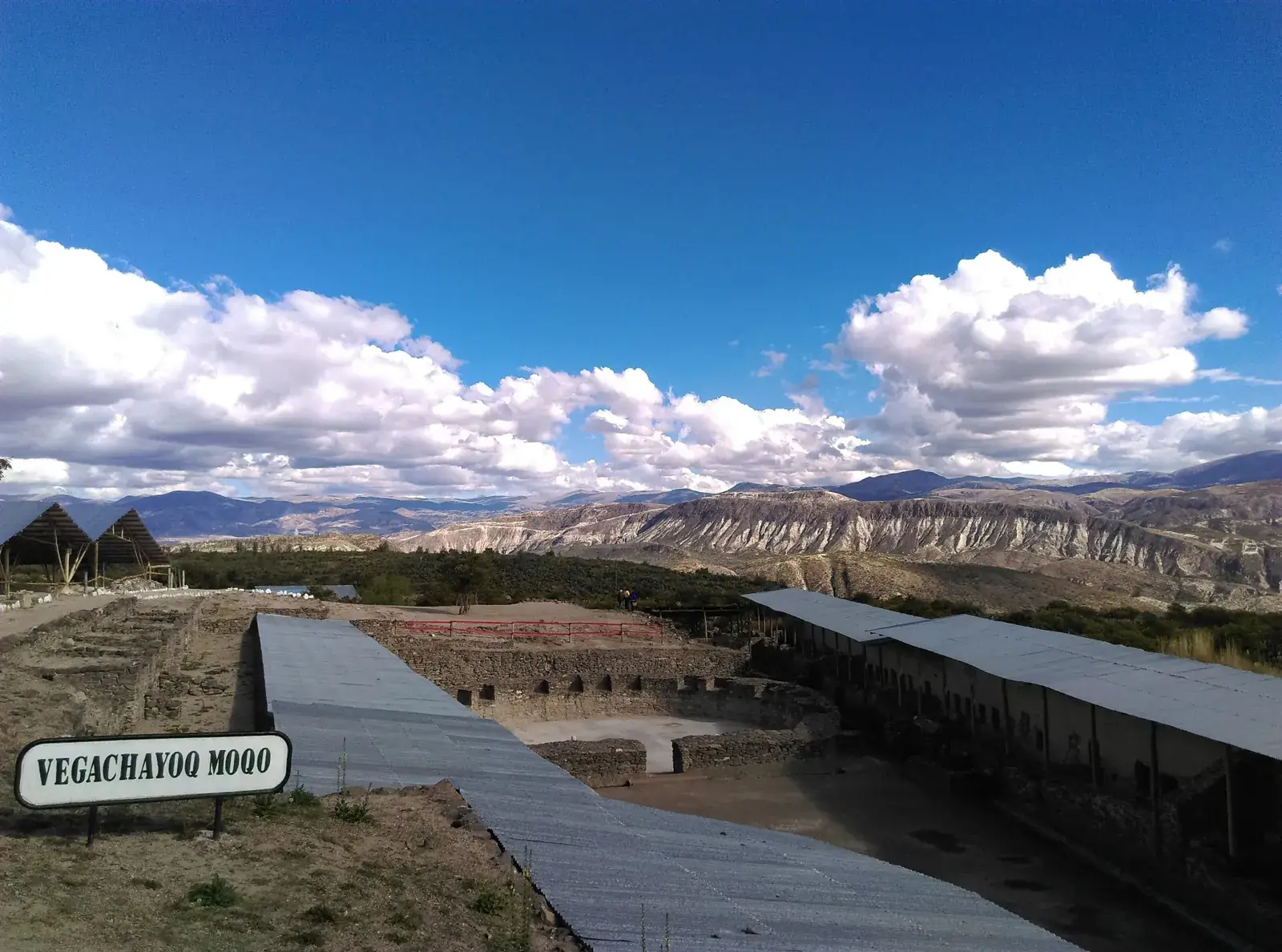
Wari is the ruined capital of the Wari empire, which flourished in the Andes roughly between the 7th and 10th centuries, centuries before the Incas. It lies about 22 to 25 km north-east of Ayacucho on the road to Quinua, and a visit takes one to two hours including the small site museum. Expect low walls, tomb chambers and wide views rather than polished Inca stonework, and go with a guide, because without explanation the ground looks like scattered rubble.
Map
What Wari was
Wari (also spelt Huari) was the capital of an empire that rose in the central Andes around the 6th and 7th centuries and declined by about the year 1000. It was one of the first political systems in the Andes to administer distant regions through planned centres, roads and a shared style of ceramics and textiles. When the Incas rose, around four centuries later, they inherited landscapes that Wari had already organised in places.
The city sits on a rolling plateau at roughly 2,700 m in the Ayacucho basin, a dry landscape of prickly pear, eucalyptus and eroded hills. Estimates of its size and population differ between sources, but all agree it was very large: researchers speak of an area of well over a thousand hectares and a population in the tens of thousands at its peak. Only a small part has been excavated and opened to visitors, which is why the place feels sparse on first impression.
If the name rings a bell, it may be because of other Wari sites. Piquillacta near Cusco is a provincial Wari centre, and the background to the whole period is explained in pre-Inca cultures.
Why it matters
Wari is not a single monument but a city, and that is what makes it important. Archaeologists use it to study how an Andean state worked before the Incas: how a capital fed itself, how it stored goods, how it buried its elite and how its influence reached the coast and the far south. Wari-style pottery and architecture turn up hundreds of kilometres away, including in the Nasca region, which links the site to the story of the Nazca area.
The city is also a reminder that the Inca empire was not the first of its kind. The terraces, roads and storehouses that visitors associate with the Incas have precedents here, though how much the Incas copied directly from Wari is debated and should be treated as an interpretation.
For a traveller this means Wari rewards curiosity more than spectacle. It is a place to understand a missing chapter of Peruvian history, ideally on the same day as the Spanish-colonial and independence sights of the region, described in the Ayacucho guide.
What you see on site
The visit is organised around a few excavated sectors that a guide links together on foot. The best known is Cheqo Wasi, a group of carved stone enclosures described as elite tombs. Monqachayoq has underground stone galleries that served as burial chambers, and you can look into them from the surface. Other sectors, including Vegachayoq Moqo, show walled enclosures and patios that give a sense of how the city was laid out. The names and the numbering of sectors vary between sources and on-site signs, so follow your guide rather than a fixed list.
The most striking feature is the sheer scale of the walls. Some stretches are several metres high, built of fieldstone set in mud mortar and originally plastered, which is why Wari looks rougher than the fitted masonry of Cusco. Researchers also describe D-shaped temples at Wari and related sites, a layout peculiar to this culture.
Panels and models in the site museum help to read the plan. Bring a hat, because shade is limited and the plateau is windy.
The site museum
A small site museum stands near the entrance, on the road to Quinua. It displays polychrome ceramics, textiles, stone tools, carved monoliths and human remains from excavations, plus models that help to picture the city. Visitors describe it as modest in size, and it is best treated as a twenty-to-thirty-minute introduction rather than a full museum.
The ceramics are the highlight. Wari potters made large ceremonial vessels with bold, stylised figures and geometric designs in several colours, and the style is easy to recognise once you have seen it. The monoliths are worth a look for their carved faces and figures. Check beforehand whether photography is allowed and whether the museum and the ruins share one ticket.
For more regional archaeology in town, the Hipólito Unanue regional museum in Ayacucho holds archaeological pieces from across the area, and museums in Peru gives general advice on how to plan museum days. Opening hours of both change, so confirm them in Ayacucho.
Getting there from Ayacucho
Wari lies on the road from Ayacucho to Quinua, about 22 km from the city and roughly 30 minutes by car. The simplest way to go is on a half-day tour that combines Wari with the village of Quinua and the Pampa de la Quinua battlefield, or by hiring a taxi for the circuit and agreeing the waiting time in advance.
Public transport is possible. Shared colectivos to Quinua leave from a street near the centre of Ayacucho and pass the entrance, so you can ask the driver to stop at the Wari museum. Getting back means waiting on the road for a colectivo coming from Quinua with a free seat, which is less predictable, so allow slack in your plan and do not rely on it if you have a flight to catch.
Ask your hotel to confirm transport details, since routes and prices change. If your trip depends on road travel, read strikes and road blockades first. Most visitors reach Ayacucho by plane; see flying in Peru.
Combining it with Quinua
The natural partner of Wari is the Pampa de la Quinua, a high plain 37 km from Ayacucho where the battle of Ayacucho was fought in December 1824, the engagement that effectively ended Spanish rule in South America. A monument stands on the plain. The story is told in independence in Peru, and many tours drive straight from the ruins to the battlefield.
The village of Quinua, on the same road, is known for ceramics, including the small clay churches placed on rooftops across the Andes. A half-day tour that covers Wari, the village and the plain is long enough to feel complete without being exhausting.
This pairing gives a useful contrast. In one morning you move from a city that rose and fell more than a thousand years ago to the field where a colonial empire ended, with the pottery workshops in between. If you have a full day, you can add more stops along the same road, but check which ones are open before you go.
Best time, altitude and effort
Wari sits at about 2,700 m, close to the altitude of Ayacucho city itself (about 2,750 m), so the site is not a challenge for visitors who have spent a night in town. Anyone arriving directly from Lima should take the first day easily and read the notes on altitude sickness.
The walking is light, on dirt paths with some uneven ground. There is little shade, so sun protection matters year-round at this altitude. The dry season, roughly May to September, gives clear skies and the best views of the surrounding hills, though nights in Ayacucho are cool. In the rainy months, roughly December to March, paths can be muddy and afternoon showers common.
Morning is a good time to go: the light is softer, the air calmer and tour groups often arrive later. Weekdays are reported to be quieter than weekends. The route is suitable for most ages, but there are few facilities on site, so bring water and snacks.
Frequently asked questions
How far is Wari from Ayacucho?
About 22 km to the north-east on the road to Quinua, roughly 30 minutes by car. Some sources give a slightly longer distance because they measure to different parts of the complex.
How long does a visit to Wari take?
Plan one to two hours for the ruins and the museum together. A half-day tour that adds Quinua and the Pampa de la Quinua usually takes four to five hours from Ayacucho.
Do I need a guide at Wari?
A guide is strongly recommended, and local sources describe visits to the sectors as guided. Without explanation, the sectors are hard to read. Confirm the current rule locally.
Is Wari older than the Incas?
Yes. The Wari state flourished roughly between the 7th and 10th centuries, several hundred years before the Inca empire. See pre-Inca cultures for the wider picture.
Is Wari worth visiting if I have seen Machu Picchu?
It is a different kind of site: less visually dramatic but more revealing about the Andes before the Incas. It suits travellers interested in history and archaeology, and it rarely has crowds.
Can I visit Wari without a tour?
Yes, by taxi or by colectivo towards Quinua, which stops at the entrance. The return by colectivo is less reliable, so allow extra time. A tour booked through your Ayacucho hotel is simpler.
Is there anything to eat or buy at the site?
Facilities are limited, so bring water and a snack. The village of Quinua nearby has pottery workshops, and general buying advice is in souvenirs.